

Smitten!
by TOM CURREN
scouting by LLEW DAVIES
Around this time last year, SCOUTED released its first midfield Archetype. The Developer, inspired by many hours of watching Sverre Nypan - in his pre-Manchester City era - was built primarily around movement. We felt most fans understood midfielders who progressed the ball through line-splitting passing or ground-eating carrying, but that movement was an under-appreciated, and perhaps slightly obscured, element of the midfield toolkit. So often we focus on the immediately obvious when the ball moves up the pitch, and disregard the subtle actions of the receiver: it’s always ‘what a pass’ and rarely ‘what a run,’ especially if that run is a five-yard shuttle between two zones. But there he goes, Sverre Nypan, darting between the lines, and there moves the ball, up the pitch with him. Developers are players who turn build-up sequences into dangerous attacks by moving without the ball: they are the row of stitches that hold a garment together. They turn the screw, darting behind defensive lines and sliding into advantageous positions, and they’re becoming ever-more prominent at the top level.
This essay first appeared in Volume II. Subscribers can download, read and read the magazine in full!
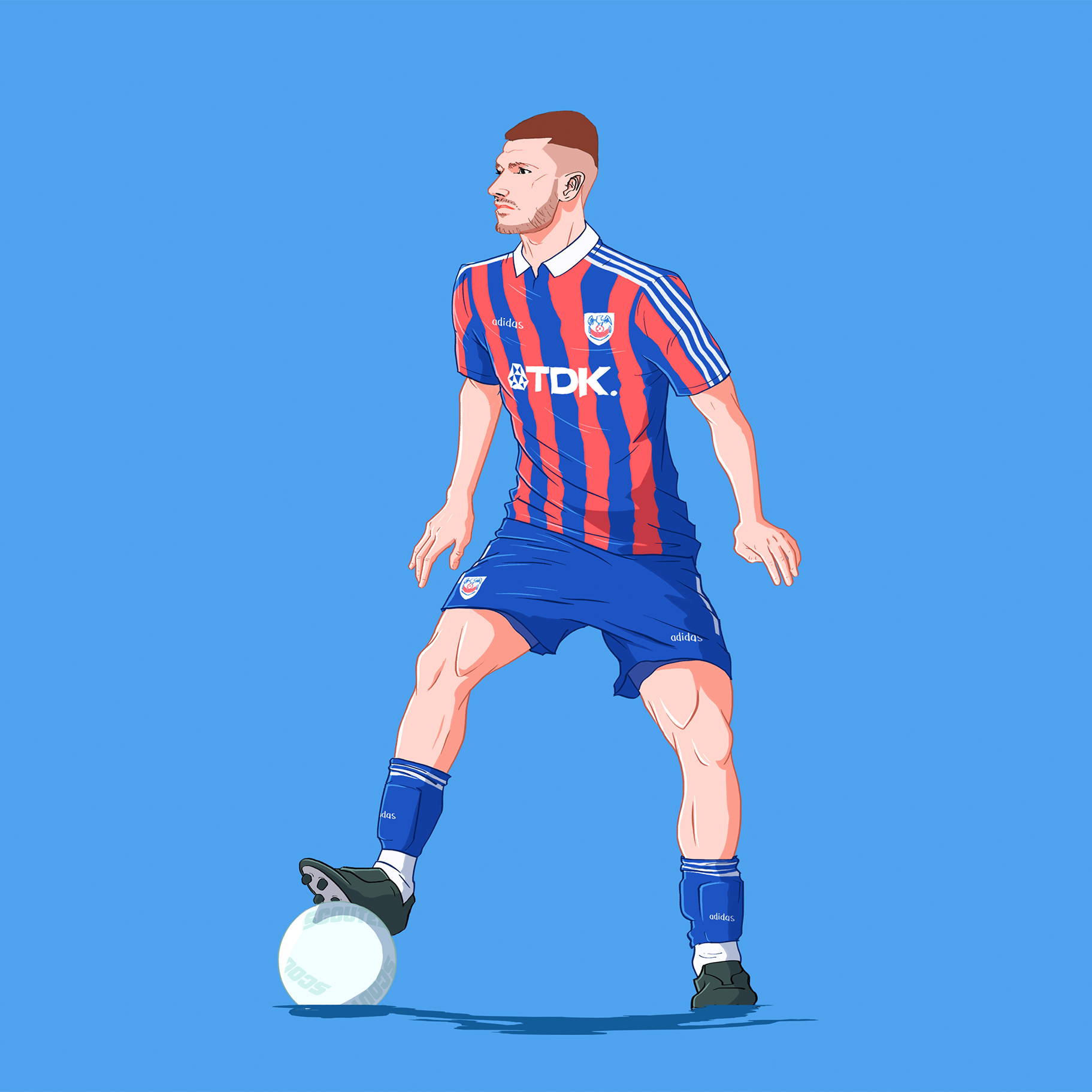
In November 2025, AZ Alkmaar came to south London. Many UEFA Conference League watchers that night will have been hoping to catch a glimpse of Adam Wharton, the headline talent of this Volume, strutting his stuff in European competition. Sadly for them, Wharton started from the bench. Eyes instead were drawn to one of his opponents, a redheaded teenage Dutchman starting as AZ’s left-sided No.8. There he goes, Kees Smit, darting between the lines, and there moves the ball with him. Llew Davies was so enamoured with Smit’s performance that night he wrote a comprehensive breakdown of his every touch. “He moves, constantly,” Davies wrote; “he drops, slides and bursts towards it in every phase of play. He rolls underneath, pops up between lines, slips to the outside and breaks ahead of play, sometimes all in the same sequence.” AZ lost 3-1, but their goal came from a typical Developer sequence orchestrated by their new star. Smit starts an elegant move by the touchline in his own half, turning away from pressure before completing a one-two with a teammate, and he’s away, up the touchline; he sees a runner ahead and finds him before crashing towards the box and making the assist. Pass, move, stitch it all together. Before you know it, the ball is in the box.
In March of this year, Smit made his senior Netherlands debut. He’s still just 19, though it feels like we’ve been talking about him for ages. In many ways, we have: his youth career was long and storied, and we first laid eyes on him as AZ won the UEFA Youth League. Now the world is beginning to understand what we’ve seen. This summer will likely be decisive and the spotlight will soon be heavy. Like Nypan, Kees Smit will be of interest to the world’s biggest clubs because he represents the future of his position. Others might label him an No.10 or No.8 but Smit is a true hybrid, a multi-phase midfielder who could still be anything. In the future of midfield, that roundedness, the ability to solve all kinds of problems, is more valuable than gold.
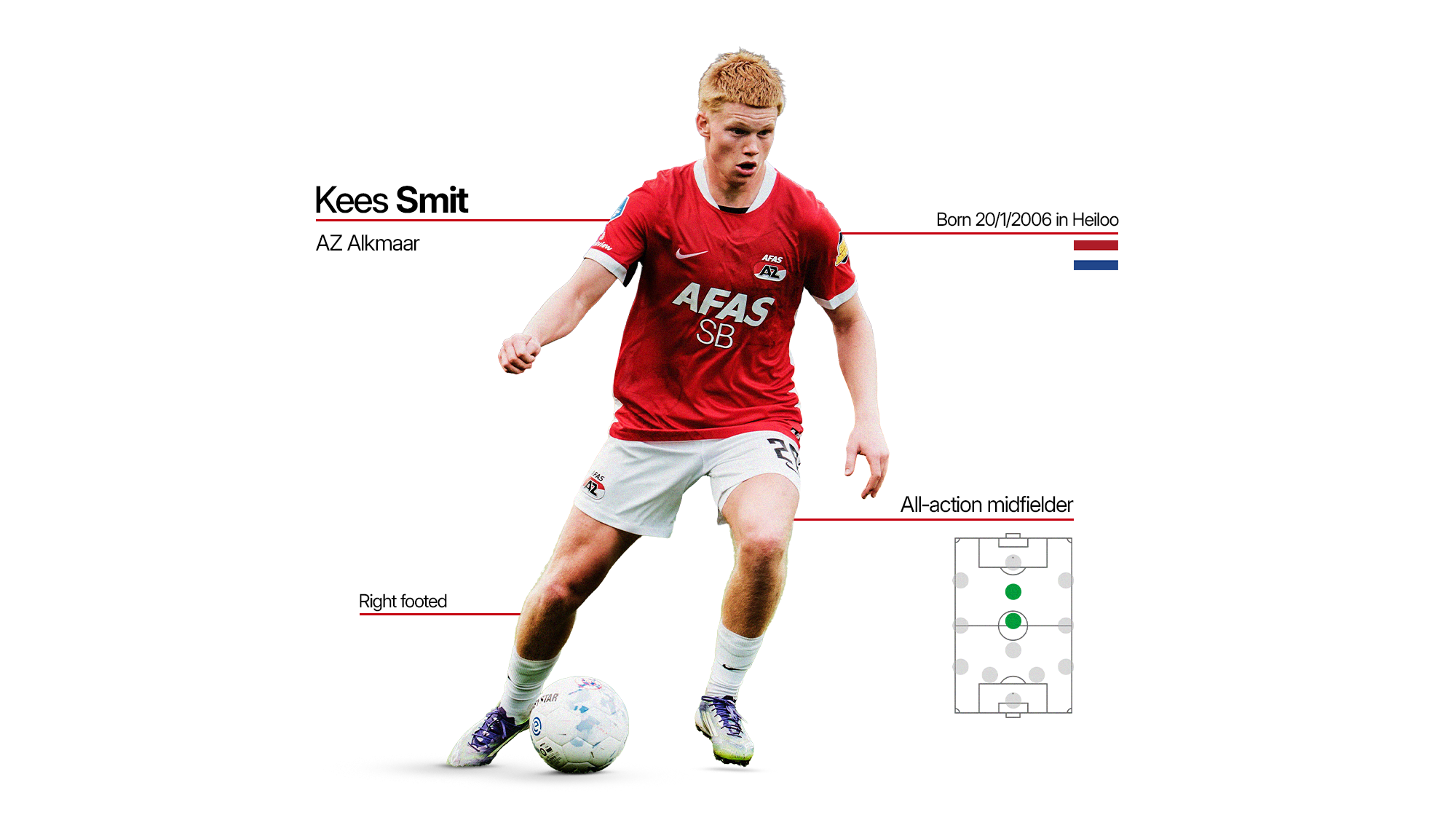
Kees Smit was born in Heiloo, a picturesque town in North Holland, in January 2006. The name of the town means ‘sacred forest’ and in autumn the leaves turn gold and orange. It is said to be the site of a miracle.
Heiloo’s largest neighbour is the city of Alkmaar. Smit joined the academy of the club there at nine years old. Alkmaar has a population of just 110,000, but the club’s academy punches well above its weight. In 2020, AZ Alkmaar led the Eredivisie when it was called off early due to the COVID-19 pandemic, just weeks from their third-ever title. That squad was led by Teun Koopmeiners, Myron Boadu, Calvin Stengs and Owen Wijndal, four players who had been at the club since they were 12. The club reportedly have an internal target of 50% of first-team members to be academy graduates; that 2020 side hit 67%. AZ Alkmaar’s story is one of deep academy coherence, of an environment in which young players are shepherded towards the first team with a sense of near-inevitability. Since 2020, AZ have made a reported €150m from academy player sales including, in 2023, Tijjani Reijnders.
In the season preceding Reijnders’ sale to AC Milan, AZ Alkmaar won the UEFA Youth League. That campaign included wins against Real Madrid and Barcelona. Against the latter, a young midfielder - who had already made senior training, and was floating around the edges of the first team - scored from the centre-circle. The name ‘Kees Smit’ was suddenly all over the internet. In a battle of academy values, little AZ had defeated La Masia and La Fábrica, which spoke to the club’s collective coherence. Their star was on the fast-track to the first team, who himself was the perfect mirror for AZ’s holistic approach to development. Smit could do it all, snap into a tackle to start a move and finish it with a hammer from inside the box. At youth level he demonstrated the multi-phase dominance that is so often a signal for ‘I’m ready.’
Help!
In the world of clickbait and 30-second attention spans, writing like this doesn't sell.
We need readers who, like you, value long-form stories on football's future, to keep us alive. Please consider becoming a subscriber.
Smit was elevated to Jong AZ, the club’s reserve side, to cut his teeth in Eerste Divisie, the Netherland’s second division. Among adults for the first time, in 2023/24 Smit totalled 2,270 minutes across 29 appearances, which constituted his first full-season run in senior football. The youth dominance translated into senior trust, and that season he got a 16-minute taste of the first team. The season following, he played more for the first team than he did for Jong AZ. That summer, he arrived on the world stage proper. At the U-19 European Championship in the summer of 2025, Kees Smit became the first Dutchman to ever win UEFA’s Golden Ball (he also won SCOUTED’s slightly less prestigious version of the same prize), joining a Spaniard-dominated list that includes Fernando Torres, Marco Asensio and Mason Mount. The Netherlands won their first tournament with a dominant, possessive style, and Smit was at the heart of every move. “Whatever he did, he did it at 100 percent,” Davies wrote at the time. “When everyone else was fading, dropping in the debilitating heat and humidity, Smit was still going at full pelt. He was non-stop action, non-stop excellence. He never stopped running: he developed situations with sharp off-ball runs, he moved the ball with incisive passes to facilitate attacks, he scored four goals and showcased excellent ball-striking off both feet in the process.” And then, the kicker: “This was as clean cut a breakout tournament performance as they come. When Smit is playing at the highest levels of the game in years to come, probably at one of Europe's best teams and with the senior Dutch side, we’ll always hark back to this three-week stint where he drove the Netherlands to the title in Romania."

In the season since his youth international breakout, Kees Smit has become a key player for AZ Alkmaar’s senior side, and won his senior Netherlands debut in March 2026. He has shone in the Conference League and contributed 15 goal involvements in just over 3500 minutes - a worthy return for a senior breakout season. There is no doubt now that he’s arrived. The question has become where and how he’ll affect the future of midfield, and for whom. To understand that question, you must understand the player.
Kees Smit is an all-round, generalist midfielder with the fundamentals of an elite-level player. The goal against Crystal Palace detailed above is the perfect microcosm of his ability to affect games: a multi-phase domination that happens quickly, through a blend of elegant movement, quick passing and dogged physicality. Watching a great Developer is like watching football played at the edge of a question. Every touch, every shifty pass-and-move, every little dart into space offers is a probe for a solution. When it comes together it clicks satisfyingly into place and the pitch opens up and the path the Developer has charted through play looks obvious in retrospect. Following Smit move possession through the thirds is an exercise is saying ‘of course,’ even when the answer he’s found is only clear after it’s plotted.
In this sense, Developers are best understood as a loop, rather than a clean skillset. They path through spaces with a sequence of skills that are all of equal importance; Smit displays elite-level potential in all. To pare the full sequence down, it looks a little like this: scan, receive, connect, move, arrive. Scanning allows the Developer to find the next angle, the next little pocket of space. He moves into it, receiving the ball with a touch that sets up the next action. He connects quickly, usually with a two-touch tempo, then moves, darting to become the third man. This loops until the ball moves up the pitch, at which point the Developer executes by arriving at the box late, often around the edge, with a stealth that eventually becomes decisive violence. Developers are involved in every phase of possession, and it’s this that makes them so enticing on the wider market. They are both small-space and large-space physical, and possess a spectrum of technicality that can alter games whatever the game-state. Under the cosh against better opposition in Crystal Palace, Smit knitted a path through an intense and physical pressing side, but it’s easy to see how the same skills would help break down a low-block for a possessive side.

SCOUTED’s scouting database has notes on Smit that cover years, and we can chart our own Developer’s course through them to understand his wide range of attributes. The first anecdotes of note come from the U-19 EURO final, at which Smit sealed his indisputable position as Golden Ball. “Relentless intensity in every direction/phase is the biggest green flag ever,” we wrote. This is crucial to the loop detailed above: everything happens quickly and with power, with and without the ball. Smit is, in addition to his cultured smarts, a relentless physical engine and runner. “HARD WORKER,” the notes state emphatically, below details on his dropping out of midfield to pick the ball up, then moving ahead of play again as he finds the first angle. During that final, Spain press hard in the closing stages to find an equaliser and Smit throws himself into challenges, making decisive challenges in his own box.
This power set him apart at youth level and was key to him seeming senior-ready so early; physical dominance is so often a marker of readiness, especially when it underpins technical fundamentals. He’s a powerful large-space runner but still nimble enough to affect the small; his immense engine allows him to repeat intense efforts over and over again, and support the loop. “Growing when everyone else is blowing,” the notes from an earlier U-19 group stage game, a 2-0 win against Norway, say. “Proper high-level athlete with rounded shoulders, solid physique and stringy legs. When he does something, he does it 100%.” Smit opened the scoring that day with a left-footed flick-and shoot that came at the end of a phase in which he’d created two earlier chances, as players around him faded. Crucially, his execution doesn’t slip as he tires. He’s right-footed, but during the tournament routinely took corners and dead balls with his left, from which he still generated excellent whip and finesse. He passes in open play predominantly with his stronger right, from which every pass in “ripped into feet.”
A month before the U-19 tournament, we caught Smit in the Eredivisie play-off final against FC Twente to see how his fundamentals were translating to early senior outings. “Wants the ball as much as he can,” we noted; “Lots of scanning to inform positioning and next action.” Bear in mind this performance came during the crunch moment of a season in which Smit had totalled just ~900 senior minutes. The stakes didn’t defer him from offering himself as a fulcrum in possession. We saw him being “alert and aware in every phase of play,” and then, as the game faded, the same final passage: “still has the engine and stamina to play with intensity late into tough game.” Our conclusion that day was that Smit “contributed to multiple phases, but [was] especially impressive as a tenacious defender.” When the game broke down, when play became loose, Smit mopped up, stabilising turnovers into possessive sequences, chaos into quiet. So far, AZ Alkmaar have most often used him as a third midfielder in a 4-3-3, the forward-thinking No.8 with licence to blast into pockets secure in the knowledge his pivot - usually Peer Koopmeiners, younger brother of Teun, and Sven Mijnans - is sitting in place behind him, ready to catch any sequences that fail; but more recently the side have used a 3-4-3 in which Smit is half of a pivot duo himself. As with any player, his position within a larger structure is important only it that it accentuates what he does best: knitting moves together and tearing back to defend in the same breathless run. But trusting him as a pivot player is a sign his instincts in building possession are leant safety by his own enormous engine. His ability to recover makes him more adaptable than ‘progressive No.8’ might first appear.
We know the shape of the loop he performs when those possessive sequences unfold, but the devil’s in the details. In passing sequences Smit is punchy and aggressive, popping the ball forward with zip across mid-range, often directly to feet. He has, we noted, the “De Bruyne line-splitter in his locker.” During that game against Twente, though, we noticed his execution wobbles when intensity picks up. Smit - and Developers at large - play the game at speed, when every action must happen in rapid succession, and occasionally Smit’s forward passes on the move will go underhit , or directly into traffic. The intention and speed of the action are always correct, but the weight is not always perfect. “Slack with decisions and executions of forward passes into traffic,” we noted, although this lessened in egregiousness during the second-half. Perhaps in context this can be understood as youthful exuberance, nerves or simply rustiness; certainly his ball-striking can rarely be accused of lacking weight. Around the box Smit is a menace, capable of culture and power in his shooting from either foot. Here his two-touch, distinctly Developer technique takes on a new element: he receives, shuffles and shoots without asking for permission.

“Takes, gives, goes, repeats and repeats” - this line from our database is perhaps the perfect summation of what makes Kees Smit so special. His ability to affect the game over and over again is remarkable; his ability to do so relentlessly, at intensity, makes him extraordinary. Without the ball his engine allows him to make endless, intelligent moves, shuffling forward onto the last line to occupy defenders before bursting into deeper space to receive so quickly defensive structures can’t react. He has the instinct to go beyond, too, to act as a decoy forward to pull centre-backs around with sharp running. He is in every way a movement engine, who doesn’t need the ball to drag structures around and change the picture of the game. This translates to his tenacity as a defender, where he’s alert, dogged and intense. He harasses and harries in the press; you get the sense his energy is frustrated at the prospect of sitting in a zonal block. He rarely disengages from what’s developing around him, and follows play all the way back into his box often, as illustrated in the final with Spain. Defending a lead, he is ferocious.
And this ferocity brings us to the intangible quality that makes all the difference at the most elite level: his fearless competitive edge, aptitude for leadership, and unmissable on-field personality. He is a zipping general, pointing his teammates into shape even as he moves relentlessly, orchestrating structure around his ever-moving axis. He is demanding of the ball and a regular set-piece taker. He is the kind of player it’s very easy to imagine becoming a senior leader as he ages and grows in experience. In every way his all-action style is reflected in his playing personality, and it’s impossible to imagine one without the other.
If Kees Smit represents the future of midfield - the slightly hyperbolic thesis of this Volume - it’s because he can do the whole job, everything, without ever slowing down. Right now, he’s one of the Eredivisie’s best midfielders, and clearly capable of taking the step to a higher league. How far he can go will depend, as it does for all young players, on ironing out the wrinkles. Sverre Nypan, the original Developer, arrived at Manchester City after a transfer battle with Arsenal and Aston Villa, but his immediate loan to Middlesbrough in the Championship did not go as planned. Developers, so defined by their engines and movement, are put to the test when the competition becomes as relentless as they are; for many, it will take a moment to adapt.
Smit’s ceiling is obvious. He’s immensely talented, able to define small and large spaces, and the Netherlands midfield already looks like a natural destination. He was in Ronald Koeman’s final camp before the World Cup this summer, and it looks increasingly likely he’ll be on the plane. There, watch to see how his forward passing finds runners like Jeremie Frimpong, Cody Gakpo and Donyell Malen. Consistency and detail in finding his forwards at speed remains one of the final markers to know he’ll be a hit at the very highest level. And if he’s still dominating the latter stages of tournament games as he did at youth level - as players flag around him in the North American heat - we’ll know for sure he’s arrived. Other wrinkles to watch include his sense of responsibility in possession: is he picking the ball up off centre-backs to begin sequences, or is he gliding through lines beyond? How is his risk management in carries? Answers here will allow us to be more specific in understanding what kind of player he becomes, and which suitors might be most interested.
For now, know we’re smitten. Kees Smit is a relentless engine and a lovely technician. He’s a bundle of red-headed power who blasts into the box and shifts through lines, and does everything at pace, forever. The future of midfield is not just control, it’s in development, in multi-phase dynamos who can change the game wherever it flows. If what we’ve seen so far holds true, Kees Smit will have a role in shaping it.

Member discussion