
Walking Africa's latest path to Europe

The future of football is Africa. The enormous continent is home to 1.4 billion people with a median age of 19 years old; discovering which clubs and countries have become trailblazers in investing and developing talent from it can get teams ahead in the transfer market. SCOUTED have consistently looked to do exactly that.
In 2021, we published the incredible story of Right to Dream in Volume X. The Ghanaian academy has expanded into three separate continents since its establishment in 1999 and owns its own clubs in Denmark (FC Nordsjælland) and Egypt (FC Masar) as well as MLS franchise San Diego FC; no wonder that more Ghanaian footballers are migrating to the USA than anywhere else, per the CIES Atlas of Migration. In January 2024, we published the Mali Story, detailing how legendary Frenchman Jean-Marc Guillou went from one African capital city to another, transforming the footballing fortunes of Côte d'Ivoire and Mali with the Academié JMG. Again, it’s no surprise that France is the most common landing spot for these West African hotbeds. These pathways to Europe are becoming increasingly well known: one of the secrets of Scandinavia was the fact their clubs have been tapped into this market for a while. It doesn’t seem so secret anymore.
However, there is one emergent path for aspiring African footballers that SCOUTED have yet to explore.

Support SCOUTED
This analytical epic is free to read courtesy of SkillCorner, our data partners. Subscribe now to keep in-depth content like this coming your way.
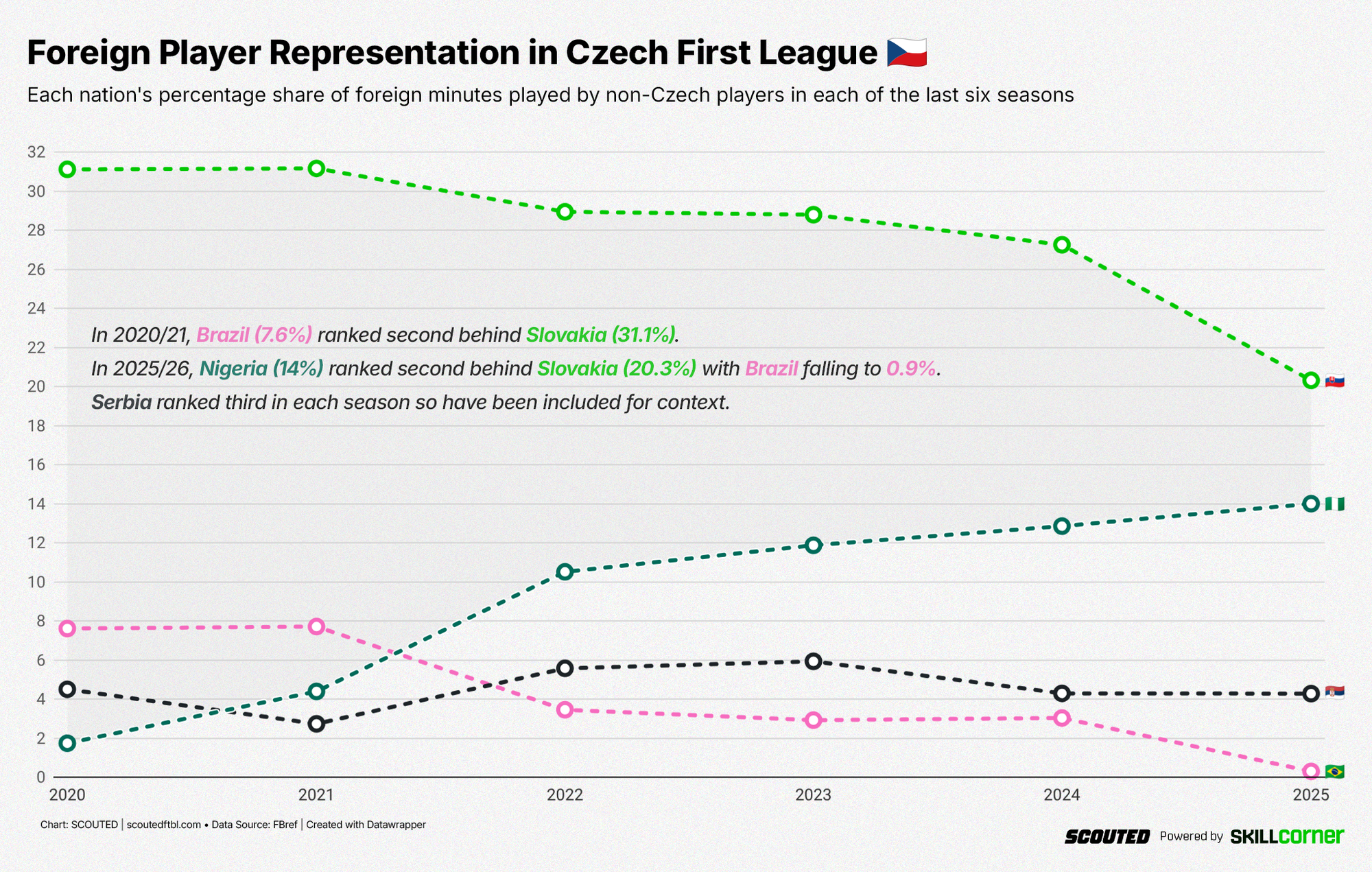
Subscribe for freeCzechia is the number one destination for Nigerian exports, as per the CIES Migration Atlas. Also, according to FBref, Nigeria is the second-most popular foreign nationality in the 2025/26 Czech First League, both in terms of the number of players to feature and their combined minutes; only Slovakia can beat them. In fact, Nigeria has ranked second for both metrics since the start of the 2022/23 season, pulling away from its closest rivals Serbia and Brazil.
On 13 May 2025, four Nigerian players became champions of Czechia as SK Slavia Prague smashed FK Jablonec 5-1 to retain their title. Their starting XI in that match was made up of seven Czechs, three Nigerians and a Slovakian up top. Another Nigerian, the exciting teenager Mubarak Suleiman, featured on the bench.
As per FBref, their 2025/26 first-team squad included 10 African players, five of which are from Nigeria - 2007-born Right2Win graduate Chinedu Isaiah never made a senior appearance but was named on the bench a couple of times. Of those 10, eight were born in 2004 or later. Across the entire squad, three of the seven players born in 2004 or later to start a league match this season are Nigerian; that’s more than any other nation, including native Czech players.
The club’s relationship with Nigeria was formalised in April 2025, on the way to ending a four-season title drought. The club announced they had officially established a multi-year partnership with the Right2Win Academy, headquartered in Umuahia with strong ties to the capital city of Abuja. The reason was made clear in the press release:
"In addition to building its brand in Africa, Slavia's intention is to gain, among other things, a strategic advantage in finding promising players in the region."
It turns out that until formalising their link with Right2Win, Slavia have relied on their prestige within the league to pluck the best African imports from other clubs. 2000-born Defender Ogbu Igoh was signed from Lillestrøm after four years at multiple Norwegian clubs. More interestingly, the younger Nigerians were signed from fellow Czech sides in the middle of the season. 2004-born midfielder David Moses was signed from MFK Karviná in January 2025 while 2004-born full-back Samuel Kelechi Isife was signed from local rivals this January.
Slavia’s partnership with Right2Win is clearly a move towards missing out the middle man. The consistency at which Czech clubs have made an almost-immediate profit on their Nigerian imports has become impossible to ignore.
But is there a particular profile Czech clubs are scouting for in Africa? Or is a key skill prominent across all imports? We can translate common skills into SkillCorner data points to answer those questions - and explore why this new and under-the-radar landing spot for Flying Eagles is so effective.
Nigeria’s Archetype
To do this - a process that could be repeated for any team and any nation - we can use Responsibility. Essentially, this is part of our SEER player evaluation framework (Style, Effectiveness, Efficiency, Responsibility) that focuses on performance within a specific environment.
21 of the 34 Nigerians that made an appearance in the 2025/26 Czech First League season were born in 2003 or later. 11 of those players met the SkillCorner threshold of 5 Performances of at least 60 minutes. I have grabbed those 11 players, calculated the percentage difference between their output and the team average for each metric, and then calculated Z-Scores based on how large that gap is relative to other players.
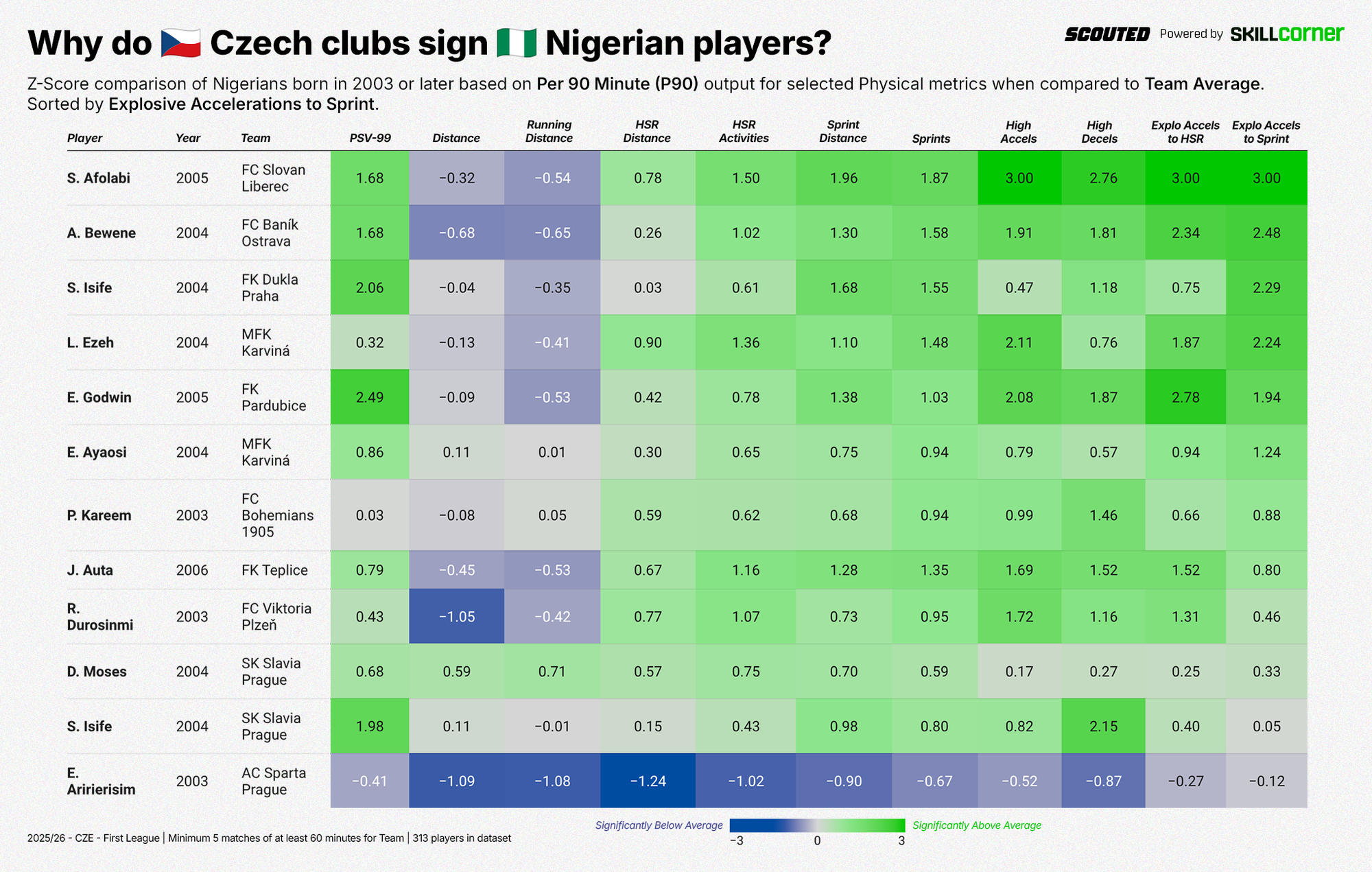
The elephant in the room is how position affects output. My usual riposte is that role dictates output rather than position. However, there are natural variations we expect from each Position Group. For example, the only Central Defender, 2003-born Emmanuel Uchenna Aririerisim, ranks below average when compared to Sparta Prague teammates for all metrics. Even still, the fact the majority of these players belong to the Full Back or Wide Attacker Position Group provides the first insight into which type of player Czech clubs are recruiting from Nigeria; we would usually expect these groups to house the quickest, most explosive players.
So, by looking at squad averages, we start to unearth which attributes Czech teams are relying on their Nigerian imports to deliver and how they are looking to platform them. That brings us to Accelerations, in all its forms.
These young Nigerians players both accelerate and decelerate most frequently in their respective teams. None more so than Afolabi Soliu. Signed from Czech 2nd Division side FC Silon Táborsko at the start of the 2025/26 season, Soliu first walked the path from Nigeria in 2023, joining FST from Lagos-based Box2Box FC.
The importance of team context is also illustrated by the output of Samuel Isife. At both clubs, he ranks as one of the quickest in terms of PSV-99. However, while at Dukla he was a huge outlier for Sprint and Explosive Acceleration metrics, he shifted towards average at Slavia Prague. This might be expected from a player that moved from opposite ends of the league table. At eventually-relegated Dukla, he was a standout superstar. At the eventual-champions Slavia, more players can match his output, if not his speed.
It seems obvious to me that Czech clubs are looking to Africa, specifically Nigeria, for their ability to repeatedly change pace at explosive speed. When looking at Explosive Accelerations to High Intensity, the majority of the top 10 are African, with two of the top three from Nigeria.
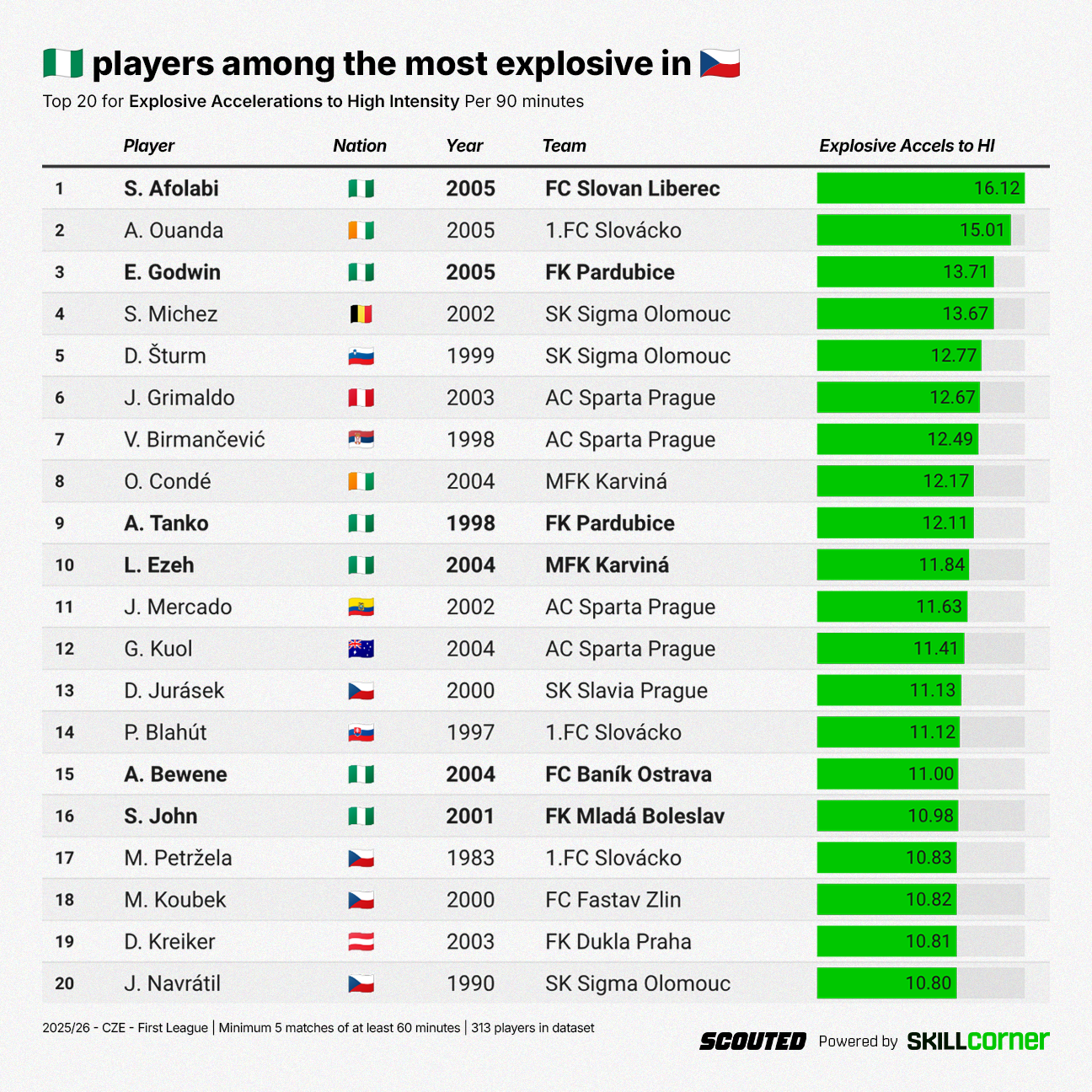
If we look specifically at players born in 2003 or later - there are 89 in this dataset - seven of the 12 possible Nigerian entries rank in the top 20.
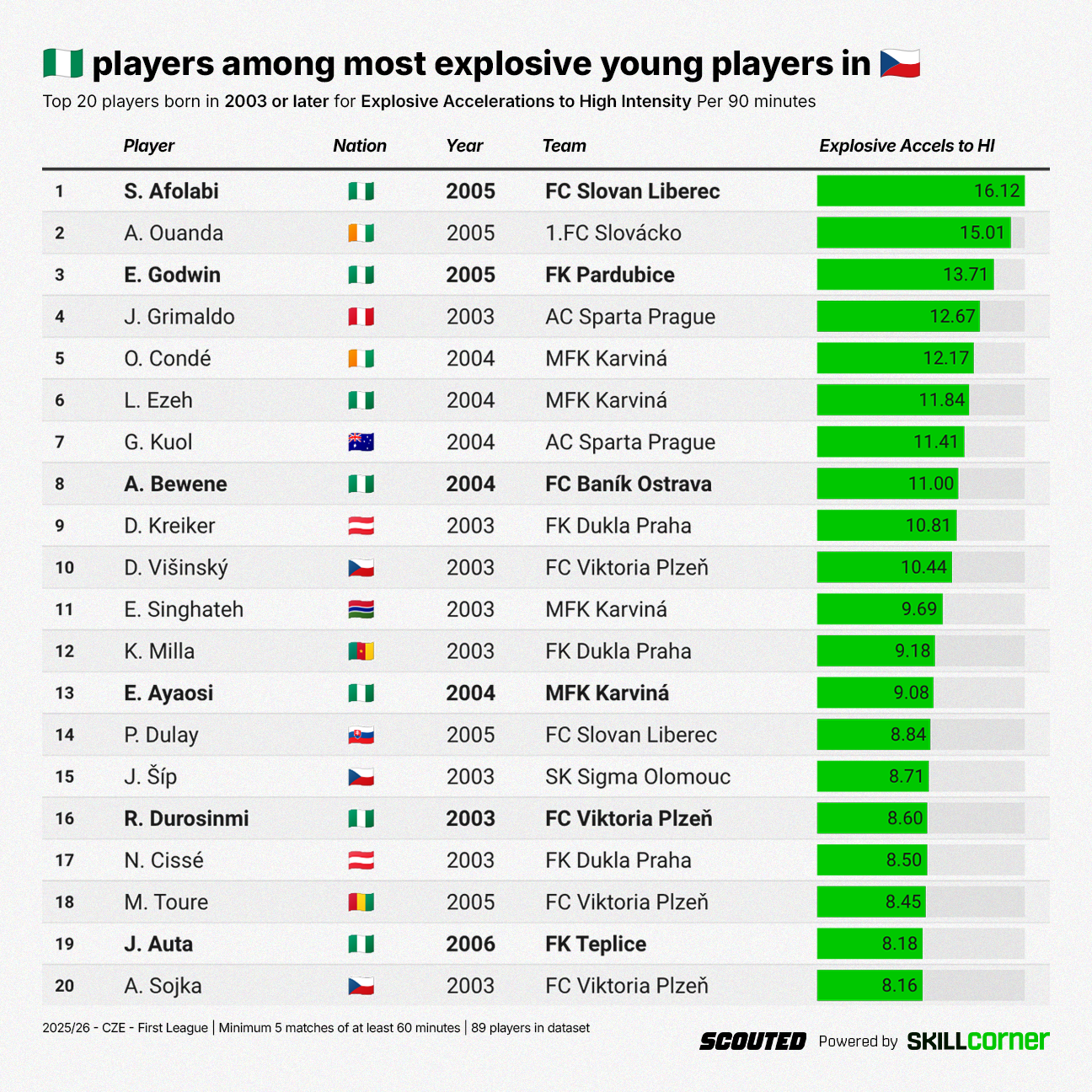
Whether Czech clubs are scouting for talent in Africa to specifically play out wide or not, they seem to be prioritising explosive, bursty players. The next step is to find out what attributes this explosiveness translates to on the pitch.
Explosive Accelerations as a platform
We always consider Physical metrics in tandem with on-pitch outcomes: what Superpower does each strain of athleticism augment? What game-impacting skills do they unlock?
Another important point to make is that our initial queries have been viewed through the lens of Per 90 Minutes, to capture all Physical activity. However, when looking at on-pitch actions, we can look at Team in Possession (TIP) and Team Out of Possession (OTIP) separately.
In Possession Explosiveness
The majority of players that appeared in the initial search are Wide Attackers, so we are going to focus specifically on that Position Group for the TIP profile in order to discover which skills may be augmented by explosiveness. In particular, we are going to look at the Roadrunner Archetype.
A Roadrunner is a wide outlet capable of high-speed ball-carrying all the way to the byline before flashing crosses into the box. Their main on-pitch function is Progression, specifically through taking the ball forward themselves rather than passing. In theory, Explosiveness is a valuable attribute as it enables the consistent creation of separation.
To hone on in this particular function, we can use the new SkillCorner Pressure metrics. The upgraded suite of Game Intelligence data includes Progressive Actions under Pressure and Progressive Action Ratio. The youngest Nigerian wingers not only rank first for the effectiveness metric - even when looking across all Position Groups - but they also rank first for the stylistic metric within this top 20. They are relentlessly progressive.
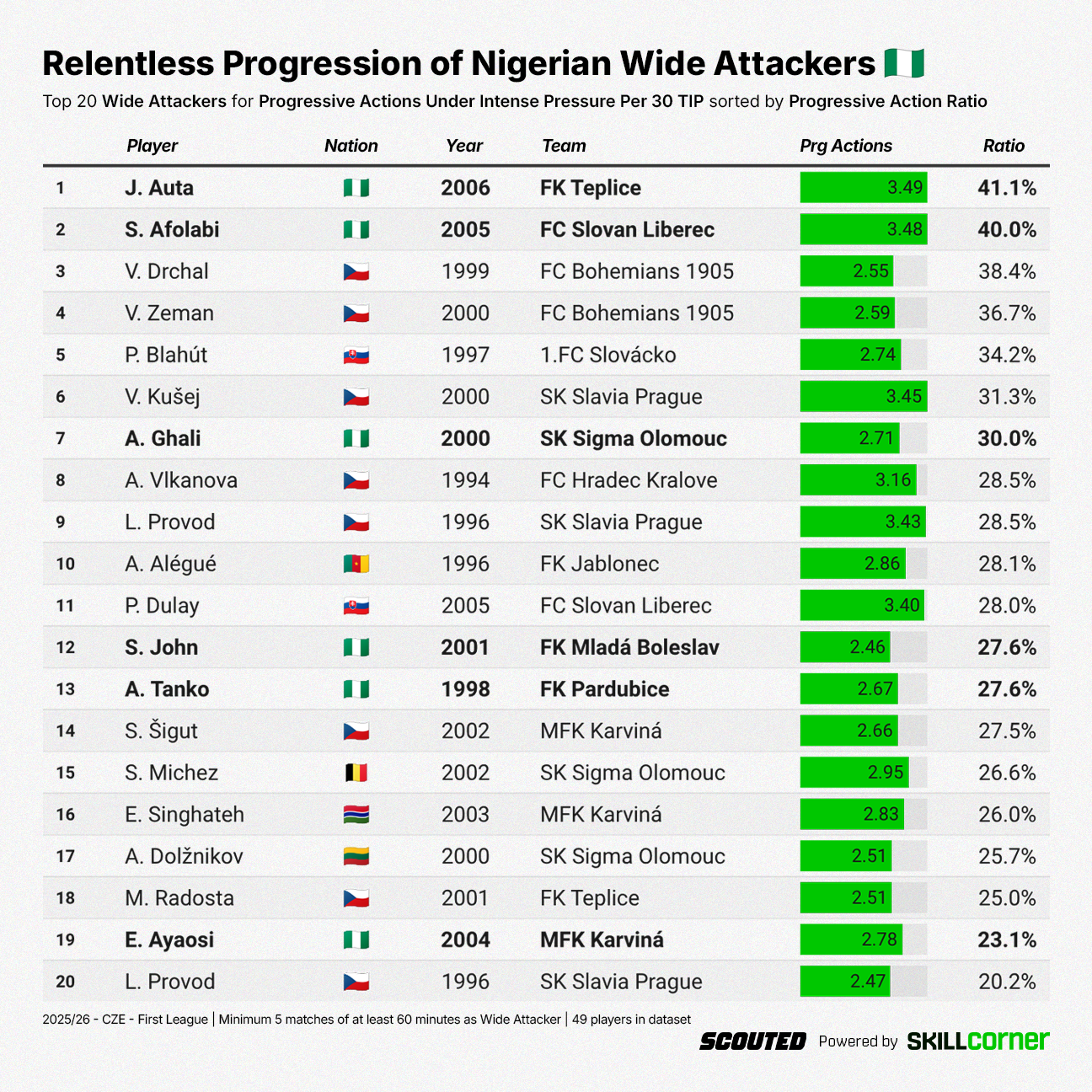
When ranking this dataset for Wide Attackers based on the Roadrunner Archetype Performance Index - which also includes metrics such as Carries at Speed - both Auta and Afolabi take top spot again.
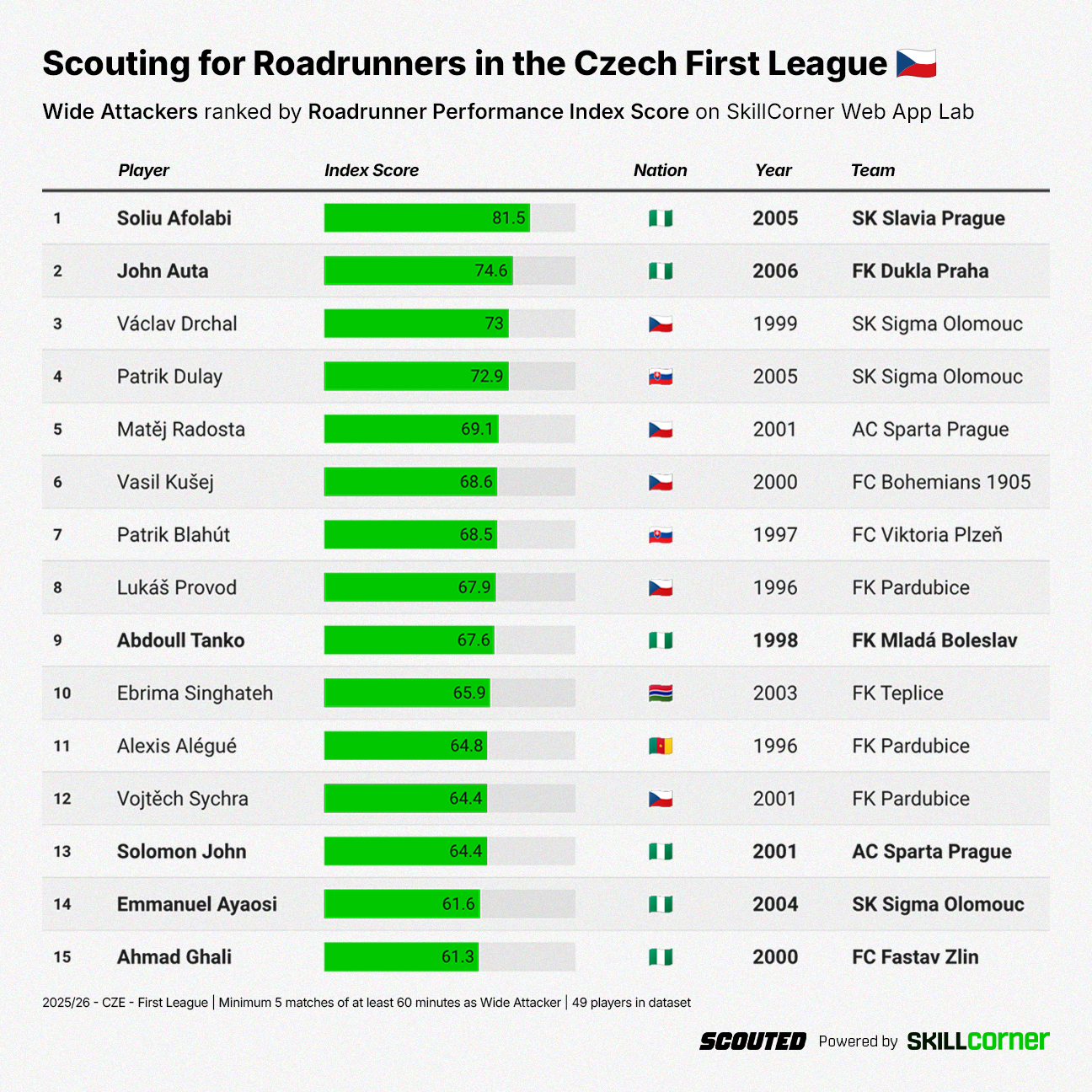
If your club is looking for incessantly explosive and relentlessly progressive ball-carriers in possession, it’s time to check out the Czech leagues. Top-flight clubs are platforming the most explosive Roadrunners from Nigeria, even signing them from second-division sides as was the case with Afolabi.
Out of Possession Explosiveness
However, Slavia Prague, pinned up as the club taking this relationship to a new level, did not have any Nigerian Wide Attackers across any of our lists. In fact, their only representative David Moses was also the only Midfielder in our list. Let’s investigate whether he is as explosive as his compatriots, albeit in a different setting.
As alluded to earlier, Moses is not a product of the Right2Win pathway. It was MFK Karviná that brought him to Czechia, signing him from Central Football Academy in Abuja in 2022 for a reported €50,000. After 20 appearances for Karviná’s youth and B teams and 45 appearances for the senior side, they sold him for €1.5 million to Slavia.
If Explosiveness is used to create separation in possession, then the opposite would be closing space out of possession. When looking through the OTIP lens, Moses is incredible.
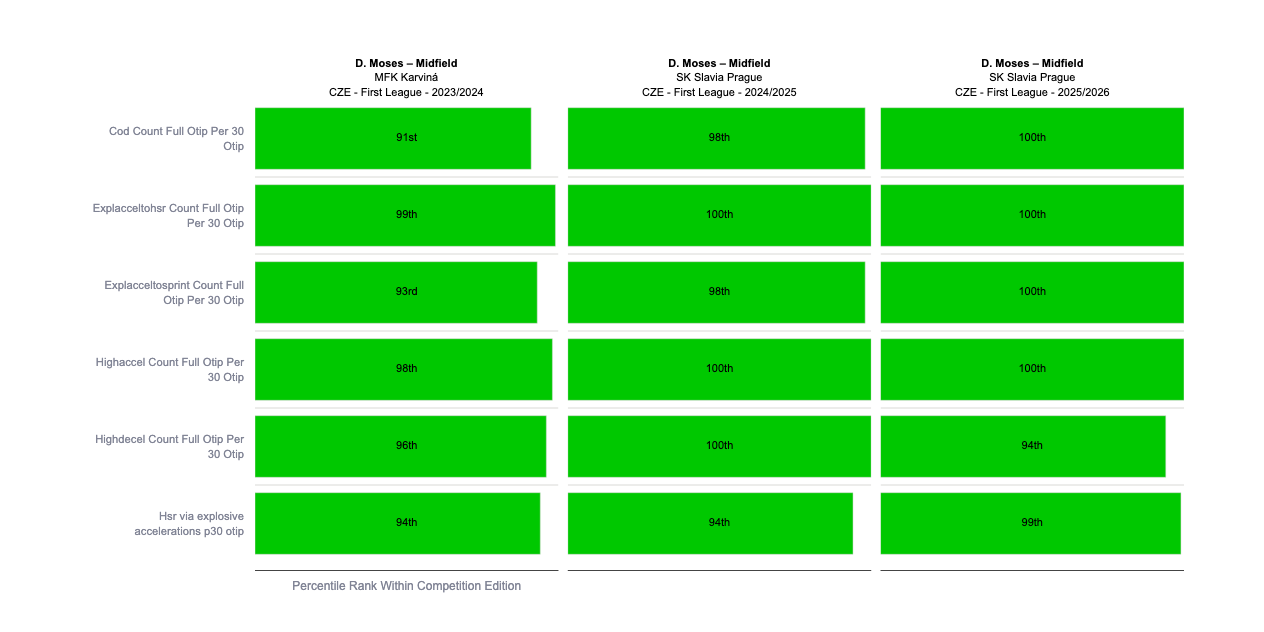
He has ranked in the top 10% of Midfielders for all six Physical Acceleration metrics in each of his three seasons in the Czech league. This season, Moses remains an outlier within the Slavia team context while all 12 Nigerians rank above team average for Explosive Accelerations to HSR Per 30 Minutes OTIP.
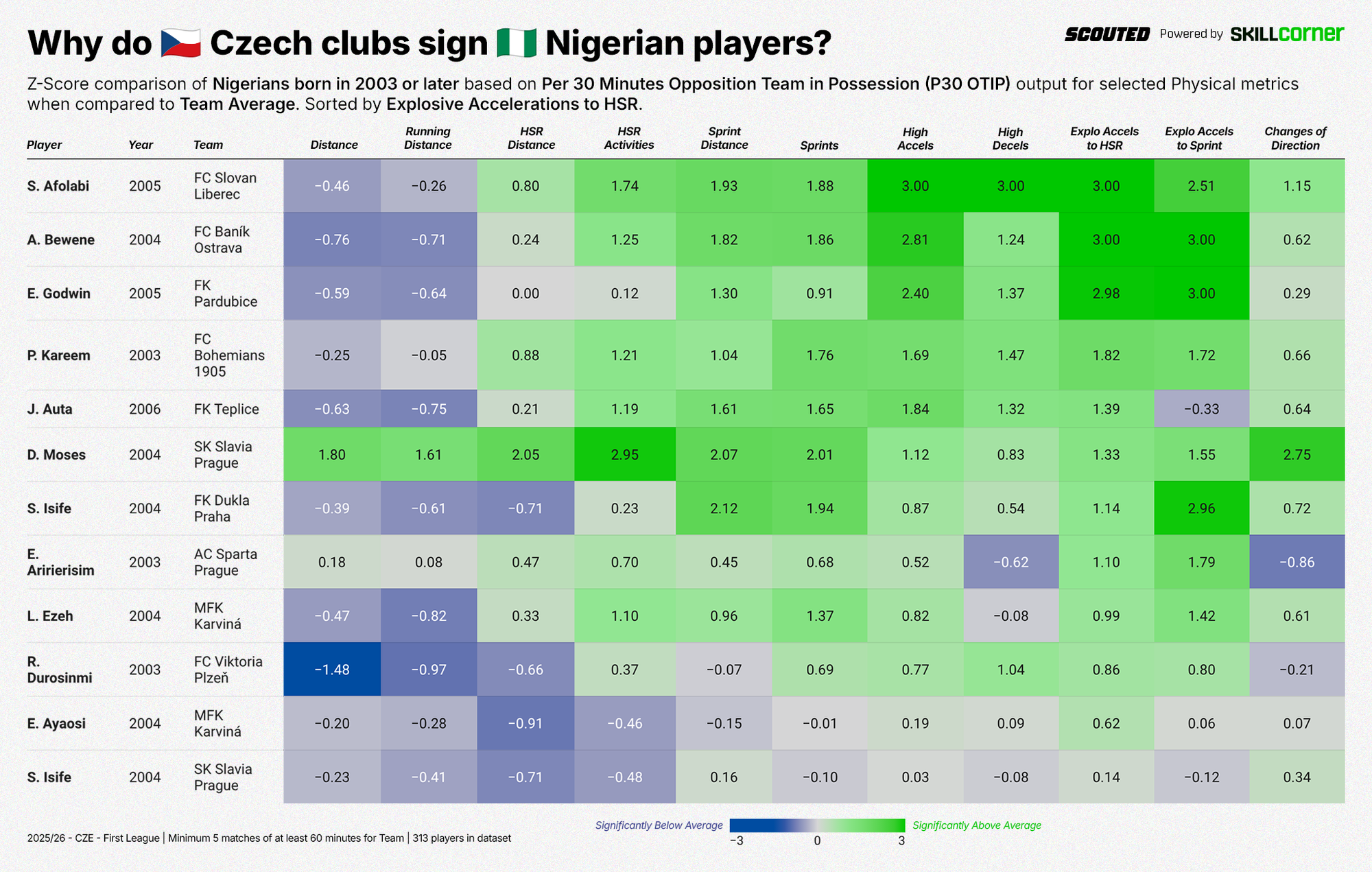
Note that Afolabi is also by far the most explosive player out of possession on the Slovan Liberec team - he’s not just a Roadrunner with the ball. This Physical trait is clearly a superpower that extends across both phases.
Looking at On Ball Engagements gives us an insight into how Explosiveness might translate to out of possession skills. Across his three Czech First League seasons, Moses consistently ranked highly for the following metrics:
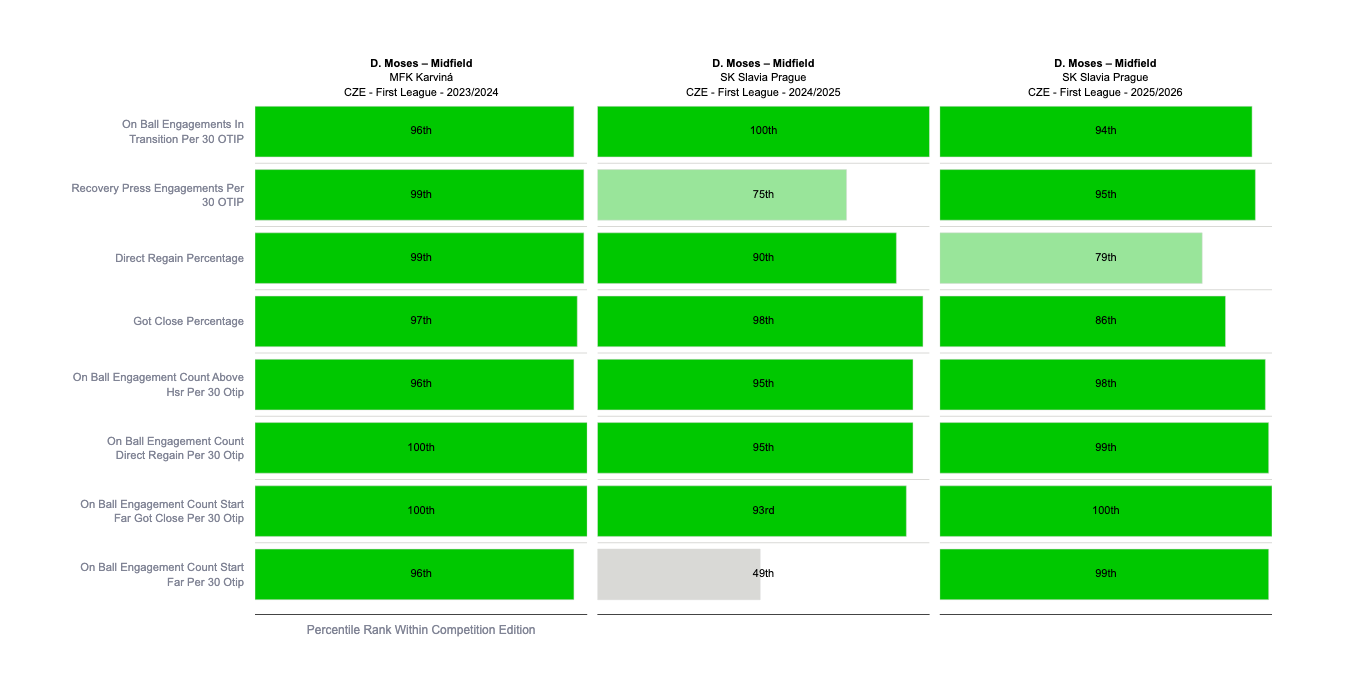
Moses is given greater opportunities to reach the High Speed band due to the high number of OBEs in Transition, Recovery Press OBEs and OBEs Start Far that his role demands. Translated: at both clubs, Moses has been asked to cover large, open spaces, often running back towards his own goal. But not all players exposed to this environment behave the same.
Players expected to perform those types of On Ball Engagements usually rank high for High Speed Running metrics: within this dataset, there is 0.54 moderate-to-strong positive correlation between Recovery OBE and HSR Distance P30 OTIP, for example.
However, there is no correlation between Explosive Accelerations to HSR Per 30 Minutes OTIP and any of those three metrics. That being said, if the environment demands that distance is covered at High Speed (20-25 km/h), then being able to reach that band at explosive speed when required becomes valuable. Afolabi also ranks well when compared to Wide Attackers for Direct Regains - both in terms of effectiveness (count) and efficiency (ratio).
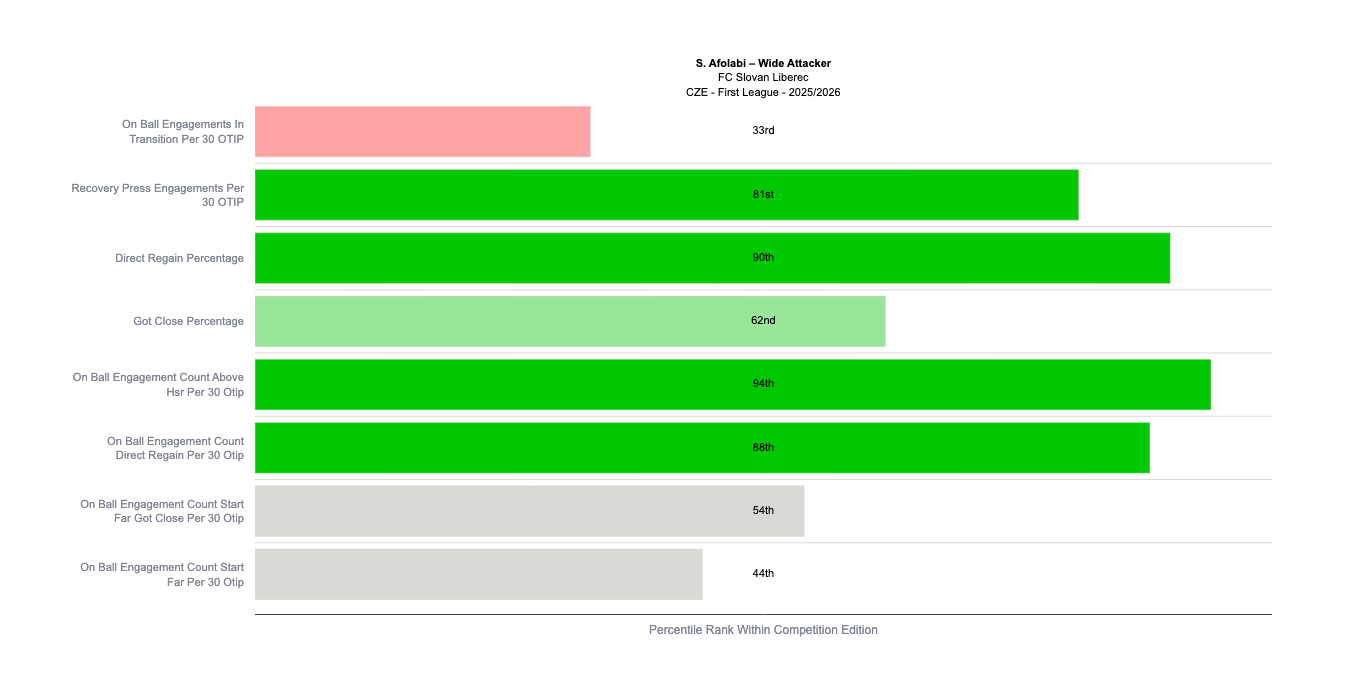
Just as the Explosiveness may augment Roadrunners’ ability to create separation during their high-speed carrying, there is early evidence that it helps recovery defenders to consistently get close to their opponents while also making more direct regains.
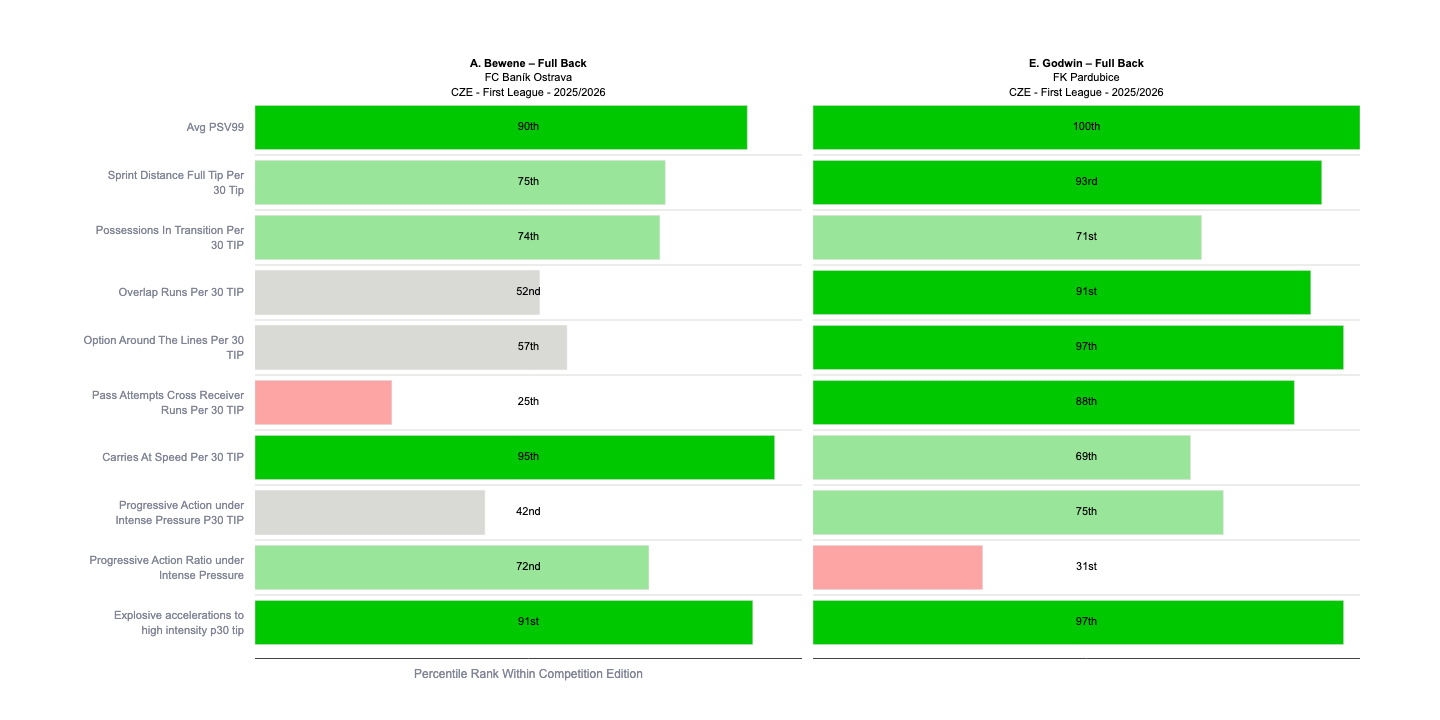
Looking at our two outlying Full Backs shows this is not an exact science. While 2004-born Abdullahi Bewene’s output matches our expectations, Emmanuel Godwin’s Physical OTIP output does not translate fluently.
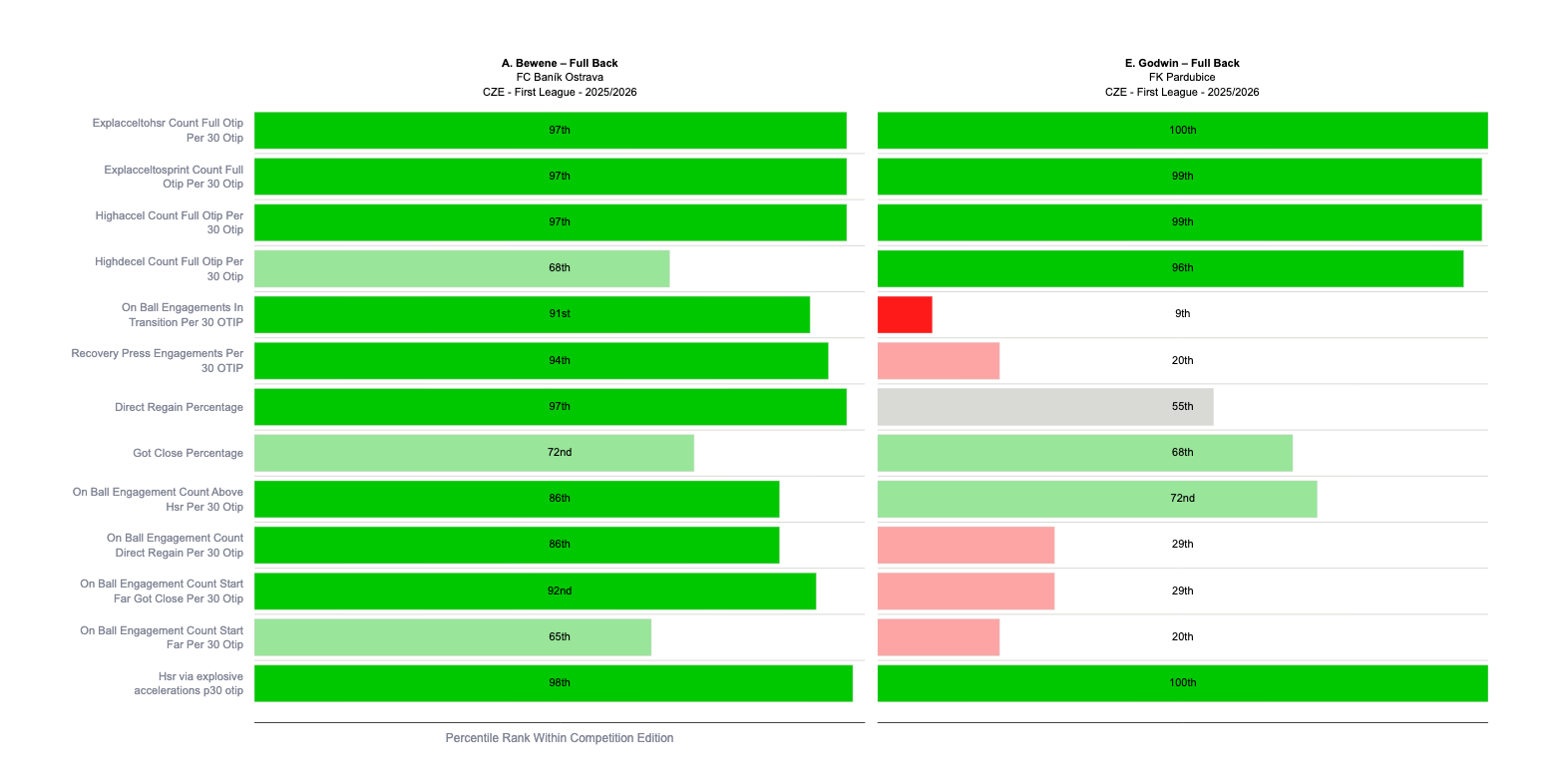
But a quick glance at the core metrics we flagged for Roadrunners suggests that FK Pardubice are at least benefitting from the explosive speed becoming synonymous with Nigerian imports in some way. Godwin is the quickest Full Back in this dataset, a consistent option out wide and keen to cross the ball.
The future of football is Africa. Czech clubs know it and they are using high-potential African prospects, principally from Nigeria, to add explosiveness to their squad. In possession, wide players are given license to carry and progress the ball at speed. Out of possession, these bursts give retreating defenders the edge to directly win possession back. This pathway is developing from a quirk into phenomenon, so much so that SK Slavia Prague have secured a direct link; they are no longer willing to wait for standout prospects to filter upwards.
This newsletter was produced under a commercial collaboration with SkillCorner, SCOUTED’s official data partners. Their tracking and performance data is used by more than 150 of the world’s biggest clubs, leagues and confederations.



Member discussion