
Kennet Eichhorn, the new-age carrier

by TOM CURREN
scouted by LLEW DAVIES
This essay was published in Volume II under the title 'Nuts and Bolts'. Grab a copy of the full magazine in digital:
Every so often, a player breaks into senior football at an age that is, by itself, remarkable. You don’t need fancy data models or a worldwide network of scouts to spot it: a big, red flashing klaxon simply appears in the air and a disembodied tannoy blares the announcement. A sixteen-year-old is starting in the 2. Bundesliga.
Scouts will have flocked to watch Kennet Eichhorn like flies since it first became evident his emergence into Hertha BSC’s first team was no passing fancy, but the beginning of a serious career. There, they’ll have born witness to a remarkable scene: a teenager resisting the usual hallmarks of a ‘wonderkid’ in favour of an anachronistic maturity. Eichhorn is not necessarily a headline-grabber; he is rarely swerving through German midfields with flair and youthful exuberance. Instead he plays with the steadiness of a marshal twice his age. He is emotionally stable, physically present, and technically functional. He looks already like a normal and unfussy member of a senior squad; totally unremarkable, in fact, until you happen to glance at his age.
At least, this was true for the first three months of 2025/26. Hertha made a stuttering start, earning two points from their opening four games. Eichhorn started from the bench in all four and earned 67 minutes total. A month into the season, Stefan Leitl chose to twist, and Eichhorn started every game save one between September and December, as Hertha’s results ticked up. He earned four caps for Germany’s U-17s in the same period and scored twice. The cat - or squirrel, as his surname charmingly translates to - was out the bag. Then, in January of this year, he suffered his first major setback: an ankle injury that has kept him out of action since.
The story of Kennet Eichhorn reflects, on one hand, the changing standards of physical development. Although clearly still an outlier, he is symptomatic of processes that are producing players ready for senior competition at earlier ages than ever before. But he’s not been thrown into the maelstrom simply because he’s tall and strong: Eichhorn is a remarkably smart and steady presence, and that’s the true spine of this tale. This is a story of agedness, of a boy whose scanning, stability, body use and decision-making makes his team of grown men much calmer around him. You don’t need a big red klaxon to tell you that’s extraordinary.
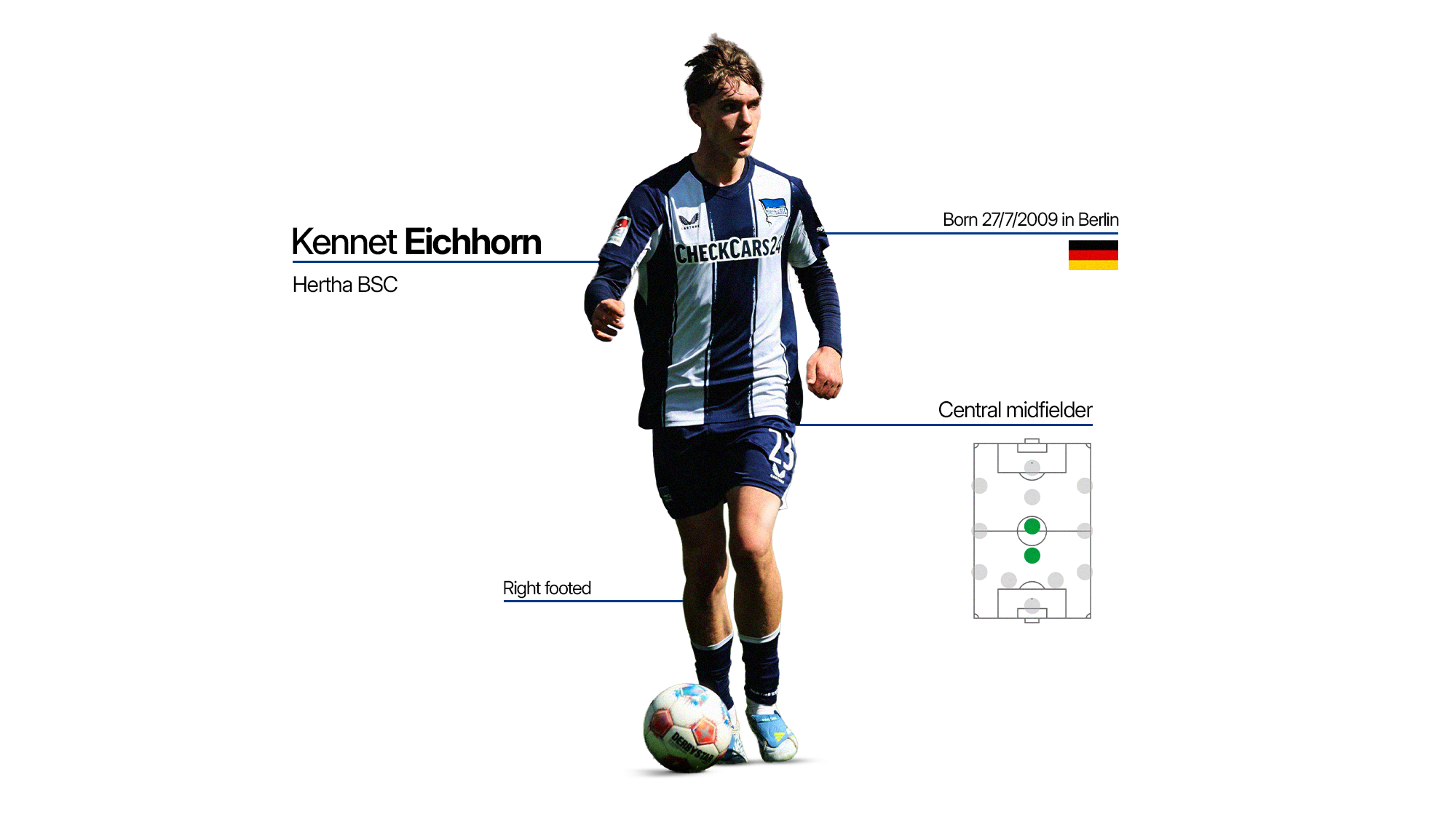
Describing a young player as mature does some heavy lifting. It tells you Eichhorn is technically secure, physically imposing and mentally unflappable. It tells you his teammates trust him, and he trusts them, and he rarely looks a step behind the pace of the senior game. It won’t necessarily give you the finer details, like that he’s a ground-eating carrier in the second phase, is capable of twisting out of tight situations with the ball, or has a blend of small and large space qualities that are enticing given his youth. For that, we’ll need more words than one.
Let’s round out the maturity first. On the pitch, being unflappable means his decision-making is calm and unhurried; he doesn’t play like a young man out to impress, but a player who understands his first duty is to the team. He doesn’t hide, but is eager to take responsibility both with possession and without. In days past, his body usage would be emblematic of a more experienced, wily player, although that’s starting to change. As SCOUTED detailed during the emergence of Myles Lewis-Skelly, Eichhorn uses his torso and arms as a lever to keep separation between his marker and the ball, protecting it and disrupting a challenger’s approach. With the ball he is composed, and executes the simple, efficient pass without fuss or the need to try the spectacular; he only punches it through lines when the picture becomes clear enough to see. We’ve yet to see much evidence of a truly expansive passing range, which remains for now a future indicator of his growth.
At sixteen, this maturity is a Superpower itself, but will fade in significance as he ages. Scouts will be watching to understand which of his traits are scalable as his career develops and the level of opposition escalates. The first is clearly his small-space aptitude. At the base of midfield he’s already capable of absorbing pressure and twisting away, using his body to protect the ball and quick feet to move it into space. On its own, this is notable - but when combined with what he does next, it becomes really exciting. Once Eichhorn has separation, he switches into large-space mode, where his big frame powers him into a ground-eating run. In this sense he can be considered a converter of pressure into carries, small space into large; if you’ve read The Future of Midfield earlier in this Volume, you’ll understand the significance. This second-phase acceleration is a core element of Eichhorn’s quality. He beats his marker and drives forward with the ball, pulling defenders around and moving the block into chaos. These runs seem instinctual, almost primal, but also point at where Eichhorn is most raw. He often holds the ball too long, runs into dead ends, or misses the runner ahead of him. By the time he’s looked up, defenders have made recovery runs, and his gains have dissipated.
Without the ball, Eichhorn is already a plus and retains room to grow. He’s tall, upright, and will fill into his frame further. He looks the part among men already, and the years ahead might transform his physical profile from competitive to dominant; it’s easy to see opponents one day ragdoll around him as they do our original Ground Eater, Declan Rice. And out of possession this physicality lends Eichhorn a scrappy kind of competence. He’s proactive in messy situations, launching himself into duels where his body use lends him an edge. He competes for headers and wins second balls, cleaning up the chaos around him before stretching his legs to turn such moments into drives. To hammer the point home, it’s this quality of conversion - sucking the danger out of tight spaces and messy situations and transforming it into opportunity - that make him so exciting.

“What were you doing at sixteen?” That seems to be the phrase of the moment, passed around mainstream media like an anthem, directed at Lamine Yamal, Max Dowman, and would be today at Kennet Eichhorn, were he wider-known in the Anglosphere. The advantage Eichhorn has over his fellow phenoms is the relative quiet. The scouting world is abuzz but the noise remains contained for now, tempered by the status of the 2. Bundesliga and Eichhorn’s unfortunate injury.
Of course that hasn’t stopped the rumour mill. The usual suspects are circling: Bayern München, RB Leipzig, Bayer Leverkusen and Borussia Dortmund are, of course, perpetually on standby to hoover up German prospects; but the Premier League has been touted, too, a potential move he wouldn’t be able to realise until July 2027, after he turns 18 years old. There’s even talk of Real Madrid and Paris Saint-Germain. All will be watching for Eichhorn’s return, to see how he might settle back into the rhythm of this closing season.
From our perspective, we’ll be waiting to see which direction Eichhorn’s natural development takes him. If he tightens the timing of release after his destructive carries, he could grown into one of Europe’s preeminent Ground Eaters. If, instead, he develops a cultured and expansive passing profile with disguise and range, his career takes a different direction; as it does if he stays a safe connector only, who offers calm security with and without the ball. All things are possible in the life of a squirrel.
Member discussion