
10 (more) World Cup Breakouts
In the end, the UNICEF bath prophecy was fulfilled. Lamine Yamal and Spain triumphed over Lionel Messi, and reigning champions Argentina, to lift the World Cup for the second time.
But that primary narrative arc is not what interested SCOUTED the most about the tournament; we had our eyes on the breakouts. Which young players put their name on the map? Which piqued our interest for the first time?
Support SCOUTED
This analytical epic is free to read courtesy of SkillCorner, our data partners. Subscribe now to keep in-depth content like this coming your way.
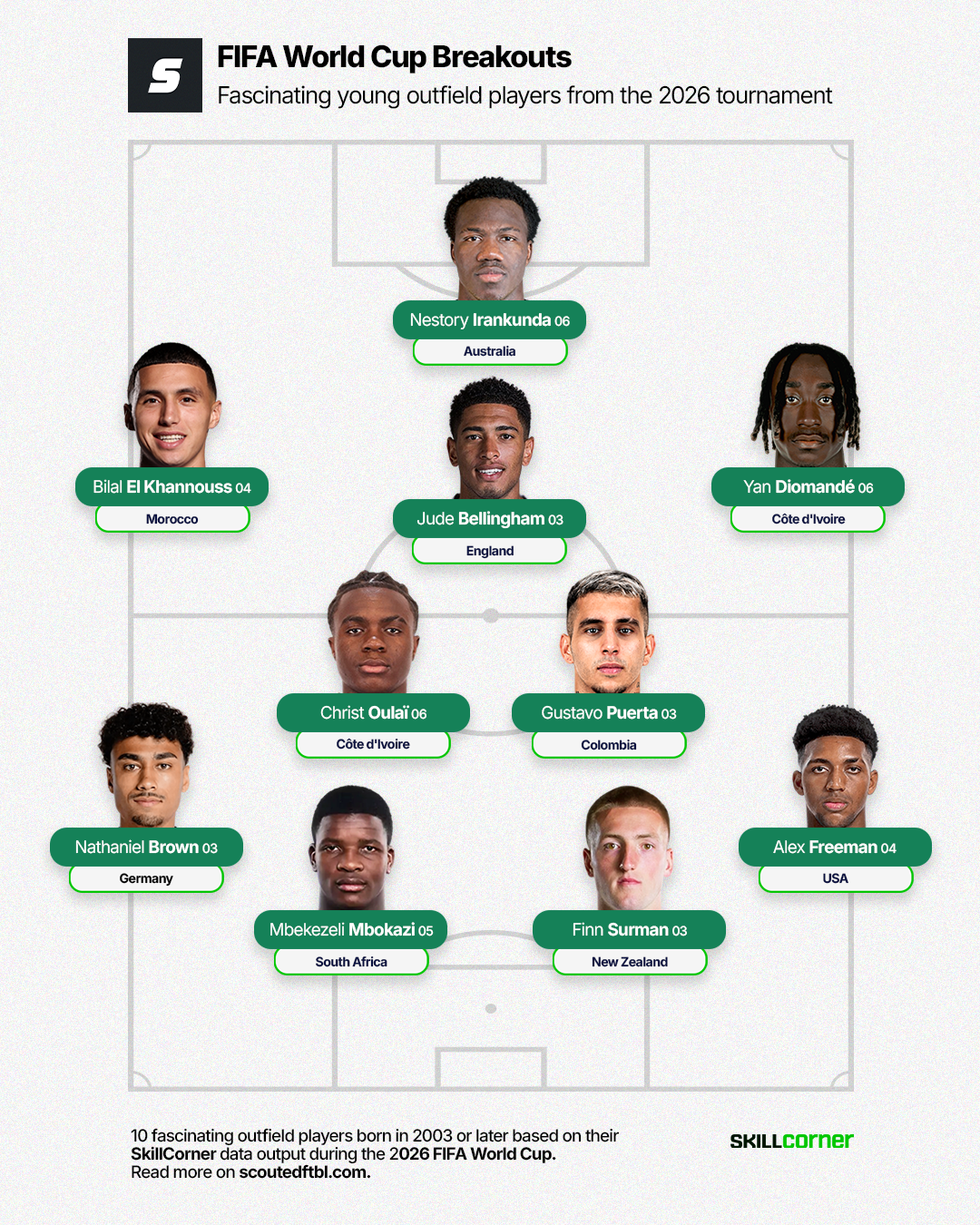
Subscribe for freeTo answer those questions, we’re going to use SkillCorner data to highlight the most fascinating young players from the FIFA World Cup 2026. These 10 outfield players were all born in 2003 or later and were not included in our pre-tournament list of breakout stars. So if you are looking for data and insight on Johan Manzambi, Ayoubb Bouaddi and Ibrahim Maza - all three had brilliant tournaments - then start here.

 Llew Davies
The major caveat for this post-tournament version is that of course the data sample is very small. The recommended SkillCorner threshold of five 60-minute games is only met by 76 players, just six of which were born in 2003 or later. Also, Per 90, Per 30 TIP and Per 30 OTIP normalisations become volatile within the tournament setting due to cameo appearances, so we’ll be using Per Match filters to get closer to spotting players that made an in-game impact. That leaves us with a pool of 428 players with three 45-minute appearances to their name, with 59 born in 2003 or later to pick from.
🇿🇦 Mbekezeli Mbokazi
Mbekezeli Mbokazi makes the list for a number of reasons. Firstly, he popped up frequently in SCOUTED’s communication channels (our WhatsApp group) as we were keen to watch more of him at this tournament after hearing plenty of good things about his debut season at Chicago Fire.
Secondly, Mbokazi represents an emerging and increasingly successful pathway from South Africa to the United States which will be the subject of a SCOUTED x SkillCorner investigation at some point during the 2026/27 season.
Finally, the data. Mbokazi ranked as one of the most ambitious passers from centre-back at the tournament. No centre-back attempted more Line Breaks through the Last Line than Mbokazi, while he ranked third for Average Pass Distance and third for Pass Attempts to Runs In Behind - first for both within the 2003+ pool. In fact, he is the only 2003+ player that ranks in the top 10 for that second metric when looking across all positions.
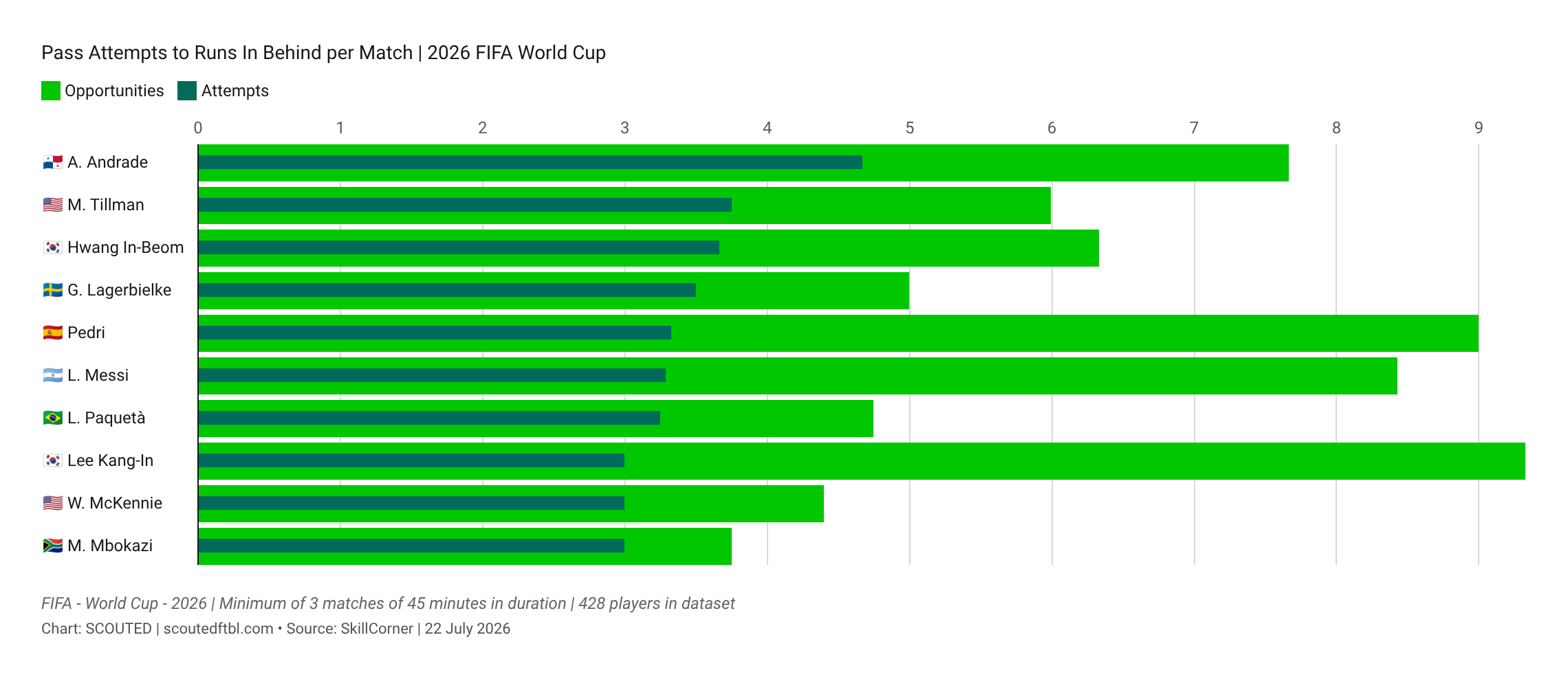
Also note that Mbokazi has fewer Opportunities to Pass to Runs In Behind than any other player in this top ten. All of this adds up to suggest Mbokazi can operate as a Pathfinder - a player responsible for ball Progression and Penetration from deep - from a wide centre-back role. As Llew has described in our database:
Mbokazi also ranked first for Percentage of Passes as Difficult Passes among 2003+ centre-backs. Comparing his 13.9% ratio to that of his 2004-born teammate Ime Okon (8.4%) suggests that Mbokazi’s passing was informed by player instinct rather than team context.
🇳🇿 Finn Surman
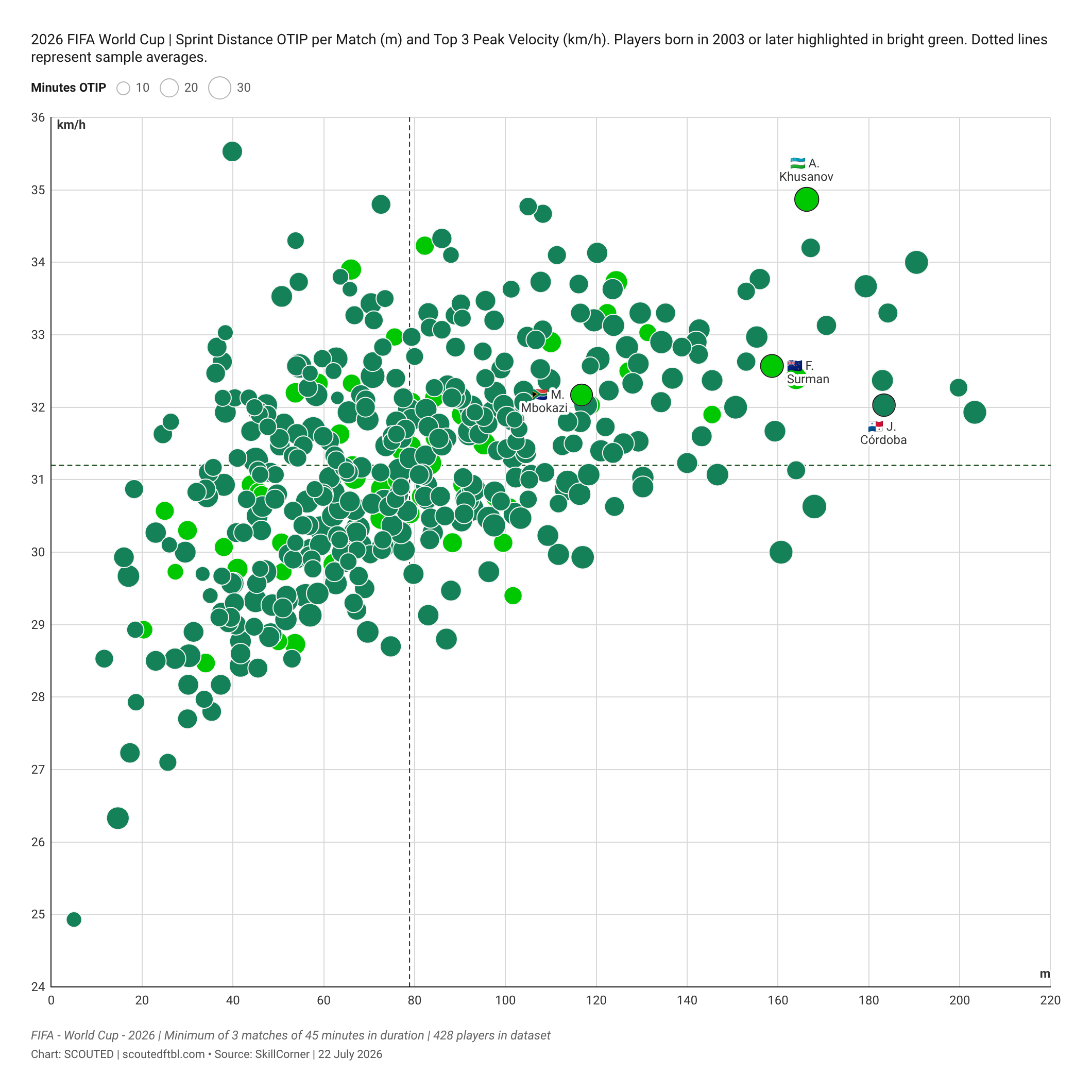
To complement a technical pick in Mbokazi, the second centre-back is an athletic standout that also plays his club football for an MLS franchise. New Zealand’s Finn Surman was one of the fastest 2003+ players at this summer’s World Cup; Abdukodir Khusanov was the only U23 centre-back that recorded a higher Top 3 Peak Velocity. Per Match, only José Cordoba and Abdukodir Khusanov covered more Sprint Distance OTIP.
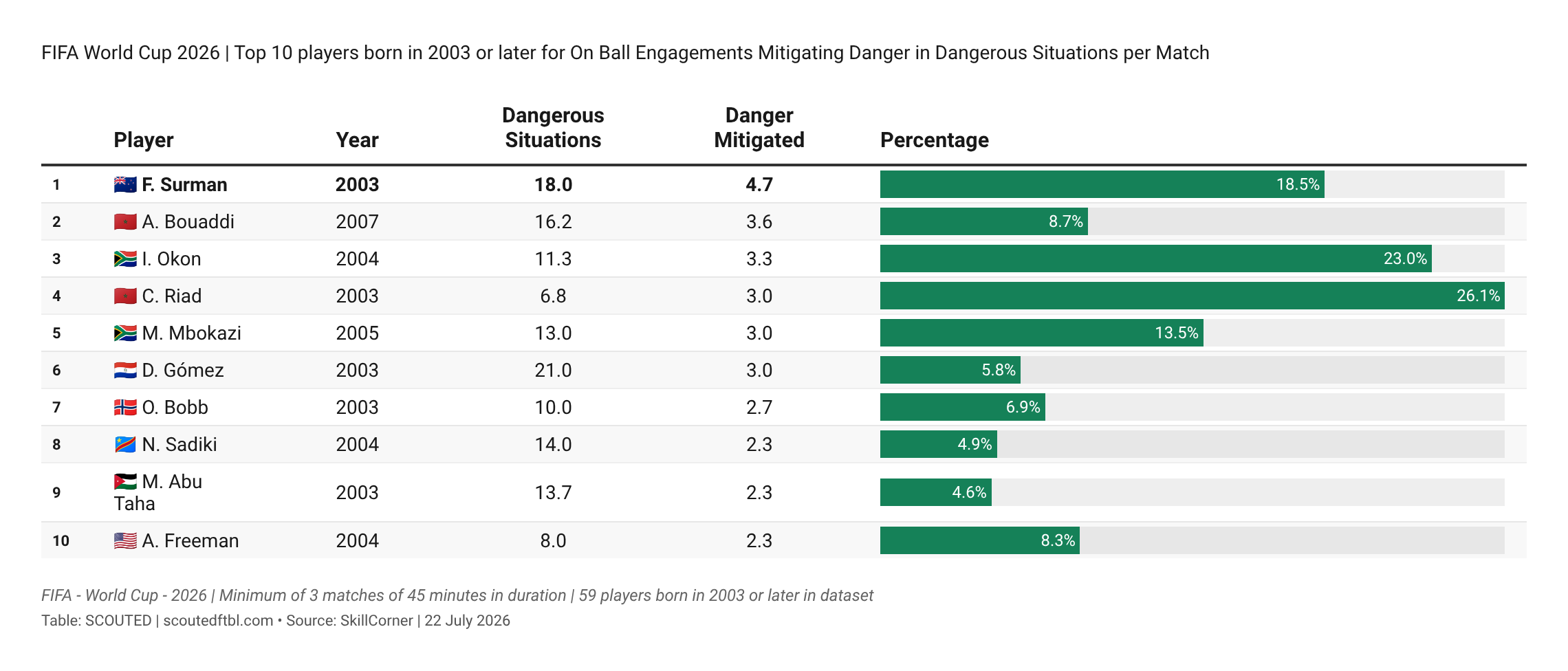
But Surman was not just charging up and down the pitch. Among all 2003+ players, he ranked second for Engagements in Dangerous Situations and first for Danger Mitigated in Dangerous Situations. But he also ranked second for Percentage of Engagements Mitigating Danger. He was effective and efficient at reducing threat, even in the face of increased exposure.
We were aware of the Cardiff-born centre-back’s height and aerial ability before the tournament but discovering his speed allows for confident predictions of an imminent move to the Big Five Leagues.
🇺🇸 Alex Freeman
Alex Freeman recently moved from MLS to Europe. The now-Villarreal defender was part of a delightful triangle of balanced profiles on USA’s right that particularly caught my eye against Australia. In that match, Freeman provided the platform from right centre-back for Weston McKennie to make vertical runs in the half-space while Sergiño Dest flicked through his box of tricks.
It was a more reserved role than Freeman is capable of. We highlighted his Wide Receiver heritage in Volume I, focusing on the athleticism that makes him a consistent threat whether covering ground at speed or leaping into the skies. At the World Cup, he demonstrated a proficiency in platforming possession and defensive 1v1s.
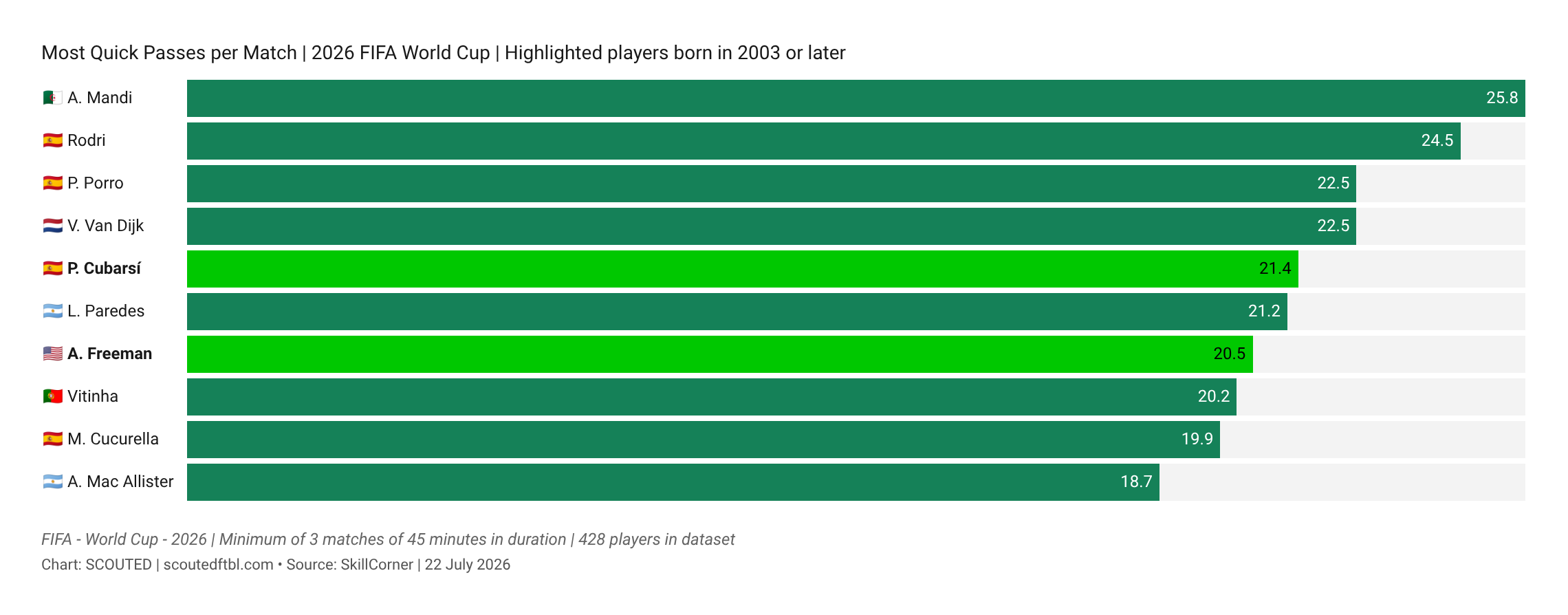
Quick Passes is a nice metric to uncover metronomic passers that move and circulate the ball swiftly. Freeman and Young Player of the Tournament Pau Cubarsí were the only 2003+ players in the top 10 for this metric.
As for the defensive side, of the 84 players across all ages to make at least two Direct Regains or Disruptions per Match, Freeman ranked fourth for the percentage of On Ball Engagements that resulted in those direct outcomes.
🇩🇪 Nathaniel Brown
The World Cup may have been many’s introduction to what makes Nathaniel Brown such an exciting prospect. His displays should also eliminate any doubts about whether he will become Bayern’s Alphonso Davies replacement.
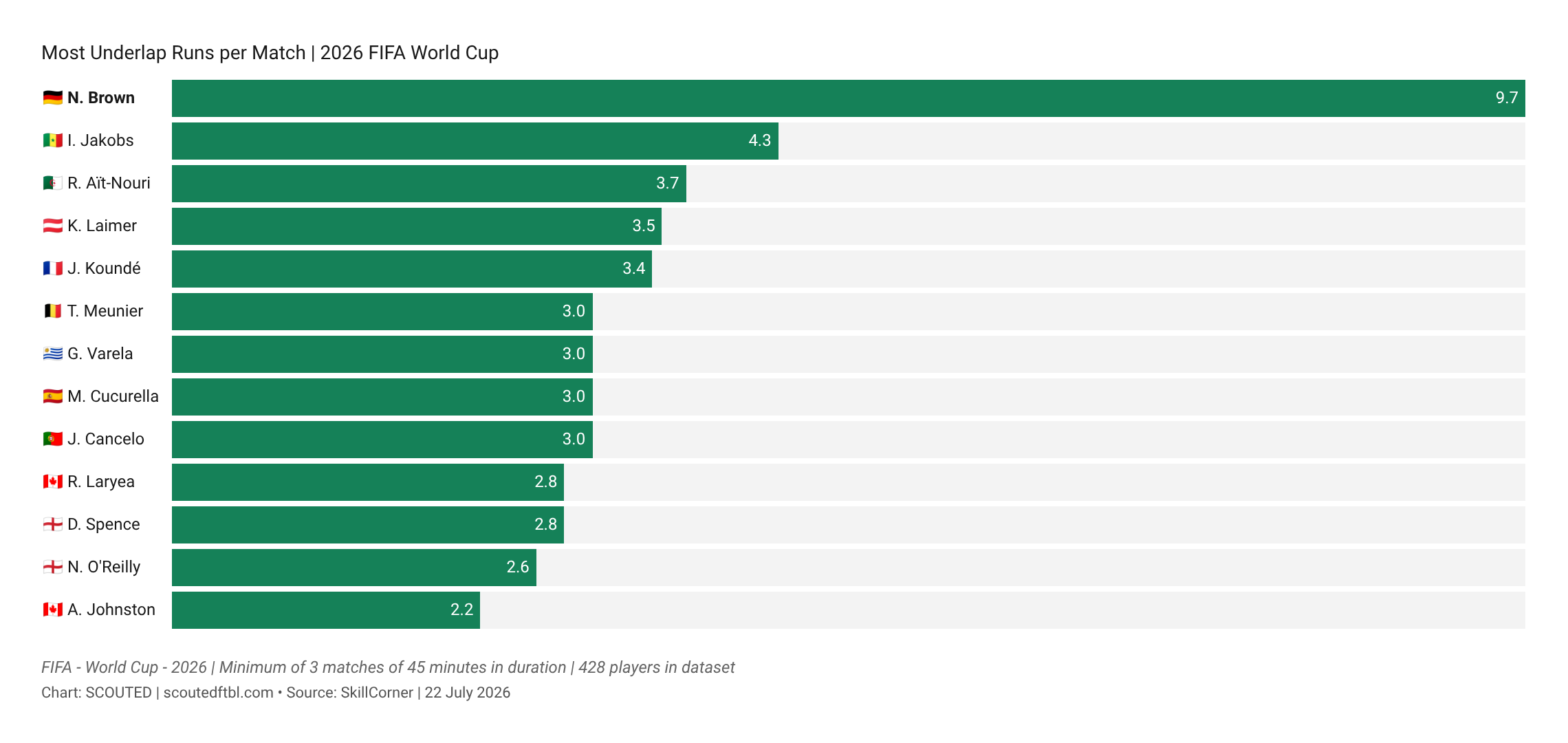
His ability to carry the ball over large distances at high speed is reflected by the fact that no player, across all positions, retained more Long Carries with a Forward Trajectory above HSR per Match (2.33). Brown also ranked third for Give-and-Gos (6.0) and blew every player out of the water for Underlaps, recording more than twice as many as the next player. Even when adjusting to Per 30 Minutes Team in Possession, he averaged at least 2.68 more than Ismail Jakobs (second place in both rankings).
All these skills highlight an ability to accelerate play with and without the ball. The fact they are augmented by Brown’s incredible speed points towards a player likely to flourish in Bayern’s dominant system. Whether that will be as a Roadrunner - indexing more into this Carrying - or by providing high-speed vertical movement as a Flyer will depend on his left-wing partner and perhaps Bayern’s opponent.
🇨🇴 Gustavo Puerta
Multi-phase generalists that do everything, everywhere, all at once were SCOUTED’s predicted hot commodity for the summer and we’ve found a nifty data search that acts as a starting point for their discovery. Across all players and all positions, 15 players ranked in the 75th percentile or above for Off Ball Runs in Build Up, Off Ball Runs in Create, Off Ball Runs in Finish and Off Ball Runs in Transition. Of those 15, only three were born in 2003 or later.
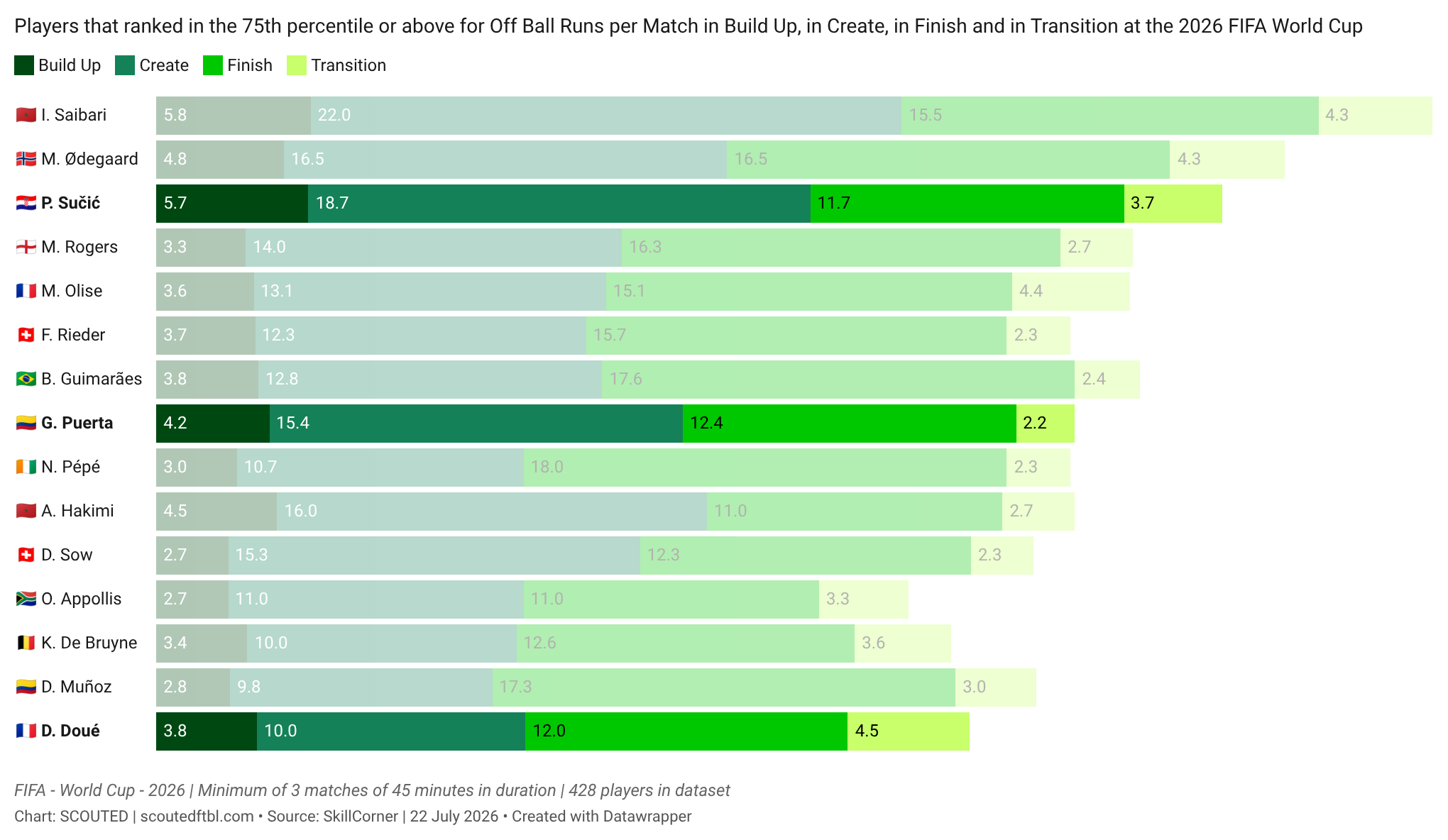
With Doué and Sučić at PSG and Inter respectively, the fascination with Gustavo Puerta becomes two-fold. Firstly, he fits our in-demand do-it-all profile - La Pausa have written a detailed report about this todocampista.
But Puerta is not only an example of how valuable it is to look for ‘good’ across lots of metrics and phases (generalists) as it is searching for ‘excellent’ in specific areas (specialists), he is also an advert for talent that be be discovered in the second tiers of the Big Five Leagues. In that environment, the Colombian’s omnipresence becomes even more extreme. When compared to 128 Midfielders with at least five 60-minute games in LaLiga 2 2025/26, the Racing Santander man ranks in the 94th percentile at least for Possessions in Build Up, in Create and in Finish Per 30 TIP.
As a little tidbit, Elliot Anderson - a now £116 million midfielder of the generalist mould - ranked in the top 5% for all three metrics among Premier League midfielders during the 2025/26 season.
🇨🇮 Christ Oulaï
A Defuser is defined by their ability to flip pressure into positive situations and Christ Oulaï perfectly captured this Archetype at the 2026 World Cup.
💣 Defuser
The Defuser superpower is Possession and Progression under Pressure. They flip pressure into positives from central and half-space zones inside their own half, usually in the Build Up phase. Centre-midfielders and inverting full-backs are the most common Defusers.
Within our player pool, 42 players Escaped Pressure at least once per match. However, Oulaï was not just the only one to turn over more than 50% of his Receptions under Intense Pressure in Constrained Pressure into an escape, his record was flawless.
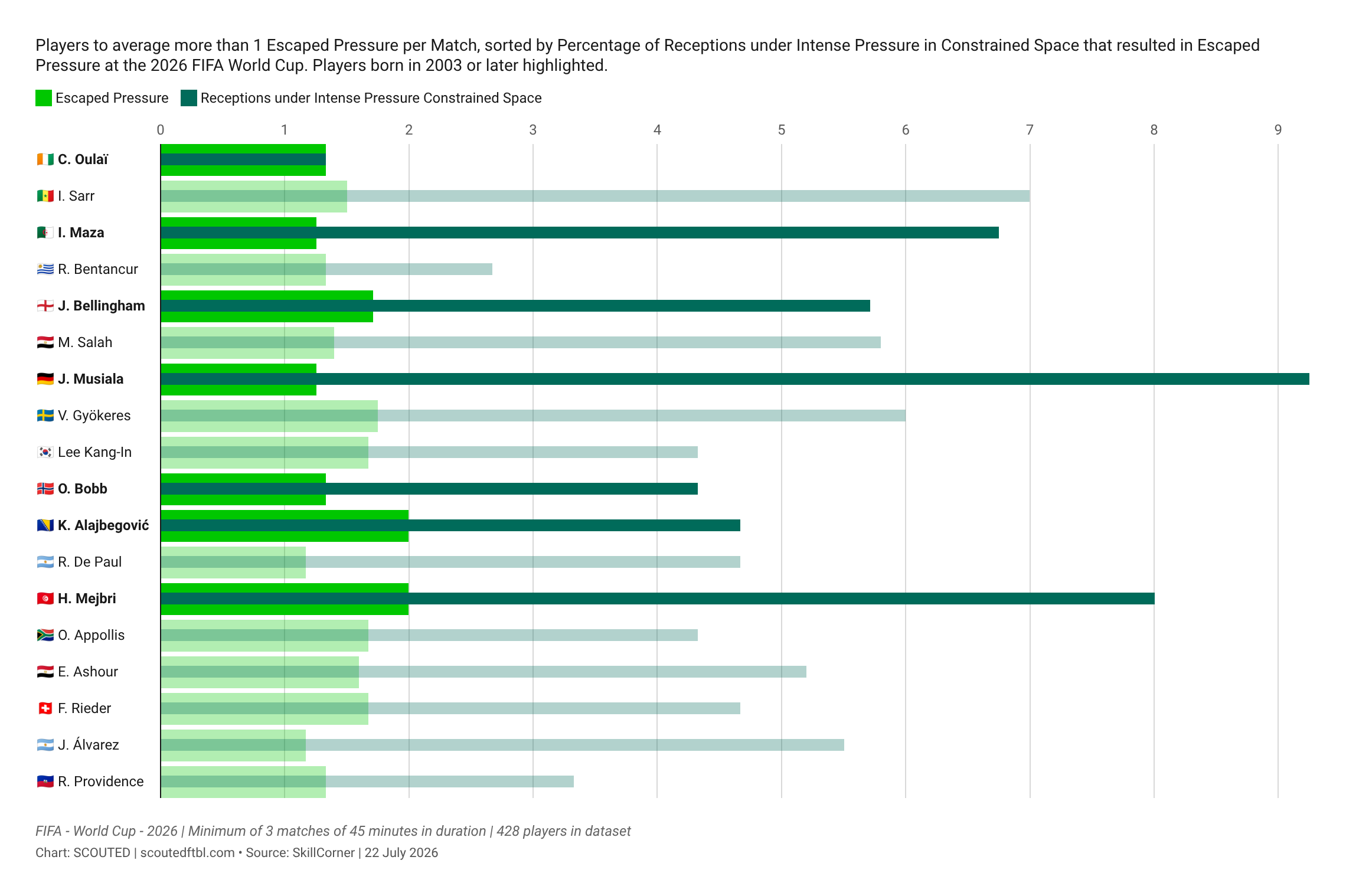
To complete the Defuser picture, Oulaï also ranked first within this group of players for Percentage of Receptions under Intense Pressure that led to a Progressive Action with 42.9%. He is not only able to secure possession under duress, but he flips opposition pressure into an advantage for his team.
Whereas clubs would have once been scrambling for a breakout performer like this after the tournament, Fiorentina have already wrapped up their €30 million deal for his services. As a side note, their €25m signing for Arthur Atta (2003) from Udinese and the €14m pick-up of Brazilian centreback Viery (2005) are also worth tracking very closely.
🇨🇮 Yan Diomandé
Given the apparent collapse of a move to Liverpool and potentially PSG, some might say the future of Yan Diomandé is uncertain. Yes, the club he is playing for might be in question, but the World Cup was yet another reminder that he is ready for the highest level.
Anyone that had not watched the Ivorian before this summer’s tournament immediately understood why a €100 million price tag had been slapped on him. Diomandé’s ability to eliminate opposition players in 1v1 scenarios is just one part of the package he offers. Only Lamine Yamal ranked higher for opposition players Beat by Possession per Match (5.43 vs. 4.75). Only Ali Iyad Ali Al Olwan ranked higher for Long Carries with a Forward Trajectory Above HSR (4.33 vs. 3.75).
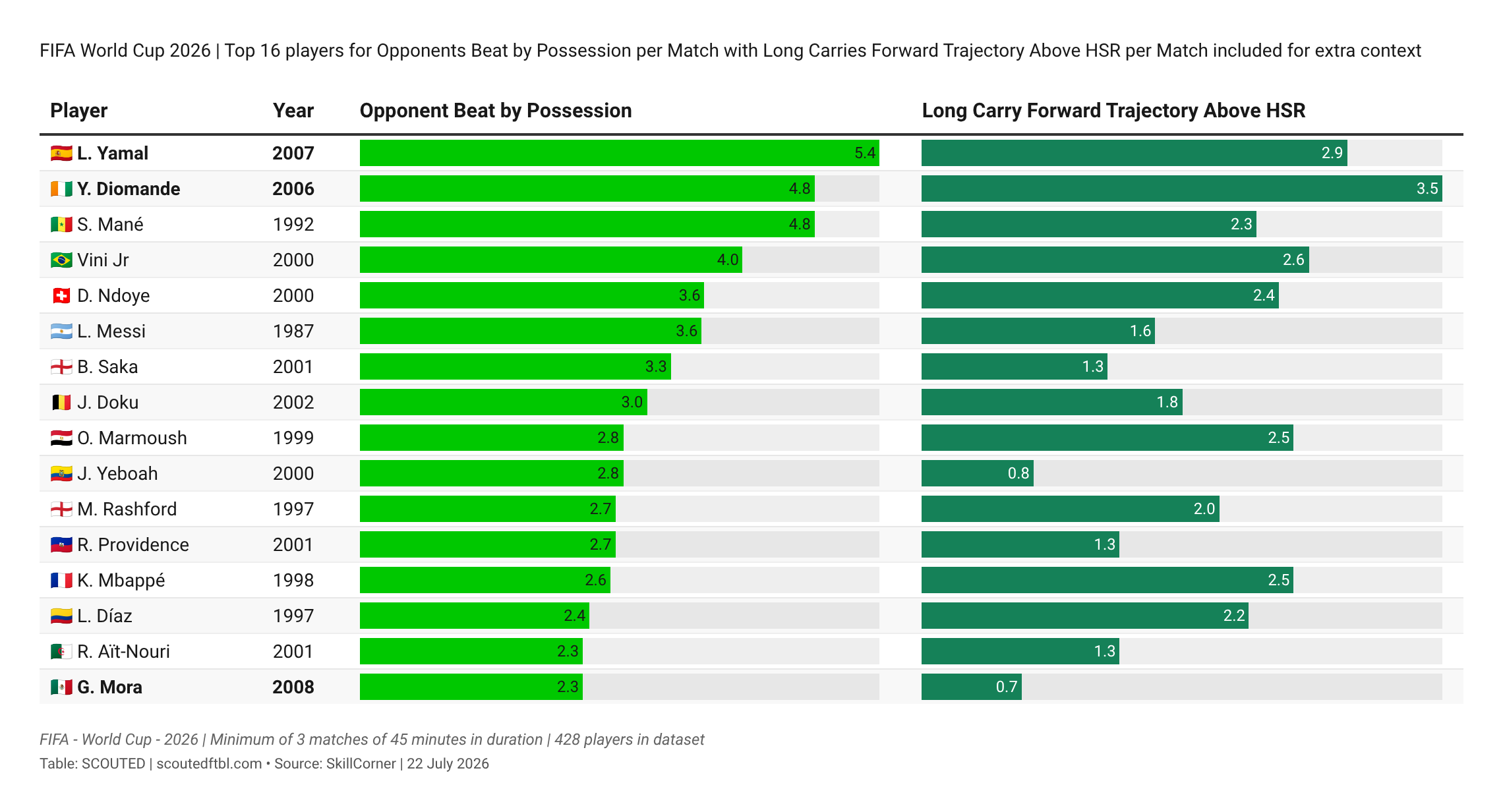
This immediately illustrates that Diomandé is not only able to engineer room to manoeuvre in tight areas, he is also capable of providing high-speed thrust and verticality when in space. But what makes him a premium talent is his passing. As Llew highlighted during the tournament.
One thing that consistently impresses about Yan Diomandé is the detail of his passing. It isn't a trait many expect from a dribble-first winger, but the way he passes inside and slips in runners is almost always of strong standard. One of many high-floor skills he has.
— SCOUTED (@scoutedftbl) June 14, 2026
This is also evident in the data. Diomandé’s Pass to Runs Completion Ratio is greater than his Average xPass. Again, adding in a nod to those passes that lead to a shot highlights his super productivity. 119 players recorded at least one Pass to Run Leading to Shot per Match, so we’ve plotted those.
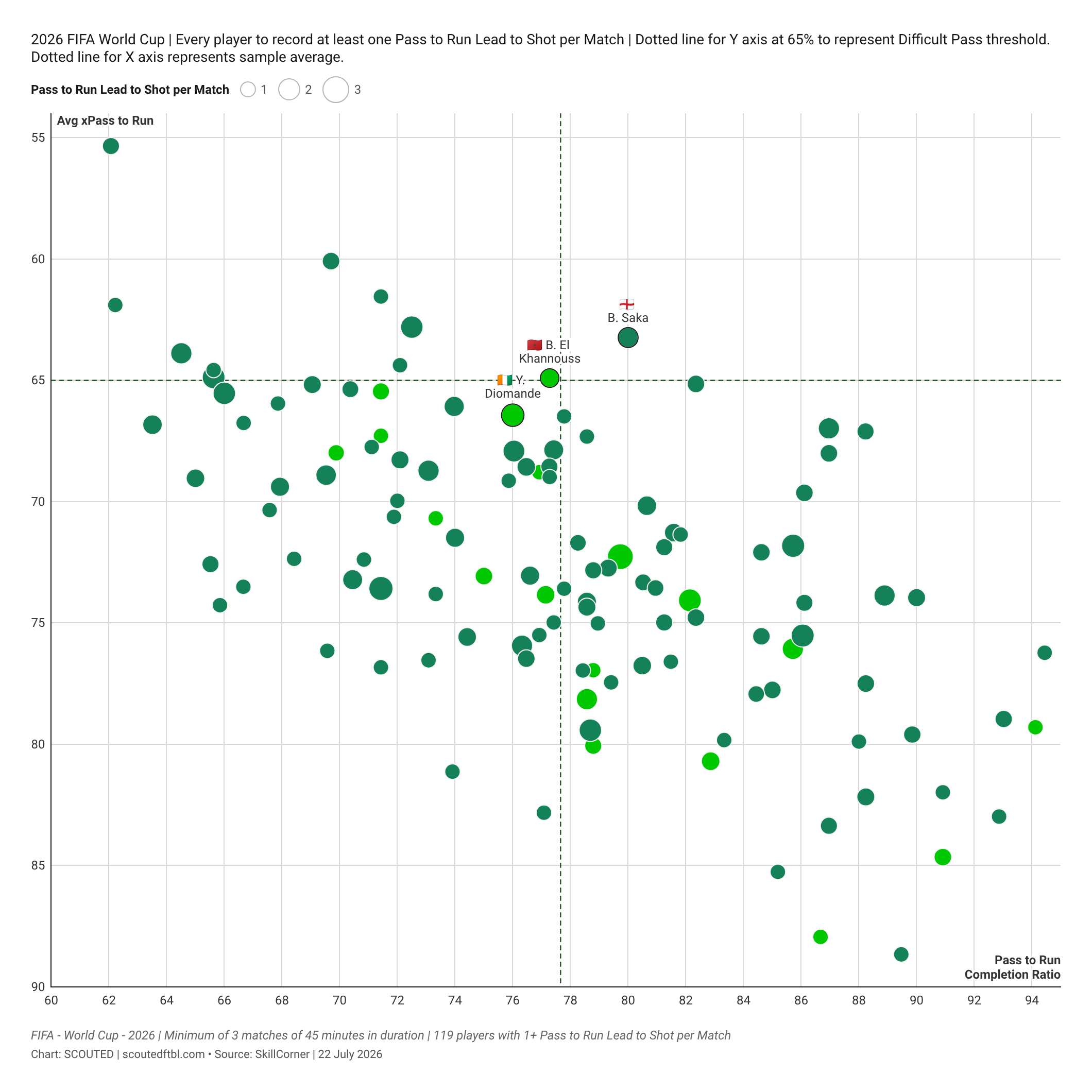
SkillCorner define a Difficult Pass as one that has an expected completion rate of 65% or below. This graph begins the process of discovering players that are completing Difficult Passes beyond the expected rate. Although Diomandé’s Avg xPass is slightly above the Difficult threshold (66.7%), he is completing these passes with 76% accuracy. This is a translation of Llew’s eye-test notes into data. It also captures our next pick.
🇲🇦 Bilal El Khannouss
During the tournament, we were once again left perplexed at the fact VfB Stuttgart were allowed a free run at Bilal El Khannouss last summer, signing him for €22 million. Those watching him at the World Cup will be once again kicking themselves; those at Stuttgart will be very pleased.
El Khannouss demonstrated his ability to act as creator in chief. He was one of 14 players to attempt at least five Dangerous Passes and at least ten Difficult Passes per Match - a certain Lionel Messi also features. Of these players, El Khannouss ranked second for Dangerous Pass Serve Ratio, which measures the ratio of Dangerous Passes completed compared to opportunities to make them.
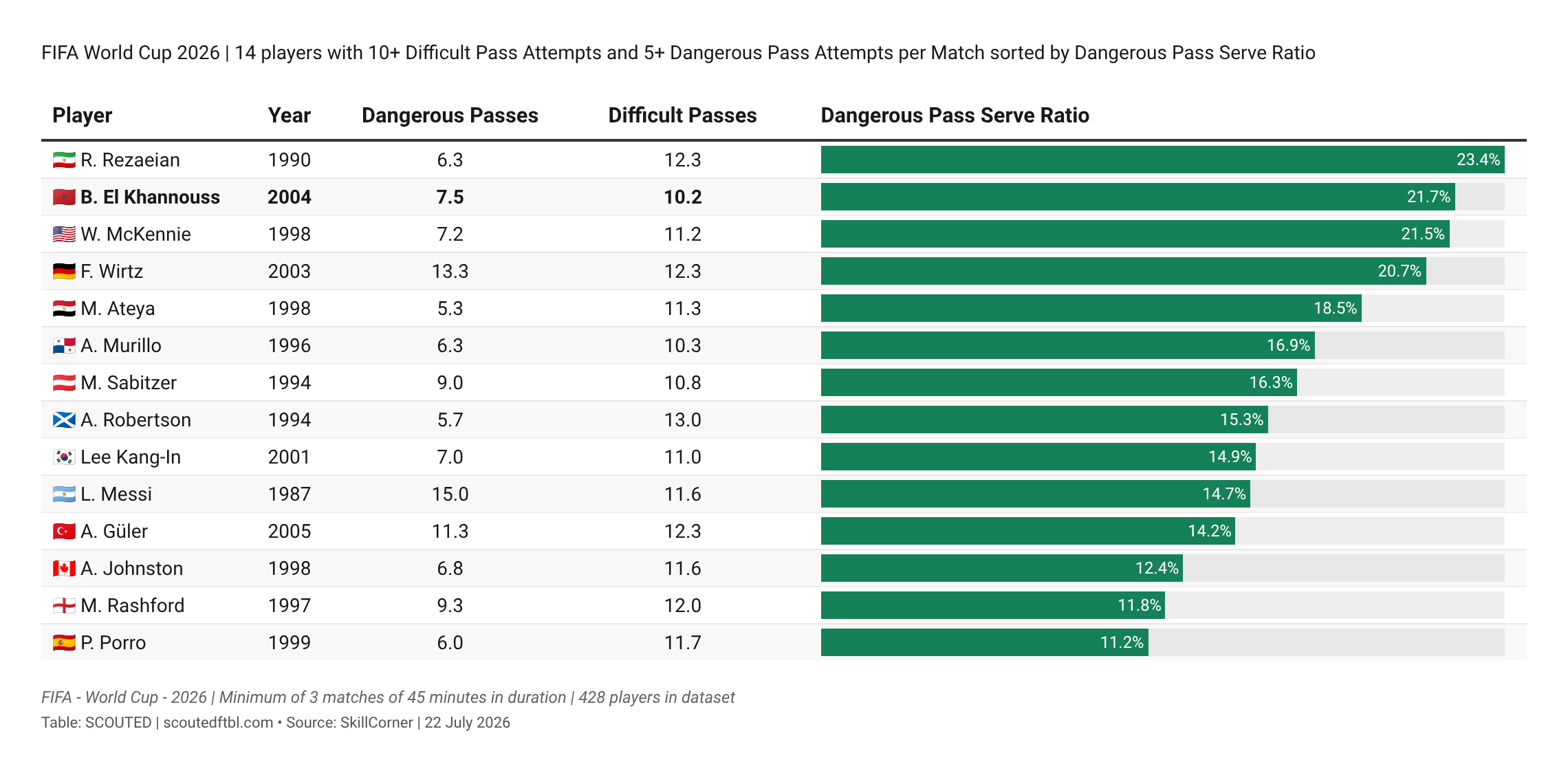
This concoction of metrics are the foundation of the Safecracker Archetype: a player that can consistently spot and find teammates in dangerous positions, no matter how tricky the pass may be. What elevates El Khannouss’ appeal is that he has an elite physical profile to go with it.
🏴 Jude Bellingham
For the attacking midfield pick, I desperately wanted to break my rule. Ibrahim Maza ranked third for Danger Created under Intense Pressure per Match behind Kylian Mbappé and Lionel Messi while also ranking second for Counter Presses per Match. This is across all ages.
Loved this Ibrahim Maza moment to set up a disallowed Algeria goal early on against Argentina. Scanning that informs the decision, turning on his safe side, then taking players out of the game with sleek change of tempo and a deft through ball on the move. High-quality sequence. pic.twitter.com/nxezREpaJl
— SCOUTED (@scoutedftbl) June 17, 2026
The Algerian is a dream player that marries elite technical ability with relentless work rate. Expect a big season in 2026/27 and even bigger bids for his services in the near future. However, as he was included in the pre-tournament article, I’m using this slot as an inter-jude.
Jude Bellingham is a known quantity, but his inclusion serves as an illustration of how you can capture his style with SkillCorner Data, as well as how much of an outlier he is for his age.
Bellingham was the only 2003+ Midfielder to make at least 10 Runs into the Penalty Area in a single match this summer. He did that three times. He was also the only one to make at least 20 Dangerous Runs in a single match. He did that twice. Bellingham also occupied the top three spots within this pool of players for Runs In Behind, Dangerous Runs In Behind and Runs In Behind above HSR.
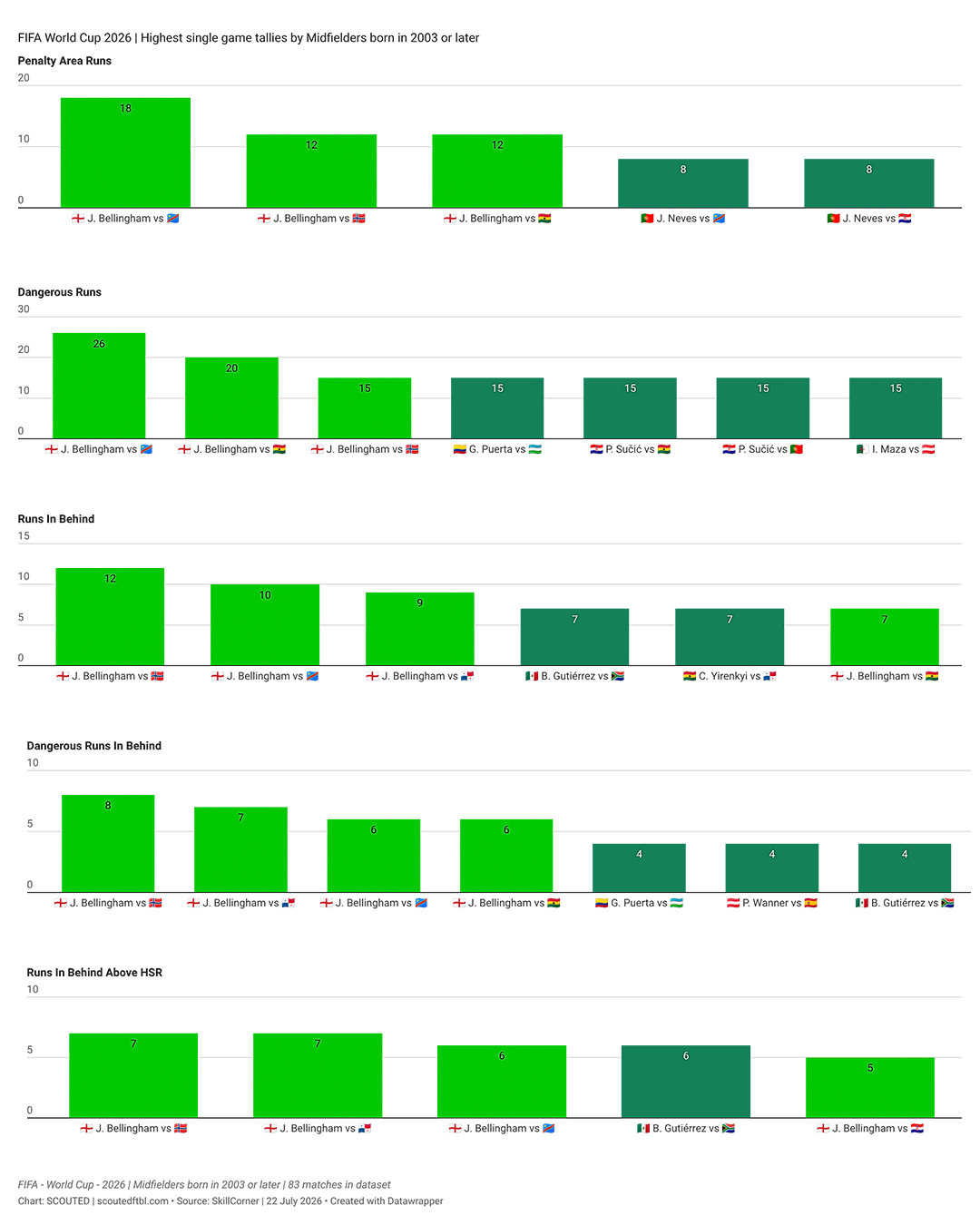
On the way to scoring seven goals, the most-ever by an English player at a single major tournament, Bellingham was relentless with his running into depth. The fact he was able to repeat this across multiple matches is a testament to his athleticism and his appetite to consistently make those runs. These are just two of the many qualities that make him one of the best players in the world at 23 years old. They are worth looking out for when scouting for new prospects.
🇦🇺 Nestory Irankunda
Australia had a host of young players we were eager to watch this summer. 2007-born Lucas Herrington could have easily been included in the centre-back section. We highlighted 2005-born Paul Okon-Engstler in a SkillCorner article earlier this year; he has since secured a move to 1. FC Köln.
 Jake Entwistle
But the most fascinating of all was watching both Mohamed Touré (2004) and Nestory Irankunda (2006) switching in and out for each other up top. However, given the latter’s imminent move to Sporting CP, we’ll take a moment to explain why he’s become so coveted.
Irankunda’s explosive ball-striking has defined his career to date and thrust him into the spotlight last season after he smashed in a couple of sensational free-kicks. But this explosiveness also extends to his running. When specifically looking at centre-forwards, Irankunda (0.99) was one of just two players, alongside Omar Marmoush (0.97) to record a Time to Sprint under one second, while also logging the sixth-fastest time (1.08). The Australian was also one of just three centre-forwards to record four Explosive Accelerations to Sprint TIP in a single match, alongside Kylian Mbappé and Mousa Al Tamari.
A further illustration of this superpower is that Irankunda ranked first among all centre-forwards for the Percentage of Off Ball Runs Above HSR.
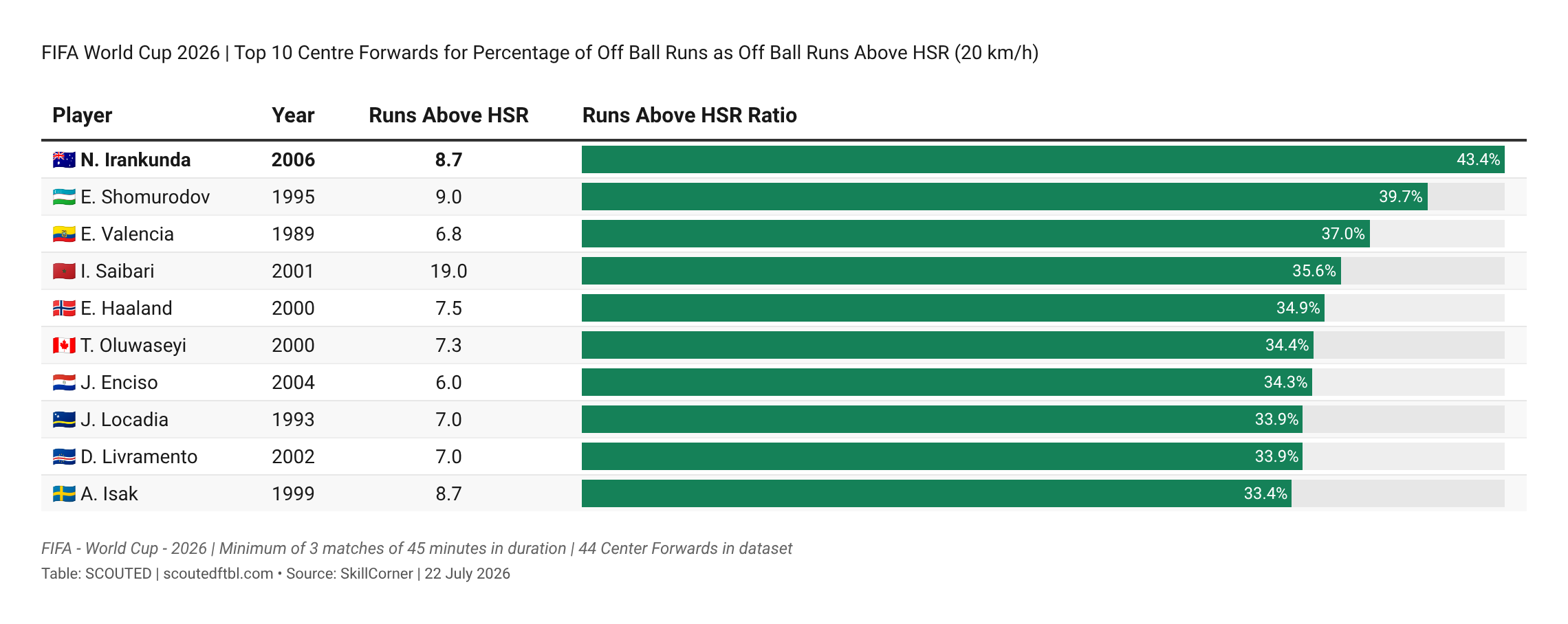
He was also one of 15 centre-forwards to make at least five Runs In Behind and five Cross Receiver Runs, with only Cédric Bakambu spending fewer minutes TIP per match than Irankunda. There is devastating potential here. If Sporting give him the platform to marry his explosive ball-striking with his explosive acceleration, he could become one of the most electrifying forwards in Europe.
This newsletter was produced under a commercial collaboration with SkillCorner, SCOUTED’s official data partners. Their tracking and performance data is used by more than 150 of the world’s biggest clubs, leagues and confederations.




Member discussion