Mapping the future of midfield
This essay was published in Volume II under the title 'Future Midfield'. Grab a copy of the full magazine in print or digital:
By TOM CURREN
On April 29, 2025, a host of Parisian red-and-blue arrived in north London. Luis Enrique’s Paris Saint-Germain were the Champions League favourites; they’d hit stride at the perfect time. At the apex of their fluid attack was Ousmane Dembélé who, since undergoing a surprising evolution into a lone No.9, had emerged as Europe’s primary goalscoring talent. The summer’s Ballon d’Or would adorn him the world’s best player.
PSG’s semi-final opponents seemed their perfect foil. Mikel Arteta’s Arsenal were considered the best out-of-possession side in the world by many analysts, a reputation built on a near-impenetrable centre-back partnership, the relentless engine of Declan Rice, and robust and physical pressing systems. They were experts at locking down talented attackers, and had allowed the triumvirate of Jude Bellingham, Kylian Mbappé and Vinicius Junior just one goal in 180 minutes during the previous round.
Three minutes into the semi-final, Arsenal harass and harry. Martin Ødegaard leads the front two, Rice roams, Mikel Merino hovers beside him. They chase the ball backwards, locking PSG deep into their own half, with nowhere to go but Willian Pacho, the left centre-back. The moment Pacho touches the ball, it’s as if a switch is flipped: Arsenal go. Ødegaard tears forward. The team follow their captain, roaring towards the ball. Rice races up the pitch, Merino screams after the dropping Vitinha, Leandro Trossard and Bukayo Saka sprint towards their opposing full-backs. The ball is pushed to Nuno Mendes at left-back, deep in his own half. He’s cornered. Then, with one left-footed pass, he splits the middle of the pitch, right through a yawning gap in the Arsenal press, to find Dembélé, who has dropped from No.9 into central midfield, and is totally free. Dembélé leads the Parisians up the pitch and scores. Arsenal never recover.
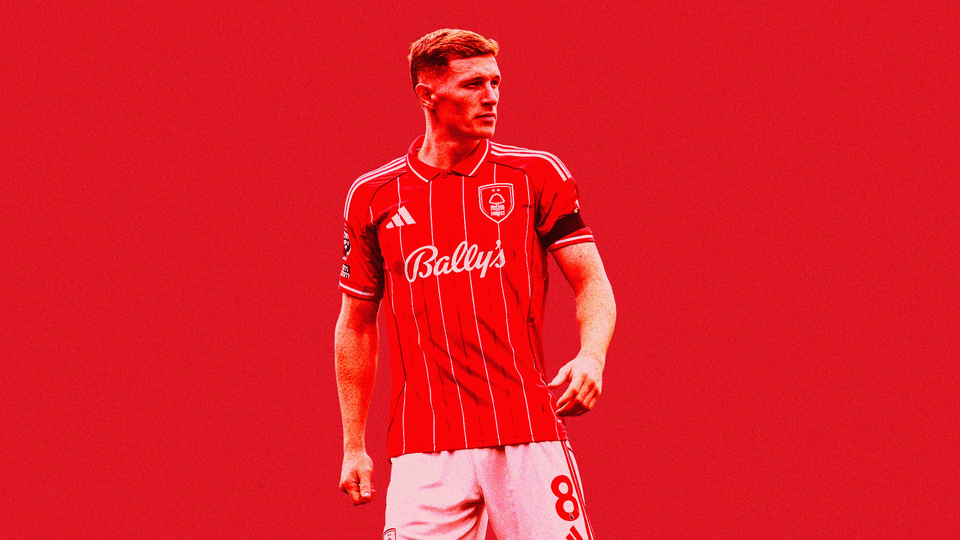
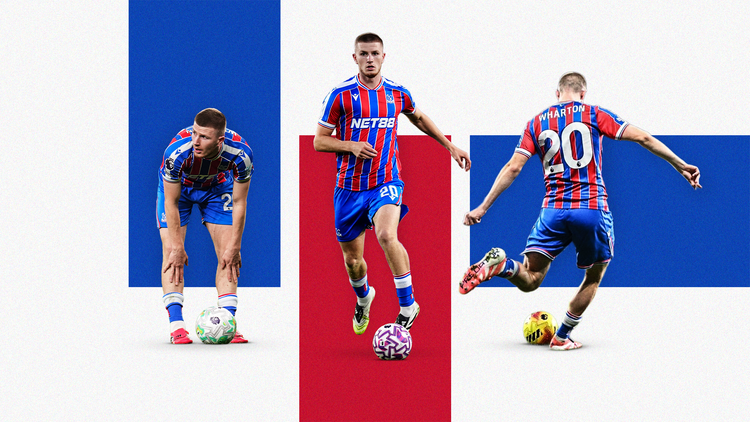
When I sit down with The Athletic’s Jon Mackenzie and SCOUTED’s Jake Entwistle to discuss the future of midfield, this game is where we start. That moment - when Arsenal’s press fails to contain one simple, elegant pass that effectively ends their Champions League hopes - is illustrative, Mackenzie tells me, of a much wider tactical context. I’ve brought these two analysts together because I want to explore the mysteries of the midfield, and chart a course for where it might go next. Over the past few years football tactics have evolved perhaps faster than ever, supercharged by the era of data analysis and relentless, high-stakes competition. The players have changed with their environment. Rodri is the defining midfielder of this era, but just years ago John Stones dictated a Champions League final next to him. Physical monsters like Declan Rice are en vogue, but there’s still a pedestal for technicians like Pedri and Vitinha. Full-backs are midfielders now, and vice-versa: some have inverted into the pivot, as Oleksandr Zinchenko did to define Arsenal’s 2022/2023 campaign; many now push further forward as No.8s, as Nico O’Reilly does today. Matheus Nunes, signed supposedly as a ball-carrying No.8, is now Manchester City’s first-choice right-back; low-touch, high-impact passers like Adam Wharton are coveted. Elliott Anderson is almost priceless because he can simply do everything. Is Cole Palmer a midfielder? What about Morgan Rogers? Bernardo Silva was a No.10, but now starts as a No.6. Nick Woltemade is a 6’6” left-winger, No.9, and now apparently a midfielder. Joelinton, Jack Hinshelwood, Joshua Kimmich, Rico Lewis, Ryan Gravenberch, Konrad Laimer - what’s going on?
All of these players occupy a loosely-defined area of the pitch - the middle - to do wildly different things, for wildly different reasons. This journal is packed with our favourite top-level midfield talents, but to understand what future-proofs a midfielder, we need to map how the tactical tides of the midfield have turned, and are turning. What follows on these pages is an acroamatic, academic discussion that twists and turns over itself as we attempt to untangle an ever-changing question; in many ways, it’s about the questions more than the answers. Many will find that frustrating, but I think the eternal chase for understanding is what makes football a continually gorgeous pursuit. Part of being a good football analyst is resisting the temptation to be definitive or prescriptive about the future, and that is particularly prescient when it comes to questions of the midfield. After I finished writing this essay, I asked Entwistle to look over it, frustrated I hadn’t found a satisfying conclusion. “Phase-based recruitment is prominent and midfielders are multi-phasers,” he said. “So it’s still a huge problem to solve. The goal is just to introduce others to the questions we’re asking.” You might consider this our attempt at that introduction.
935/1200
Download and keep the entire magazine for the price of a latte. Read Adam's exclusive interview. Enjoy priority access to our limited print store. Help keep our independent dream alive as we push to 1200 subscribers.
Subscribe and download the magWhen Jake Entwistle was researching his latest SCOUTED Archetype, The Berserker, he leaned heavily on Jon Mackenzie’s writings on the hybrid press. For the uninitiated, ‘hybrid pressing’ refers to a dual system that combines both ‘zonal’ - a tight, structural arranging of players to each cut off a specific zone of the pitch - and ‘man-to-man’ - having each player individually press a specific opponent - pressing systems. Mikel Arteta employed hybrid pressing in the above example against PSG. Arsenal were arranged zonally in their typical 4-4-2 as their opponents circulated possession; unable to find a way through, PSG went home to Willian Pacho, a ‘trigger’ - meaning Arsenal had been instructed to rapidly switch states when he gained possession. Even before the ball arrives at Pacho, Arsenal jump into their famed man-to-man press like a heat-seeking missile, aiming to aggressively win the ball in a horrifying area, or at least force a hapless punt up-field. They failed at both.
Key to Mackenzie’s theory on the hybrid model is a concept he calls ‘the space between.’ When a hybrid system moves from zonal to man-to-man (we’ll use ‘man-to-man’ here, though it should be noted Mackenzie and others often prefer ‘player-to-player’ or ‘player-oriented’ - ed) both midfielders jump aggressively onto their respective opponents. This leaves a large gap between them and their centre-backs: the ‘space between.’ Entwistle was interested in this gap because it was key to The Berserker profile: a player, like Morgan Rogers, who exploits the transitional nature of hybrid pressing structures by carrying the ball through them. In that early jump against PSG, Arsenal discovered the best forward on the planet had drifted into the space between, and pain unsurprisingly followed.
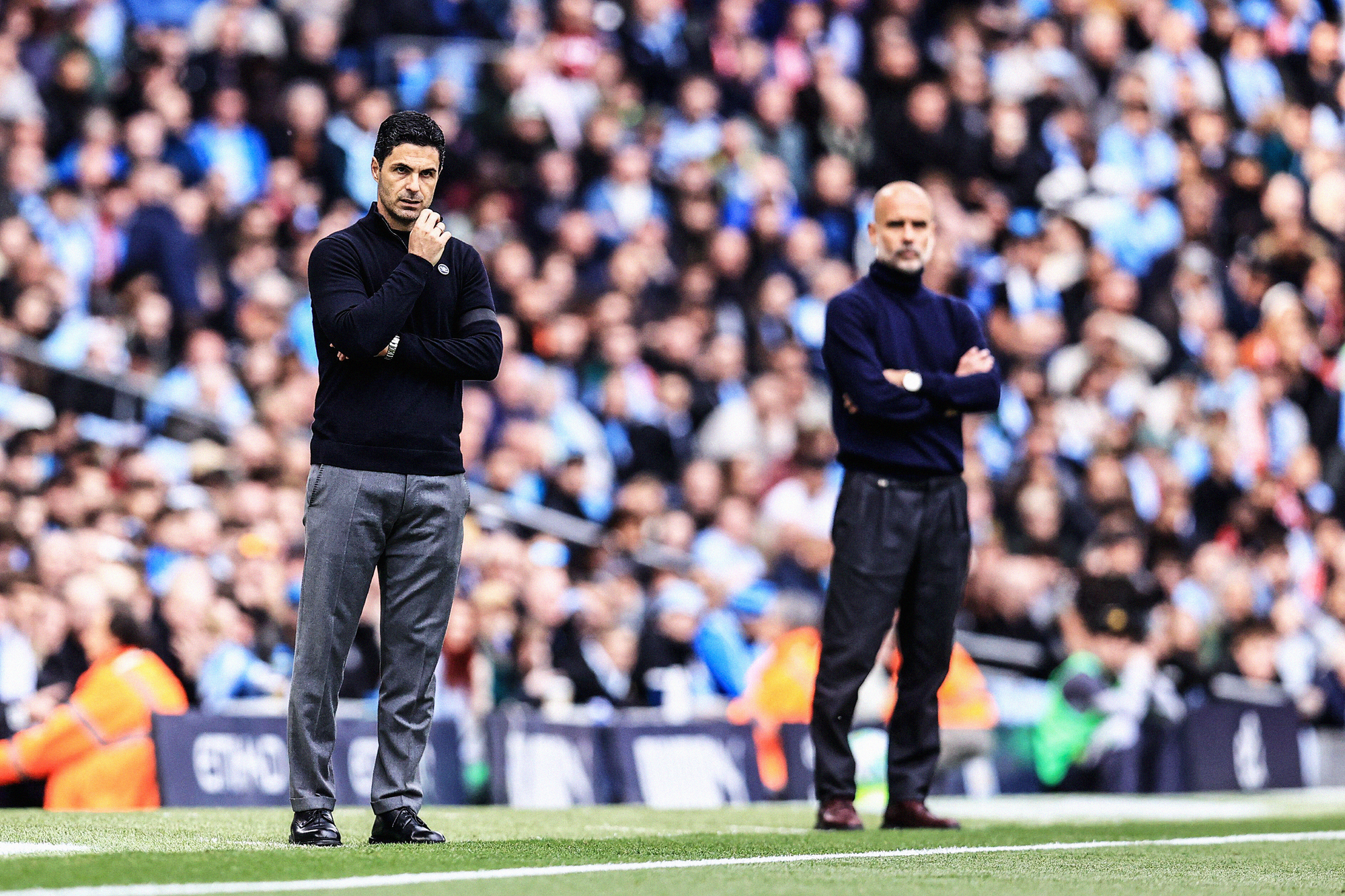
The three of us first speak on the evening after Arsenal’s 2-0 Carabao Cup defeat to Manchester City. That rivalry has long been used by Mackenzie as a case-study for systemic evolution, not just because it represents the pinnacle of tactical football but because Arteta and Pep Guardiola have been suspended in a kind of storied dialectical relationship: so much of Arsenal’s recent development can be read as specific reactions to problems Guardiola has caused them, and vice versa. In the game we’ve just watched, City found an alarmingly simple means of stopping Arsenal progressing the ball: they simply stood in a four-strong line that zonally blocked all routes out. Without Martin Ødegaard, Riccardo Calafiori, Myles Lewis-Skelly, or any kind of line-breaking, angle-finding progressive player, Arsenal lacked any way of connecting deep possession with their forwards, and most sequences ended with Kepa Arrizabalaga helplessly going long. Arsenal rely heavily on exploiting their opponent’s press to engineer space in midfield, so City simply didn’t press at all. After the game, Nico O’Reilly revealed Guardiola had tasked his players with routinely finding Rayan Cherki in the space behind Declan Rice, who is famed for his aggressive jumps from midfield.
This case-study is illustrative of the development Mackenzie is seeing in pressing structures at the top level: an era he’s calling ‘back down, double down.’ When hybrid pressing was new and fancy, it worked consistently as teams struggled to come to terms with what their opponents were doing. But it contains a flaw. Because it is so patterned and designed around triggers, hybrid pressing is readable; it’s very possible to predict, and therefore manipulate, the moment an opponent will jump. And because the space between opens once the jump begins, it’s inherently exploitable, too. Some teams are reacting to this development by, like Manchester City in the Carabao Cup final, backing down. If the potential upside of winning the ball from a jump is not outweighed by the danger of opening the space between, staying zonal is preferred. At the time of writing, Arsenal have just lost at home to Bournemouth, and their title hopes are hanging by a thread: it’s hard not to read their late-season struggles as anything but a result of teams simply figuring out their structural ideas, and that solution spreading like a virus. Arsenal have been left without the player options, or time, to offer anything else. And while many in the Premier League are backing down, other continental sides are going hell-for-leather. Mackenzie cites Bayern Munich and PSG as examples of teams who have doubled down on the hyper-aggressive man-to-man press: two sides who have such vast talent disparities with their opponents that attempting to manufacture 1v1 duels all over the pitch is consistently valuable. When your players are simply better than their opposite numbers, trusting their talent to prevail makes perfect sense.
Of course, this discussion is a two-sided coin. Everything teams do without the ball is an answer to the fashionable build-up systems of the moment, which are itself influenced by the out-of-possession trends. This push-and-pull, emergent synthesis of opposing forces is what makes football such a fascinating puzzle to solve, and why it continues to surprise and delight (and perhaps, bore) us in novel ways every season (and why it’s no surprise Mackenzie’s background is in Hegelian academics, but let’s leave the philosophy for another day). We’ve just exited a period of Guardiola-led dominance in which controlled possession was the favoured build-up style of the best sides. With opponents arranged zonally, neatly progressing through the thirds allowed dominant sides the means to pin teams back, squeeze them, and probe for gaps. Naturally, this led to the rise of the metronomic, pace-setting midfielders, as well as those who could unpick the tightest locks. Nobody needs reminding of Xavi Hernández and Sergio Busquets, Andres Iniesta and David Silva, but this era was not contained to Guardiola: Toni Kroos was one of the world’s dominant midfield forces; Jorginho finished third in the 2021 Ballon d’Or. As hybrid pressing became near-ubiquitous, the question changed. Now the goal was to bait aggressive man-to-man jumps, survive them, and move quickly into the space that appeared. Suddenly, physicality was back on the menu: Kevin De Bruyne was inarguably the best midfielder in the world. Tight-space technicality became as valuable to marshalling No.6s as it was to tricky No.10s. Of course, none of this represents a set of rigid rules; a player as good as De Bruyne would’ve flourished in any tactical era, and Kroos and Jorginho both excelled in their twilight years. But each changing of the tides alters the kind of profiles favoured at the top level very slightly and, crucially, where on the pitch they’re deployed. Football changes, and carries the players with it.

About halfway through our conversation, Mackenzie says something that changes the rest of the discussion. “We’re not really thinking about footballers having profiles or skillsets anymore,” he says. “We’re thinking about footballers having skillsets within phases.” In the world of complex pressing systems, where both zonal and man-to-man setups are common and the picture might change at any time, players can no longer be considered keys to unlock a specific door. Player profiling needs to become more granular to match what the best coaches are doing. In ages past, a player like Bernardo Silva might’ve been exclusively considered a No.10 because his small-space technicality was most useful in cracking open a deep block. But now, such technicality is crucial in beating the first line of the press, which explains why Guardiola has spent this season using him next to Rodri, deep in midfield. But ‘beating the press’ itself is only one phase in the chain possession sequences unfold into. After solving the first line, space appears: now there’s a pocket to access and movement becomes the most valuable skill, as well as the ability to make a neat touch or punchy turn. Solve that and teams are faced with open field, and runners come to the fore: suddenly the skillset required is carrying, an ability to move very quickly, threaten depth before defensive lines can stabilise, and drive into space. Each phase in this possession chain offers different demands, and the task for coaches is to match a player’s role in each phase with their best skills.
This is a complex topic to translate to prose, so let’s use an example. When building the Berserker Archetype, Entwistle argued Morgan Rogers works so well in Aston Villa’s setup because Unai Emery had designed it to maximise his abilities. Villa bait the press before playing over or through it, ensuring Rogers can cause maximum damage with his ability to receive under pressure, shrug it off, and then drive through space. Rogers turns the second stage of possession into the third, and so Villa attempt to engineer that opportunity for him as often as possible. At City, Guardiola has often used Jeremy Doku - one of the world’s best dribblers - in the inside half-space, in a kind of approximation of Rogers’ role, before slotting in Rayan Cherki as the Frenchman found his feet. Guardiola wants his best carriers to be wherever his team is trying to engineer space later in the possessive chain. Breaking possessive sequences down this way helps us to understand why midfields are organised as they are.
It does, however, cause significant complications in player profiling. When Entwistle and I profiled Riccardo Calafiori earlier this year, we noticed a problem. In the first 25 minutes of a game we watched against West Ham, we spotted Calafiori performing as a Platformer Archetype. Two minutes later, he’d performed a skillset we most associate with a Defuser; minutes after that, he was acting as a Developer. In less than half an hour, Calafiori had embodied three separate Archetypes, dependant entirely on which phase of possession he was acting in. This is a problem Entwistle has been grappling with since he first introduced SCOUTED’s Archetypes to the world a year ago. They were initially conceived as position-specific boxes to help recruitment teams understand how the profiles emerging from tracking and event data would fit in team context on the pitch. Football players, however, are often too fluid to be neatly quantified (long-time readers will fondly remember we once included Bukayo Saka as a left-back in an early Handbook). The Imposter was a full-back Archetype inspired by Myles Lewis-Skelly, built to capture full-backs who invert into midfield to progress and control progression. But what, substantially, is an Imposter doing in-possession, and is that really different from particular midfield Archetypes? ‘Inverting’ by itself is not a skillset, and is not particularly descriptive of what a player can do with or without the ball. One might argue the only difference between Lewis-Skelly and a player starting at No.6 or No.8 is where they’re positioned without the ball.

One means Entwistle is experimenting with to improve the accuracy of Archetypes is to split them into phase-specific profiles. With the ball, Myles Lewis-Skelly is Arsenal’s only real Defuser, able to receive the ball under duress in the build-up phase and flip it into a positive action; without the ball, he retreats to left-back, because the same skills that see him swat away pressing opponents make him a decent shutdown defender when he can get tight (Arsenal watchers will admit he’s had trouble defending in space this year). This is an example where two Archetypes would probably be appropriate: one for in-possession, and one for out-of-possession. By designing a means to capture each skillset, Archetypes might become more readily useful to hyper-specific tacticians and squad builders. Mackenzie raises the point that formations, as we classically understand them, are now largely only instructive to out-of-possession shapes - but even that’s imperfect. Arsenal, for example, defend in a very obvious 4-4-2, but are only ever put to paper as a 4-2-3-1: because most understand Martin Ødegaard, who usually leads the press, as a player who pulls deep in possession as a No.8 or No.10. The way we talk and write about and understand football is an amalgam of historical, outdated and anachronistic concepts that have congealed into a static shape so we can still grasp them, when the modern game resists quantification near-entirely. You’d need about eight tactics boards to describe a Manchester City or Bayern Munich line-up with any accuracy.
“When you’re trying to profile players,” Mackenzie says, “everything eventually escapes you. You feel like you’re getting somewhere, that you finally understand this, then you realise: maybe my profile is reductive. Maybe there’s another way to think about this. Or maybe the profile I’ve designed is starting to influence my thinking, rather than reflect reality. So much of football analysis right now is about people trying to force their ideas onto other people, or onto the game itself. So much of the tactical space on social media is about people trying to defend their own buzzwords, their own views on how the game should be conceived.”
Entwistle agrees. “I’m the kind of person who likes saying ‘I told you so,” he says. “But I also hate being that person. I’m constantly in a battle of not pushing my profiles as correct - because I can’t make like, 400 to cover everything on the pitch. Profiles are useful because you need to something to communicate what you’re seeing, but then they’re inherently reductive. It’s a battle.”
“I’ve been trying, recently, to be a little more passive,” says Mackenzie. “To not force the game to fit the shape I think it should. To let the game speak to me a little more.”
In this blur of complex ideas, semantics and changing structures, we have a central question to answer: what does the midfielder of the future look like? I start by asking a silly question to the brain trust: if Riccardo Calafiori and Declan Rice broke through from the same academy today, which one would develop into a midfielder? Which would be the full-back?
Mackenzie responds by pointing out Calafiori is a full-back who inverts into midfield, while Declan Rice might be considered the reverse. With the ball, Rice often fills into the space Calafiori vacates, so his immense passing range has the space to come to the fore. But without the ball you want Rice in the centre of the pitch, because his ground-eating athleticism is essentially a cheat code: different skillsets for different phases. If we accept this phase-specific profiling as core to the future of understanding football, what exactly is a midfielder anymore? Is it just a player who stands in the middle of the pitch when his team doesn’t have the ball?
Arguably, yes. Out-of-possession, as discussed above, is perhaps the way we now understand positions. This is again a questions of semantics as much as it is tactical, perhaps more. If Arsenal dominate possession, and Oleksandr Zinchenko spends 60% of the game moving the ball through midfield, is he not a midfielder? No, we say, because the Sky Sports graphic says not. But for our purposes, perhaps a better definition of midfielder might be offered. Central to Entwistle’s Archetypes are Superpowers, namely the core tenet of a player’s skillset they do better than anyone else on the pitch. I wonder if we might use Superpowers to find a more accurate definition: if a player’s Superpower is most effective in the area we loosely define as the midfield, would that not best constitute a midfielder? Entwistle has introduced the idea of Area of Effect to quantify this, meaning the area of the pitch a Superpower does its most damage, but even this further granularity struggles to keep up with football’s morphing shape. The real problem is that the midfield is impossible to define: it moves. “The goals stay in the same place, the box is always the box and it is always dangerous,” Entwistle says. “But if there is a five-man press then the midfield zone between the boxes becomes larger. If there is a low block, the midfield or literally ‘middle zone’ becomes smaller and at the opposite end of the pitch.” And then there are teams, Jon says, like Crystal Palace and Leeds, who employ hybrid pressing, but only when the ball enters their half of the pitch.

We will tie ourselves in endless knots chasing neat definitions in a game that inherently resists them. For now it is enough to accept we instinctively understand what a midfielder is and what kinds of players that understanding includes, and make our peace with its imperfections. What kind of player that definition might stretch to is undeniably changing, and I want to know how far it might go before it breaks, and which will be most valuable in the coming years. Both analysts grimace as I use the word ‘predictions’, then begrudgingly comply.
When I ask which midfielders will be most coveted this summer, both Mackenzie and Entwistle agree: generalists. Elliot Anderson, in particular, is mentioned a lot. “Because the exact environment of midfield is still undecided and ever-changing depending on your opponent,” Entwistle explains. “Unless you’ve got a massive squad, and can say: ‘I’m going to buy a specialist for small-space midfield battles and I’m going to buy a large-space one, and I’ll just use whichever depending on the game.’” Entwistle is gesturing at an idea we’ve not explained yet: that of profiling players based on the spaces in which they best operate in. To over-simplify, ‘small space’ players are those with the technicality to escape pressure, while ‘large space’ players operate best in the third possessive phase, when running and carrying is key. Anderson is of the rare profile that can do both. He is a box-to-box menace in the Premier League, out-running opponents and tearing across the pitch, dominating both boxes. But for England he is considered Declan Rice’s ideal partner because he can fill Rice’s small-space deficiencies in-possession, twisting away from pressure to keep the ball as a metronome and progress through lines - turning possessive sequences into space, where England’s propensity of runners can dominate.
Small vs large space is also a useful way of labelling physicality. “Midfielders in particular seem to get pigeonholed as either physical or technical,” Mackenzie explains. “PSG, for example, are often described as a non-physical midfield, which I find funny, because João Neves is one of the most physical players ever, right?” He’s pointing at the fact Neves is 174cm and diminutive, but an imperious ball-winner; when Llew Davies first started talking about Neves for SCOUTED it was his surprising leap to win high balls that first drew his eye, not his technical proficiency. Physicality is not as simple a concept as it might appear. Mikkel Damsgaard is raised as another example: Damsgaard is a slight figure and technically excellent, which often overshadows the fact he runs endlessly. He has large-space physicality to an extent, but uses his technicality to affect small spaces. Mackenzie offers a player like Tanguy Ndombelé as a small-space physical player, who shrugs off challenges to keep possession. Declan Rice is large-space physical but less effective in the small; Bernardo Silva is the opposite.

The other profile both agree will be coveted this summer are of the large-space variety, but perhaps not for the right reasons. Large-space physicality - running a lot, running fast - has grown in value if only because it’s easy to spot in the data, and because ‘being physical’ has become shorthand for ‘being good’. But nuance is easy to lose. Tottenham Hotspur, Mackenzie argues, are struggling in part because they’ve committed this very sin, buying mounds of physical players without paying enough attention to what that actually means. At the time of writing, there’s lots of discussion online about Spurs assembling a squad of powerful midfield runners while forgetting to buy anyone who can actually pass the ball to them. Physicality is en vogue, but the term does not mean one thing. “The lazy route,” Mackenzie says, “is buying lots of big midfielders and thinking you’re being smart.” The more interesting question: who will twist while everyone else sticks? If a propensity of extremely physical midfielders floods the top level, who will find the answer to beating them? “I’m more interested in where we’re going to see attempts to move the meta on,” Mackenzie says. “Who’s going to sign Adam Wharton, for example?”
I began this chapter by asking about development. Entwistle describes to me an anecdote he remembers about a youngster he followed through the Moroccan U-20 setup when he was writing Tiwizi Dreams. Naïm Byar was a French-born product of the Moroccan diaspora who played for Les Bleuets in the triumphant 2022 U-17 EURO campaign alongside Warren Zaïre-Emery and Desiré Doué - as a right-winger. He switched his allegiance to Morocco, for whom he appeared at the U-20 World Cup, and won that too. This time, he was playing as a deep-lying No.6. “For Morocco's world champions,” Entwistle wrote, “Byar operated on the right of the midfield pivot and displayed the hallmarks of a veteran screening midfielder. He demonstrated remarkable athleticism to cover space behind the full-backs when needed, shuttling across the pitch to make challenges. But his education as a winger was evident in his ability to resist and absorb pressure.” In our discussion, Entwistle fills in some gaps. “Because he was a winger, he understood how to receive with someone pressing him and could escape those players,” he says. “But his physical development meant he was never gonna be explosive or quick enough to create the same separation in space the likes of Doué or Bradley Barcola. He didn’t have the effortless speed to get in behind and he never would.
“So it’s like, how do we transport the skillset that was developed as a winger, but wasn’t augmented by his biomechanical development? Someone needed to notice, all right, so everyone says he’s winger, but he’s never been that good. Well, what did he learn as a winger that we can transport to another part of the pitch that minimises the things we’re lacking, but then platforms his good stuff? [At the World Cup] he was very good at covering ground, he was still quick for a midfielder. He did a lot of the lateral shuttering and he had a more vertical partner that went beyond to create space for others. But he was good because of those one-v-one abilities he learned as a winger; he could receive under pressure, but then he was also good in the other side of the duel as well and understood how to contest.”
“Football development is nonlinear, but it also is linear,” says Mackenzie. “What you did in the past matters for what you’re going to do in the future. You came to a fork in the road and you had to pick which way you went, and that will influence forever what kind of player you are and what you are able to do.” Declan Rice is Declan Rice, Mackenzie argues, partly because he grew up at West Ham United; we will never know what kind of player he’d have become at Manchester City’s academy, where midfielders are often required to be more small-space technical. And perhaps Riccardo Calafiori is not a midfielder simply because he was raised in Italy, where players of his size and side-bias automatically become wing-backs. "Some players have incredible levels of plasticity and can develop in different ways. But I think for the most part, once you hit 21, most players in terms of their technical and physical profiles and their biomechanic profiles aren’t going to change much. We have made players be certain positions and then we’re saying, what is a position? Well, who knows?”
The simple answer to ‘what does the midfielder of the future look like’ is: we don’t know. We can’t know. Even the term itself is an ethereal thing that changes in definition every year. In a reactive game, the challenge is not to be definitive in your predictions but to arm yourself with enough information to make intelligent responses to what your opponent is doing. In player development and scouting, our opponent is time itself: how do we ensure the right player arrives in exactly the right tactical context to bloom? Perhaps the answer, if there is one, is pretty simple: we must champion players to be the best versions of their best selves, and hope. We must understand Superpowers, small space and large space, the different shades of physicality, and appreciate each and every shape of footballer as they emerge. In many ways footballers and their profiles are just tools in an ever-evolving toolbox. We have limited control over their context; all we can do is get better at matching each to the problem they solve.

“I often think about this thought experiment,” Mackenzie says. “If you found someone who understands other sports, but not football - like an American sports analyst, for example - and explained the rules to them, and sat them down with a collection of players with attached traits: perhaps a physical trait, technical trait, intelligence trait. And you told them okay, this is an invasion sport, we’re trying to break down the other team, and you gave them a tactics board that’s empty on their side but has an opponent: where would they place their players? What would happen if we just started the game again, right now?”
Days before this story is due, Manchester City and Arsenal play again. Arsenal have learned the lessons of the Carabao Cup defeat: with Martin Ødegaard and Eberechi Eze fit to start, they progress the ball more effectively, and create a handful of good chances. At half-time, with the game poised at 1-1, Mikel Arteta brings Gabriel Martinelli on in an unfamiliar right-wing role. After a sputtering Arsenal attack, Gianluigi Donnarumma picks up the ball. There is an acre of space behind Martinelli, who has pushed much too high, and his right-back - Cristhian Mosquera, also in an unfamiliar role - has not gone with him. Ødegaard spots the hole before Donnarumma, and screams and throws his arms around, but it’s too late. A simple throw finds Nico O’Reilly in the gap, and the game is over. The Premier League title, perhaps, has been decided by a failed attempt to press, and the young full-back-midfielder who took advantage.
Although the favourites for the Premier League Player of the Year are Declan Rice and Bruno Fernandes, it’s this writer’s begrudging opinion that any of three City midfielders should be in with a fair shot. The Arsenal game, and perhaps the season at large, was and has been defined by Guardiola’s ability to put those three players in exactly the right place at the right time - in the right phase. Rayan Cherki scored the opener by dancing through the world’s best defence. Little Bernardo Silva, a No.10 deployed in the pivot, was a recovery animal - Erling Haaland called him ‘fucking Maldini’ on live television. And Nico O’Reilly was again extraordinary, a player capable of escaping tight spaces and large, of wriggling through pressure and carrying the ball through space and crashing the box, of defining all three phases of possession in one sweeping move. When I think of this moment in football history it’s O’Reilly I think of first, a large and gangly Englishman who is at once immensely powerful and quietly crafty, smart and athletic, definitive in both boxes. I think of a player who undeniably functions as City’s left-back when they don’t have the ball but who is clearly a No.8 when they do. I think of how, when the best football coach on earth is faced with a problem in midfield, a young full-back with less than 40 Premier League appearances is so often involved in the answer. During the writing of this essay I listened to an episode of Stadio, with Musa Okwonga and Ryan Hunn, and Okwonga said something I think perfectly summarises the thoughts I’ve essambled here. “Nico O’Reilly,” he said, “has the potential to be world-class in four different positions. Left-wing, left-back, attacking midfield, defensive midfield. And I don’t mean he needs a long run at each position to become world-class there; I mean he could be dropped in and deliver a world-class performance in any.”

What kind of player would O’Reilly have become ten years ago? What about ten years hence? And who on earth could have predicted what’s he’s doing right now? O’Reilly came into 2025/26 with 527 league minutes to his name, while City spent €36.8m on Rayan Aït-Nouri over the summer to fill the position the Englishman is now undroppable from. Football is a relative game. Every team is on the pitch with an opponent. Positions aren’t real; players are real. The future midfield will be defined by the questions coaches like Guardiola are asked, and the answers they’ll find in response: today, that answer is Nico O’Reilly. But tomorrow? Until they’re asked, we can’t know for sure what kind of midfielders will fit the answer - we can but learn the patterns past answers have left. “It’s very valuable for us to accept,” Mackenzie tells me, “that we’ll always be surprised by football. We like to think we understand it, that we understand the delineations of the pitch and the players and the profiles in it. But five years ago, none of us would have expected football to have gone in this direction. But it has done. And here we are.” Here we are: vaguely gesturing at the questions coaches might be asked, and attempting to trace the patterns of the answers they’ve offered before.
Here it is: the unsatisfactory ending, as promised. I suggest this is simply indicative of football’s enduring beauty. I have spoken with some of the world’s leading data analysts during my career, and have had discussions about the desire to ‘solve’ football in the same way baseball has been largely solved. Wouldn’t it be revolutionary to find a single algorithm to predict the outcome of a football game? Millions of dollars are, right now, being dedicated to this question, in a kind of nuclear arms race between global superpowers. He who solves the game would rule it.
But football resists. In every game exists near-infinite variations and variables, an impossibly complex constellation of outcomes. Can you solve an equation if a person is editing it as you try? We can capture so much of the game in datapoints and charts but there remains, and may always remain, a singularity where numbers fail, a ‘space between’ which contains that which has long confounded science: the staggering, beautiful complexity of human nature. We cannot know what exactly lives in that space. We may merely ask the question.
Member discussion