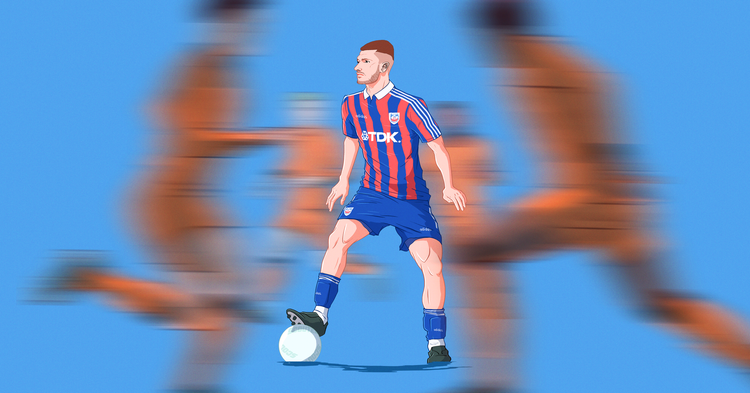
Adam Wharton, the Anachronist

This piece was published in Volume II. Grab a copy of the full magazine in print or digital.
by PHIL COSTA & TOM CURREN
Two-and-a-bit years ago, on a grey and blustery December day battered by Storm Pia and teetering on the edge of Christmas, a shaven-headed Lancashire boy sat down across from us and ordered a salad. We were in central Manchester, where Adam Wharton was something of a quiet prodigy. He lived, he told us, five minutes from the Blackburn Rovers training ground, which made his commute quite easy. He’d been playing for the club since he was a child, when he watched his older brother Scott break into the first team, and was now a senior player himself. Rovers was everything to him, because it was all he’d ever known. “I’ve never really lived a normal life,” he told us. “I always enjoyed it so much that I never really considered the things I was missing out on.” We were there because we thought those sacrifices had resulted in a very special footballer. As we’d soon learn, we were not the only ones.
A month after we first met, Adam Wharton’s abnormal life became extraordinary at a pace that, even with hindsight, is difficult to grasp. In late January 2024, Crystal Palace introduced the world to the the quiet, low-socked midfield prodigy by bringing him to the Premier League. Within the span of a few league games, he was a first-team regular. As the season closed he became a household name, the from-nowhere kid wrapping passes into the holy triumvirate of Eberechi Eze, Michael Olise and Jean-Phillipe Mateta. Palace tore the league apart. When England flew to Germany for EURO 2024, Adam Wharton was on the plane. The summer following, he’d won the FA Cup. You know this story. It moved so fast. But it had gaps, gaps we felt compelled to fill. So, in February, we accepted a second invitation to join Wharton and his team, this time at the glittering south London tower block he now calls home.

The world moves at a dizzying pace around all young people. Speaking to Wharton makes one think about that pace, and whether it’s more pronounced for him, or less. His world is a bubble if he wants it to be: training, recover, game, recover, rest, repeat. But mostly one thinks about speed and modernity because Adam Wharton is, in many ways, an anachronist. Football has sped up: the Premier League is more intense, more physical than ever, but every touch Wharton takes seems to happen in slow motion, at the pace he dictates. “You almost feel outdated,” SCOUTED’s Phil Costa told him. “Like a relic of a simpler time, when football was about technical quality, ability and vision.” He spun that into a question about Wharton’s intent during a game. “What do you think is your responsibility is on the pitch?”
“Win the game,” Wharton said, so bluntly we laughed. But these three words felt instructive. This is how you deal with a relentless whirlwind speed, on the pitch and off it: pare it down, simplify, take it one objective at a time. As we sat together on an island-sized table in a conference room seemingly designed for brokering corporate mergers, it quickly became apparent his breakneck two years hadn’t changed Wharton much at all. Same buzzed head, same easy manner. He had wandered into the room late, just back from training, in sweats and Ugg slippers; perhaps a little more confident, a little more assured, a veteran of twenty-four months of high-stakes media appearances, but still a charming and easygoing young man who feels like he was plucked from Brockhall Village yesterday. And perhaps, on and off the pitch, this is Adam Wharton’s superpower: an ability to force the game - and now London - to move at his pace, rather than be dictated to, in such a casual manner you almost can’t spot it happening at all.
When I exit my home, the street stretches to a single point on the industrial horizon, a long procession of old worker houses that frame a distant cluster of skyscrapers as if it were designed to. One of those skyscrapers, it turns out, contains Adam Wharton’s new apartment. The tower is a nice metaphor: it is a dizzying height compared to the village Wharton left. We wondered how the change in altitude and speed had affected such a young person: not much, at least by Wharton’s telling. “It wasn’t as big as it might have been for some other people,” he said. I don’t really do too much.” He was living with his parents when Crystal Palace called. “I’d thought about maybe moving out back home, but it was never like, ‘I’ve got to move out.’ I was pretty relaxed about it. When I was moving to Palace I didn’t really think about moving in somewhere until someone was like, ’Where are you going to live?’ And then I’m like, ‘I don’t really know.’ I’d only been to London when I was a kid, and maybe the year before with my friend for one night. We had a walk around London, watched a footy match, and then went home the next day. So I was literally like, ‘I don’t know where’s best.’”
He landed on his feet, and London life began as it had in Brockhall: as a homebody. “I wasn’t really bothered about going and seeing all the sights. I was more just staying in my apartment and watching football and basically doing what I did at home, but down here. Probably the biggest difference was just getting to and from training. It’s probably twice as far as Blackburn, but then it took, I don’t know, eight, nine times as long.” Ah, complaining about transport links: Adam Wharton is a south Londoner already. He mentions going out when friends come to visit, and we wonder about the speed at which fame fell upon him. When we last met, he was an icon in Blackburn but unknown most everywhere else: now he’s an England international and a face of the Premier League. One thinks about roving packs of tourists, internet culture, and being a famous but quiet 22-year-old. None of that, he says, has been much of an issue. “80% of the people in London have no clue about football. So if you go on the train… nobody really speaks to each other.” True. “You just walk past each other, stand there, headphones in, on the phone. But you get it here and there. If there’s a football fan walking on the street, they might have a little double check. If I went out for a whole day, you might get one or two.” So he can still head out and do normal things with his friends. “I don’t really think about ‘you can’t go here or there.’ The only time I’d get recognised is if I went somewhere that’s football-based. But no, in general, I just do everything as if I’m a normal person.”
931/1200
Download and keep the entire magazine for the price of a latte. Read Adam's exclusive interview. Enjoy priority access to our limited print store. Help keep our independent dream alive as we push to 1200 subscribers.
Subscribe and download the mag