
Decrypting the Bellingham enigma

by TOM CURREN & JAKE ENTWISTLE
Here's Stephen Ganavas on his favourite centre-back.
Jude Bellingham might be my favourite football player. Despite our endless exposure to his genius, there’s something still something enigmatic about him: it’s difficult to put him into a box, as we do so many football players, or to pinpoint exactly what makes him so irresistible, other than saying ‘he’s just amazing’. Perhaps that's why, before this summer’s World Cup, there was widespread discussion about his place in the England team, and whether he should start for Thomas Tuchel at No.10.
What followed that discourse was an historic and near-mythical tournament performance. I haven’t checked in with the doubters, but I imagine they’re in shambles. Bellingham cemented himself this summer, at 23, as one of England’s greatest-ever tournament icons. Still, if you asked me to describe what he did - to neatly summarise what makes him so brilliant - I’d still resort to saying things like, ‘he just put the team on his back and won games by himself.’
So, when we were organising this new series - which we’re tentatively calling The Conversation, wherein I chat to the SCOUTED analysis team on the players and ideas occupying their thoughts as they work on other projects - and Jake Entwistle mentioned he wanted to talk about Bellingham, I leapt at the chance. Turns out, I’m not the only one fascinated by his game-winning oddness. Jake, too, has been engrossed by this question of why so many seemed not to rate Bellingham before the World Cup, how we might best quantify the way he rips games apart, and whether we can use that information to scout others who share his qualities.
I will say, for those unfamiliar with Jake’s Archetypes project, a primer is in order. Archetypes is Jake’s attempt to untangle the way we talk about football players - the stereotypes, the obvious things we see with our eyes, and the messy discourse - into complex and detailed data profiles recruitment teams can use to find players with similar abilities. It’s useful to know, as this conversation develops, that the goal is to pinpoint Bellingham's core excellence in a way that can be organised in a data profile, so we might use that profile to find other players who do similar things. And although we do work our way towards that, we also have a wider discussion about England’s national football identity, Premier League intensity, team effects, repeatability, context, and data scouting’s general development.
You can catch up on all of Jake’s Archetypes here.
Tom Curren: Alright, talk to me. Explain why you've been thinking about Jude Bellingham.
Jake Entwistle: I think I'm naturally a contrarian. I want to push back against why people think things, which is sometimes good and sometimes bad. But I found the whole pre-World Cup discussion about him maybe not playing insane. Absolutely insane. So I became invested in him again. That's classic me – when he was playing well, I was like, "Yes! I'm so glad you're playing well despite the obscene attempts to say you're not a good player."
I don't think it's contrarianism. I think it's more a general inquisitiveness about commonly held discourse – the desire to explore why we think the things we do, and whether they hold any water when you actually examine them.
Well, that makes me sound much better as a person. But with Bellingham, I had a disbelief that he could ever be discussed as not a good player, considering what he's doing and the fact he's still so young. He was born in 2003, so he's younger than Morgan Rogers. Rogers isn't considered a breakout star exactly, but is discussed as someone on the rise. Bellingham's younger than him and he's already been there and done it.
Whether that means he'll have a shorter career – as in, retire younger, because he's been clocking minutes since he was 15 – is another discussion. But in general, watching him at the World Cup, then talking about how the game is changing, how the meta evolves and what's going to be most prominent, I think he embodied a trait that is going to become more quantifiable, more visible and more in demand from coaches and teams.
There are a combination of reasons for that. Opta recently published the fact that teams with less possession are winning more games. The cyclical nature of that development – the graph – is something we should include here, because it's really good. Teams with less possession are winning more often than usual. We're breaking out of the Pep [Guardiola] cycle, which has obviously been heavily discussed elsewhere.
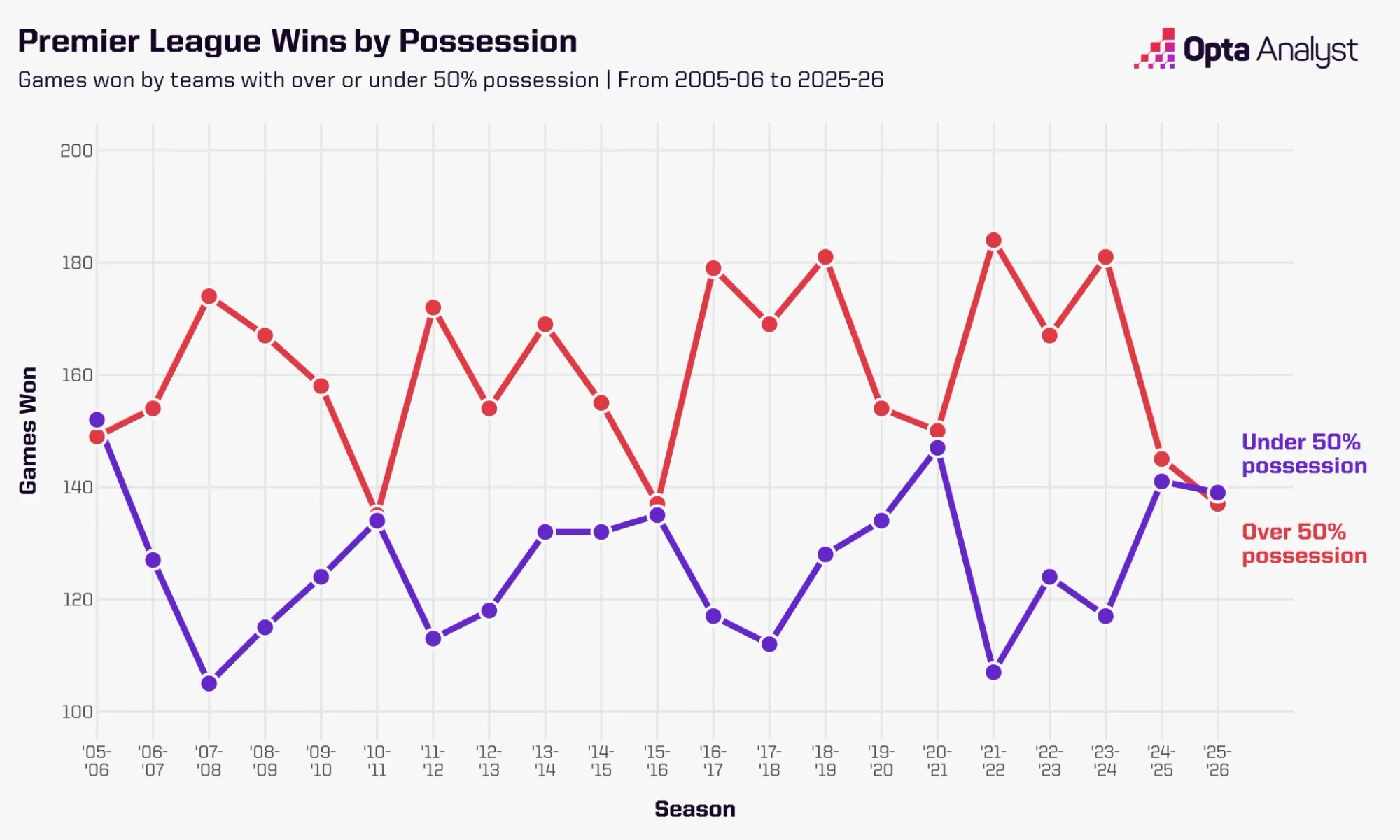
And – this isn't proven, it's just my perception – if you have less possession, you have more large spaces. You're usually sacrificing possession for shape, and teams are pushing you back, or the possession is in their box and you're pouncing on turnovers from pressing. Anyway, Bellingham's ability to just raid space, with and without the ball, massively stood out. That was the starting point for looking at this particular skill.
In the post-World Cup SkillCorner piece we did, looking at ten more players who had an interesting tournament, I forced him in. He's a known quantity, not a breakout, but I framed the argument as his skill-set being the breakout – and he still fit the age criteria, being born in 2003, which is insane. At the World Cup, although he was playing as an attacking midfielder – and you can get into all of that – he wasn't the centre-forward. It wasn't like he was a midfielder playing up front. Kane was still there. But he essentially destroyed everyone when it came to getting into the penalty area and running in behind, and doing all of that at speed relative to other midfielders.
 Jake Entwistle
This is in the breakout article: the three highest single-game tallies of Runs into the Box by young midfielders were all Bellingham. He was in the top three for Dangerous Runs. He was in the top three for Runs in Behind. He was in the top four for Dangerous Runs in Behind, and he was in the top three for Runs in Behind above the high-speed threshold, which is 20km/h.
Essentially, that article was introducing the value of, and the excitement about, a player who can make repeated high-speed vertical runs that penetrate the last line – into the area, or the space beyond that last line. Obviously he's been doing that for a while, so it's not new. But the reason it came to the front of my mind is the pre-World Cup debate: should he even play? Then at the World Cup he was one of the best players at the tournament, for a very visible skill. And it's been in the back of my mind since: how can it be quantified? That's always something I'm looking at, in order to help discover new players like him.
At the same time, it's always interesting to interrogate a player and see if you can capture what makes them special, rather than just saying, "Watch him and you'll know." Which is the case – if you watch Bellingham, he's impossible to ignore. He's one of the most exciting players to watch. But from a recruitment and data analysis perspective, can we go beyond saying, "Look how good Jude Bellingham is"? What makes him good? That was the start of it.

Free to read
This story is free to read. Just sign up as a free subscriber below.
When you do, we'll send you a link to download and keep our most recent magazine, featuring an exclusive interview with Adam Wharton, totally free.
No spam - just great football writing, players & ideas.