11 min read

Full-backs are evolving again

Throughout history, coaches have used full-backs to solve problems and push the meta forward. This summer, the tides are changing again.
Full-backs are evolving again
SCOUTED FESTIVAL

Welcome to SCOUTED's Festival of Football Writing! This week, we're publishing seven free essays by seven writers who have never written with SCOUTED before. Also:

🎪 SCOUTED50, Volume I and Volume II are totally free to read and download - this week only!
🎪 We've launched our Future Fund, a subscription drive to ensure we can survive and thrive for another season
🎪 Our Season Pass is available: lock in for all of 2026/27 today

This week is intended as a celebration of football writing and the act of reading: we hope you find something great to enjoy.

Season pass

by CALEB GEARTY

[...]Football had become an overwhelmingly athletic sport, dominated by hard running, physical power and huge squads, with very little space reserved for guile, invention, or reflection.” - John Foot, on the condition of Serie A, 1990

Football has a habit of feeling quite familiar. As the 1980s ticked into the 1990s, and Arrigo Sacchi’s great AC Milan team became Fabio Capello’s, the sentiment in Italy wasn’t as romantic as we like to remember. Neither Sacchi nor Capello ever stressed a love for defensive, pragmatic play (famously, Sacchi called football ‘a team game based on attack’), but the advent of automatisms and the compact 4-4-2 that Sacchi pioneered in Italy ensured a degree of control that sucked the jeopardy from most games. Fitness and discipline rose in prominence. Sacchi paired his talent with a rigorous system that secured the floor, and in the nine years he and Capello combined for at the helm, Milan won five league titles and three European Cups. For Milan’s opponents, the task naturally became the ending of such dominance. The most prominent solution was laughably simple.

Milan were a great team, their backline perhaps the best ever assembled. But Sacchi and Capello’s emphasis on discipline and synergy were prioritised above the expression of their individual parts. The pair’s deference to a positional system meant defence was an area where potentially ceiling-raising attacking qualities were dulled in pursuit of sustaining the immensely high floor. Their wide defenders - Paulo Maldini and Mauro Tassotti - profiled as centre-back hybrids, and this, coupled with strict positional restraints, gave Milan a near-unbeatable level of control - but at the expense of expressionistic flair. With hindsight, it’s clear Milan’s challengers could see this.

Milan won the Scudetto in 1987/88 under Sacchi; a year later, Inter edged them to the title. To close the gap, Inter had dipped into their tiny foreign player quota to sign Andreas Brehme, a flying, ball-carrying left back. If he’d been playing today, we’d say Brehme had a pair of genuinely game-breaking qualities: his final ball delivery and ambipedality; in 1990, he slammed home the winning penalty as Germany lifted the World Cup. In 1991, Milan were edged out again: this time by Sampdoria, who won their only Scudetto to date. Again, a full-back was prominent. Moreno Mannini, Sampdoria’s right-back, turned the position into one of the most important and functional parts of the side’s counter-attacking system, building overloads and attacks with driving runs, swinging deep switches and crosses.

Maybe the most interesting attempt at using the position to solve problems transpired a few years later and a few miles south. In Rome, ex-Sampdoria manager Vujadin Boškov decided his 1992/93 Roma team needed the explosive qualities of young attacking midfielder Siniša Mihajlović…at left-back. The gambit didn’t work for manager or player, but the intent was so loud and inarguably pure it was hard to ignore. Roma, Inter, and Sampdoria were all looking to make the most out of underutilised zones by filling them with game-breaking talents or qualities; to trade an inch from their floor for a foot to their ceiling. All this feels quite familiar. The past few years have been dominated by discussions of experimental full-backs, discussions branded as modern but that are, in truth, deeply rooted in history. This summer, a handful of big clubs are looking to move the meta on again.


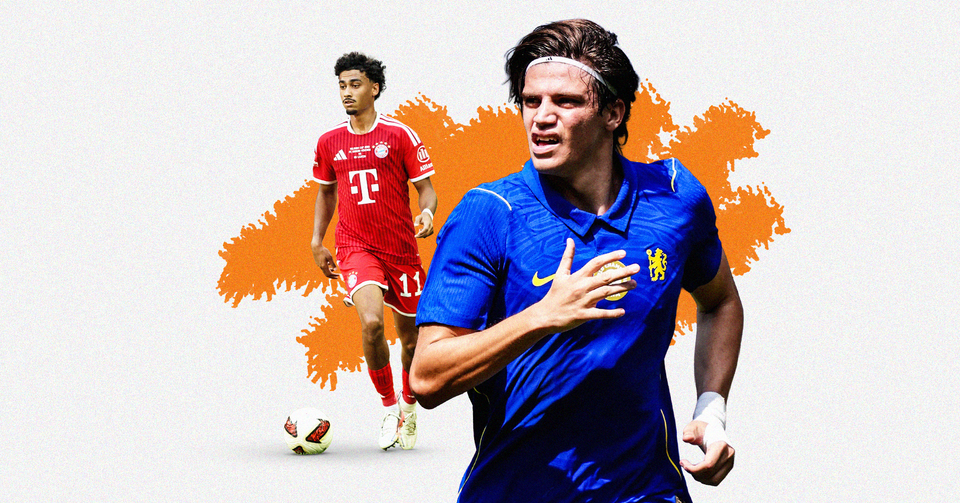
At first glance, Bayern Munich's fifty million Euro purchase of Nathaniel Brown was a typical flex. Long have Bayern used their outsized financial muscle to hoover up domestic talent and throttle any chance of a Bundesliga coup. Brown should have no trouble winning over the Bayern crowd or notoriously wary Bavarian media, either: he is a Bavarian himself, who reportedly made the club his sole priority while disregarding more lucrative offers from England. It was a simple transfer that made sense to all parties.

In May, when Bayern lined up for the second leg of their anticipated Champions League semi-final against Paris Saint-Germain, they made a single change from the previous tie. Out went the flying (if slightly faltering) Alphonso Davies at left-back, and in came Konrad Laimer. Suddenly, Bayern appeared more stabilised. With two staunch, pragmatic fullbacks in the shape of Laimer and Josip Stanišić, Bayern could exert a greater degree of control; they reduced the transitional opportunities that had seen them concede five in Paris.

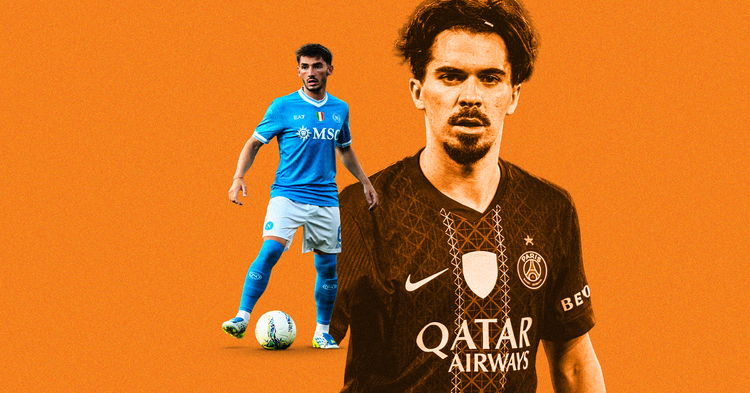
Laimer and Stanišić are tricky to profile accurately. In SCOUTED Archetype terms they match most closely to Imposters, namely full-backs tasked with retaining possession by inverting into central spaces: ‘midfielders in full-back pyjamas.’ Against PSG, both found themselves rotating between runs that pulled wide and those that pulled into the half-space; they felt more likely to carry the ball into a zone, rather than receive it there. The contrast with PSG’s Nuno Mendes, who profiles much more closely to a Flyer - a full-back who makes lung-busting runs to whip in crosses - but also looks comfortable dropping into a back three, receiving the ball both in buildup and in the outside lanes of the final third, is stark. Mendes is a player with the ability to both carry the ball into zones and appear in the right ones for the game state, perfectly positioned to receive.

Three minutes into the second leg against Bayern, he did exactly that. Mendes dropped into the backline, intercepted a lazy forward pass, and laid the ball off to Willian Pacho, who punched it through lines with comfort. Ousmane Dembélé scored from the resulting move, PSG went 6-4 clear on aggregate, and Bayern couldn’t recover.

In dropping behind his centre-back and deferring the freedom to move the ball forward to the more talented passer, Mendes understood his teammate’s strength and maximised his team's ability to create faux transitions. Bayern’s Imposters were unlikely to do the same. Rather than push the limits of their role, like Mendes, who dipped into qualities of various Archetypes and positions, they stood firmly within them. In other words, they secured the floor, but Bayern found the ability to recover beyond their ceiling. In hindsight, the purchase of Nathaniel Brown seems a little more layered than it first appeared.

Securing our future.


We're on a quest to re-ignite SCOUTED ahead of 2026/27 - and to make football writing joyous again. No clickbait. No garbage. Writing just like this, full of ideas, players and storytelling - great, intentional reading, the way it used to be.

Help us reach 1200 subscribers for the new season - a season pass is just 67p a week.

Grab the season pass

No presses were held when Chelsea spent €57m on another young defender, even if that player had been the Serie A defender of the year and in the sights of both Milan clubs as well as The Old Lady in Turin. Marco Palestra was a name probably unfamiliar to most Premier League fans prior to Chelsea’s interest; truth be told, he wasn’t exactly a household figure when Atalanta loaned him to Cagliari at the start of the 25/26 season, either. But when Chelsea went to the Emirates for the second leg of their Carabao Cup semi-final against Arsenal last season, if there was one player in the world they needed, it might’ve been him.

That night, Liam Rosenior lined his team up in a pressure-soaking back five. A bold choice, his aim was most likely to capitalise on a nervy Emirates crowd and exploit gaps borne of frustration with incisive breaks and a collapsible structure that minimised return fire. To that end, Chelsea turned to their full-backs as pressure-release valves, intending to use them to hold, drive, gain quick territory and create tension against a high Arsenal line. Neither Malo Gusto nor Marc Cucurella could offer anything close. The pair completed no dribbles, no crosses, and created 0.02xA. In all, it was a listless display that saw Chelsea epitomise ‘sterile domination.’ Rosenoir’s approach was widely mocked, considered much too timid to overcome even the one-goal deficit.

The link between Chelsea and Bayern’s semi-final struggles is clear. In respective return legs of high-octane ties in which Vincent Kompany and Rosenior had both seen their teams edged out of high-scoring contests, they saw change in full-back personnel and ‘positioning’ as key to seizing back control. In that sense, they succeeded: they lowered their opponents' xG, conceded only once each, and both ties were fiercely competitive. But neither team progressed. This summer, both have made a full-back their first signing.


Throughout the 25/26 season, both Bayern and Chelsea made use of similar kinds of full-backs. Looking at Marc Cucurella and Malo Gusto’s heat maps, you'll see players arguably more at home in the half space than on the flank, and in the 65th and 85th percentile of touches respectively; it’s clear both are on-ball players. The story is largely the same for Laimer and Stanišić: both profile as touch-heavy, half-space-invading, builder-type players who prefer to take the ball to places with short carries and quick passes as opposed to longer carries or box-crashing style runs.

When a team is the beneficiary of a talent differential, this profile works. Rolling into midfield to compact space and minimise transition threat, while also allowing wingers to stay high and wide to keep the pitch stretched for attacking moves, is valuable in an ascendancy. But in a fistfight it’s a limited toolset that gives opponents with more unique profiles the chance to overpower and assert a talent advantage.

The best teams in the world have weird full-backs. Riccardo Calafiori might be the weirdest, a flair player trapped in the hulking body of a centre-back, raised in Serie A as a wing-back and turned by Mikel Arteta into a creative, box-crashing, channel-running No.8. Joško Gvardiol, still the most expensive defender in history, had an injury-hit campaign last term but at his height was similarly as influential. Both have exploited their natural gait and the space they are afforded at left-back to transform the position into that which Arsenal and Manchester City use to generate momentum; they carry when needed, and appear in the right spaces in the attacking third when they don’t have the ball. They adjust their ball dependence as needed to be either the force that pulls a team out of their defensive third or one that meets them high up the pitch, where they have the space to crash like a traditional No.8. In Gvardiol’s absence last term, Nico O’Reilly became one of the Premier League’s most influential forces doing exactly that.

Nuno Mendes is a different breed, a Flyer by nature who is incongruously often the full-back PSG ask to drop in and form a back three in possession: a positional responsibility that doesn’t stop him from launching driving runs to carry outside of his winger. And then there are players like Federico Dimarco, who is effectively a wide midfielder, and often has to shoulder the entire creative burden of Inter’s attacks. His mixture of booming crosses, deep switches, and third-man runs to maximise his limited physical skillset ensure he is one of the most dangerous wide players in the world.

All these strange and different profiles prove there is no fixed meta at full-back; a team’s needs in the position are relative to their intentions and personnel elsewhere. But in the upgrades both Bayern and Chelsea have made this summer, a theme is obvious: both have added players who can carry long distances and generate momentum on their own. Mendes and Calafiori and O’Reilly are different shapes and sizes to Brown and Palestra, but all five share the commonality that they drive the ball into dangerous areas themselves. Despite Brown and Palestra playing last season at non-dominant clubs, both were within their league's top 75 most threatening players by xT: put simply, they took and moved the ball into areas that directly improved their team’s chances of scoring.


Just as important as carrying the ball is the ability to receive it. With strong carrying to fall back on, both Brown and Palestra feel comfortable receiving the ball in more risky situations higher up the pitch, allowing them to drive with or without it. This is especially true for Palestra; his shot map from last season demonstrates he's incredibly comfortable arriving around the box at taking a shot from medium-to-long range. Last season, he amassed over twice the number of shots in the league as Malo Gusto, and all from within a fairly defined zone in the right half-space. Of course, Palestra's tendency to push into these zones was aided significantly by the fact he primarily played as a wing-back, with three covering centre-backs behind him. This safety net afforded him greater freedom to roam than Gusto, who largely played in a flat back four and had to balance greater risks when pushing into opposition territory.

But if we can derive a theme from the world’s most competitive clubs, it seems to be this: all want to have at least one full-back who can act as both a point of relief, able to retain and recycle, and an outlet, able to carry, cross, and drive into the box without the ball. It feels as though the new ideal for this position is not a specialist but a magpie, a player who can pick and choose solutions based on game-state, with one key outstanding quality to fall back on.

In the example of Brown and Palestra, that key quality is carrying, and it’s easy to see why that might be the most attractive boon in the game right now. When the best out-of-possession shapes are so rigid and stiff, a force to crack them open is a necessity. That force is made more powerful when it comes from deep; the momentum a full-back can generate with space ahead and a covering defender behind is arguably the most of any position on the pitch. We saw this in focus in the World Cup's early stages, where Brown's underlapping runs with and without the ball drove Germany up the pitch time and time again. So crucial were these movements to Germany's build-up and chance creation that Brown averaged over twice as many underlapping runs per 90 than any other player in the tournament. In a poor German side, he was the spark to ignite stale posession into fluid attacking movements.

Versatile, driving full-backs are the reason no team has yet cracked the PSG code, and why Arsenal’s xG generated improves when Calafiori is on the pitch. Carrying and crashing from wide defensive positions breaks open games, just as Andreas Brehme broke Milan all those years ago, and as Boškov attempted to by placing his winger’s cannon of a left foot there. The tides are changing again, and full-back is on the crest of every wave. Football has a habit of feeling quite familiar.

If you enjoyed this essay, please consider subscribing from just 67p a week. You'll get a weekly feature essay - just like this one - every single week for 2026/27, a monthly recruitment analysis column, and 20% off all our print magazines. More importantly, you'll help keep an independent publication alive, and our writers paid fairly. Thank you.