9 min read

Will the diminutive No.6 survive?

Modern football is fast, furious and physical - nowhere more than in midfield. In Italy, a cadre of small, slow playmakers are keeping the flame of romance alight.
Will the diminutive No.6 survive?
SCOUTED FESTIVAL

Welcome to SCOUTED's Festival of Football Writing! This week, we're publishing seven free essays by seven writers who have never written with SCOUTED before. Also:

🎪 SCOUTED50, Volume I and Volume II are totally free to read and download - this week only!
🎪 We've launched our Future Fund, a subscription drive to ensure we can survive and thrive for another season
🎪 Our Season Pass is available: lock in for all of 2026/27 today

This week is intended as a celebration of football writing and the act of reading: we hope you find something great to enjoy.

Season pass

by FELIX NYBERG

The physical demands of modern football are brutal. The best midfielders are typically massive, if not in sheer height then in running power or strength. It’s hard to imagine a No.6 at the top level surviving without the tools to hold their own with the brutes; and yet, for half a decade, little Stanislav Lobotka has shrugged them all off. Since 2021, when he became the club’s undisputed No.6, Napoli have won the Scudetto twice, and the man lovingly mocked as being ‘built like Wario’ has become revered as one of the finest midfielders in Italy. His predecessor was a slight and slow midfielder called Jorginho, who won the Coppa Italia with the club in 2014 before leaving and adding the Europa League, Champions League, European Championship and a third place finish in the Ballon d’Or. So often, the beating heart of Naples is a midfielder who looks like he could be bowled over.

On the global stage, this is an anomaly. But in Italy it’s part of the furniture, an inarguable thread through their footballing identity. It’s been more than a decade since a bearded, late-era Andrea Pirlo waltzed his languid dance across Serie A and cemented his already formidable legacy as one of the greatest deep playmakers to ever grace the sport, bending much faster and fiercer players to his will. And as so many teams lean ever-further into the pursuit of physical dominance, it’s hard not to wonder if they’re losing something: not just romance, but the game-running authority a truly technical No.6 provides.

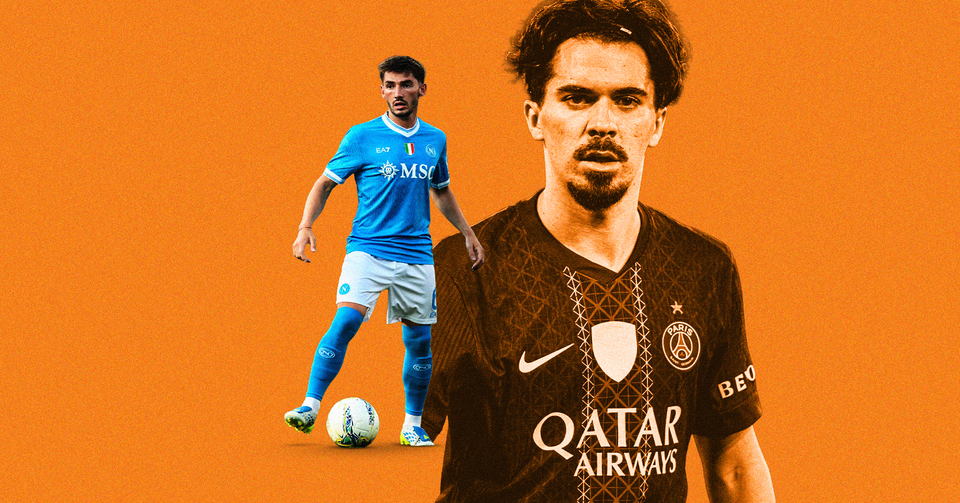
Napoli have no such concerns. Lobotka is turning 32 later this year, and his contract expires next summer; the club are bracing for life without him. Predictably, they already have yet another small midfielder waiting in the wings. His name is Billy Gilmour, and he’s an entire inch taller than the man he’s set to replace.


Once upon a time, Billy Gilmour was a member of a Cobham golden generation. When Frank Lampard returned as head coach in 2019/20, a transfer ban forced Chelsea to find creative squad-building solutions. Academy products like Mason Mount, Reece James, Tammy Abraham, Callum Hudson-Odoi and Fikayo Tomori all broke into the first team. Gilmour, meanwhile, was recognised as the club’s Academy Player of the Year. He never made the full step into Chelsea’s first-team rotation, and in 2022 was sold to Brighton. The situation at Napoli is similar: he’s still waiting on a breakout moment. But, as at Chelsea and Brighton, his talent is evident whenever he plays.

A Scottish national raised at Celtic and Rangers but who completed his footballing education at one of the best academies in England, Gilmour has always been something of an oddity. His game is, superficially at least, reminiscent of a Spanish playmaker rather than particularly British; he has listed Andrés Iniesta, Cesc Fàbregas and Luka Modrić as his biggest inspirations. He is small, technical, constantly scanning on the pitch, and builds his game on the resulting vision of his surroundings. Like a Spanish midfielder, he angles his body to effortlessly receive the ball away from pressure and into space, and passes relentlessly.

To match the often imposing profiles of his opponents, Lobotka developed immense upper body strength and an unshakeable technical consistency. And although these fundamentals allowed him to build his half-decade reign at No.6, he has rarely progressed the ball at volume. Last season, for instance, he averaged 4.49 progressive passes per 90, which ranked in the 44th percentile among defensive midfielders in the top five leagues. In the same team, Gilmour averaged 8.98 progressive passes per 90, which ranked in the 96th percentile. This is where Gilmour begins to differ from the man he’s set to replace: while neither are powerful ball-strikers, Gilmour has a penchant for razor-sharp passes between the lines, even under pressure and from awkward angles.

One wonders if Gilmour’s more progressive mentality in possession stems from his background as an offensive player. Gilmour’s tactical heritage - at youth level, he was largely a No.8 or No.10 - may not be reflected in outstanding final third production, but he isn’t the first player to move from an advanced midfield role to a deep-lying one. It may seem a counterintuitive transition considering the game’s gradual increase in intensity and physicality, but it has been tremendously successful for several high-profile players in recent years. There is no better example than Paris Saint Germain's Vitinha: not long ago, he was a technically gifted but erratic box-to-box midfielder struggling to break out at Wolverhampton Wanderers. Today, he sits in the heart of Europe’s best midfield, and can be found dancing through pressure, rushing forward with the ball, and threading pinpoint passes between lines. Vitinha’s example is stark because it developed in France. Back in Italy, the ideological home of the deep-lying playmaker, such transformations have become a trend.

Securing our future.


We're on a quest to re-ignite SCOUTED ahead of 2026/27 - and to make football writing joyous again. No clickbait. No garbage. Writing just like this, full of ideas, players and storytelling - great, intentional reading, the way it used to be.

Help us reach 1200 subscribers for the new season - a season pass is just 67p a week.

Grab the season pass

For most of his career, Hakan Çalhanoğlu stood out for decisive passes, set pieces and rocket-like shots from range. Until he approached 30 he was an attacking midfielder capable of providing headline goals and assists, but who struggled with other midfield fundamentals, not least turnovers. He enjoyed risk but lacked the burst and agility to recover mistakes; at his worst, he looked slow, uncoordinated and clumsy. At the start of the 2022–23 season, Inter manager Simone Inzaghi thought this sounded like the perfect profile for his new No.6. When Marcelo Brozović became unavailable for Inter’s Champions League fixture against Barcelona on 4 October 2022, Çalhanoğlu started alone at the base of midfield. He has enjoyed that role ever since.

As a lone No.6, Çalhanoğlu’s offensive mentality has translated into a progressive urgency that, when married with his world-class ball-striking, has made him tremendously valuable in build-up. Although he predictably has occasional difficulties passing under pressure and retaining possession, he generally plays with a poise that is shocking to those who followed his previous exploits. Still, he has retained the potential to decide games. Excluding penalties, he has amassed 41 non-penalty goal contributions for Inter since his role change. Last season he scored six from outside of the box in all competitions, of which all but one came in meaningful game states.

Last season, Como were particularly traumatised by Çalhanoğlu’s decisiveness. In their first meeting with Inter, Çalhanoğlu scored the third goal in a 4–0 rout. In the return fixture, he assisted the goal that saw Inter complete a three-goal comeback after trailing 0–2 deep into the first half. More famously, he scored the first two goals and assisted the third as Como blew another two-goal lead to Inter in the second leg of the Coppa Italia semi-finals. But one could easily argue Çalhanoğlu’s decisiveness last season was outshined by another Inter midfielder who had followed his tactical transition.

Piotr Zieliński’s first season at Inter was forgettable: he rarely played, and in the summer of 2025 was understandably linked with a move away. He remained, and the following season reinvented his game entirely. With Çalhanoğlu struggling with injury, Zieliński’s transformation into a No.6 was initially born of necessity. And although the Turk’s evolution was surprising, there was an easy-to-spot level of sense: it wasn’t hard to imagine his ball-striking translating to spraying balls around from deep. By contrast, few would have imagined Zieliński’s penetrative ball-carrying translating into excellent press-resistance and decision-making in the early phases of buildup. But it did, and last season it was part of a toolbox that made Zieliński an excellent lone No.6.

Shockingly, Zieliński’s deep passing was on par with Çalhanoğlu’s last season. He averaged 7.00 progressive passes per 90 at a completion rate of 65.9 per cent, which ranked in the 84th and 96th percentiles respectively. By comparison, Çalhanoğlu averaged a slightly superior 7.63 progressive passes per 90, but at a significantly lower rate of 54.2 per cent. Zieliński was also decisive, and never more so than in the infamous Derby d’Italia last February. As the clock approached 90 minutes, Zieliński drilled the ball into the bottom corner with his 'weaker' (he is, in truth, remarkably two-footed) left foot, deciding a five-goal thriller with Inter’s biggest rivals. Throughout the season, he scored or assisted a non-penalty goal about once every three full games.

On the other side of town, Luka Modrić signed for Milan and moved deep into midfield. At 40, his effectiveness was already in question, and perhaps doubts grew louder when it became evident he would start as a No.6. But Modrić was almost indistinguishable from his prime. With the ball he practically took the burden of Milan’s buildup entirely on himself, and it seemed no amount of pressure could ever rob him of it. Last season, many of Serie A’s best stories were of transformation, and the rise of very different but vastly effective deep-lying playmakers.


Modrić, Zieliński Çalhanoğlu are all technically wonderful footballers. The intuitive concern about their particular tactical transition was not that they’d be poor in possession, but that they wouldn’t cope without the ball. Lobotka and Jorginho faced the same; it’s not an unreasonable objection. But there are means for a smart No.6 to mitigate their physical and athletic deficiencies. Much of defending has nothing to do with one’s physical profile and, cliché as it is, the importance of reading the game cannot be understated. You don’t need to wrestle to win the ball or hustle to prevent a lethal pass if you’re simply at the right place at the right time.

Still, football becomes ever-more relentless, and trusting ‘reading of the game’ to overcome a lacking physicality remains a risk too large for many clubs. Billy Gilmour was sold by Chelsea at 21, despite excitement around his technical ability; Brighton were similarly happy to offload him at a modest price just a couple seasons later. Considering the current state of the Premier League, it’s hard to blame them, but in Italy Gilmour has proven his merits as a defender: he won 61.7% of his ground duels over the span of his two seasons in Serie A. He’s not yet as efficient at intercepting and recovering the ball, but he does position himself intelligently and covers for his backline well. The point, though, is these numbers came in Serie A. In his two seasons as a regular starter in the Premier League, he won just 48% and 49% of his ground duels respectively.

Some have argued the Premier League is dominant because of its unmatched intensity and athletic level. Others have lamented the league has cultivated an environment that diminishes the role of the artist, the imaginative, producing not only dull and rigid games but perhaps even suffering competitively. Some saw PSG’s win over Arsenal in the 2026 Champions League final as ultimate proof: technical excellence wins titles. Of course, this is a false dilemma. Technical quality and athleticism are not mutually exclusive; you can have both. Still, the physical furore in the Premier League has naturally led to an arms race that has tipped the balance to one side, perhaps squeezing out players who lack the obligatory physical baseline.

The sense of PSG’s ideological victory is sharper because the team contained Vitinha, considered by many as the poster boy of the Premier League’s squeezed-out technical stars. For better or worse, England has evidently created a footballing landscape in which such talents slip through the cracks. Naturally, these talented players need somewhere to land: and where better than Italy. With its lower intensity and greater tactical emphasis, Serie A has become a stronghold for the deep-lying playmaker, each a shade of figures like Pirlo and Jorginho, the slow and feeble who nonetheless forced Italy to play to their tune.

Jorginho’s lineage lives on, in Lobotka and Çalhanoğlu and Zieliński and, if all goes to plan, Billy Gilmour. Whether the diminutive No.6 will rise again in England is an open question. For now, we’ll have Serie A, and its host of anachronistic conductors keeping the dream alive.

We need help to stay alive. If you enjoyed this essay, please consider subscribing from just 67p a week. You'll get a weekly feature essay - just like this one - every single week for 2026/27, a monthly recruitment analysis column, and 20% off all our print magazines. More importantly, you'll help keep an independent publication going, and our writers paid fairly. Thank you.