
Argentina's armoury of centre-backs

One of SCOUTED’s primary quests since partnering with SkillCorner has been to profile the behaviour of centre-backs as purely as possible, while remaining aware it is pretty much impossible. We showcased the most important Physical data points by prospecting for gold in Brazil before introducing the duality of Shield and Spear through France’s centre-backs crèche and On Ball Engagement metrics.
But there was something missing.
Support SCOUTED
This analytical epic is free to read courtesy of SkillCorner, our data partners. Subscribe now to keep in-depth content like this coming your way.
Subscribe for freeBehind the scenes work on SCOUTED Pro has led to what was first considered a duality evolving into a tripartite spectrum. A simple split of these three themes is as follows:
- Shield: defends the box
- Spear: defends the space
- Sword: defends the man
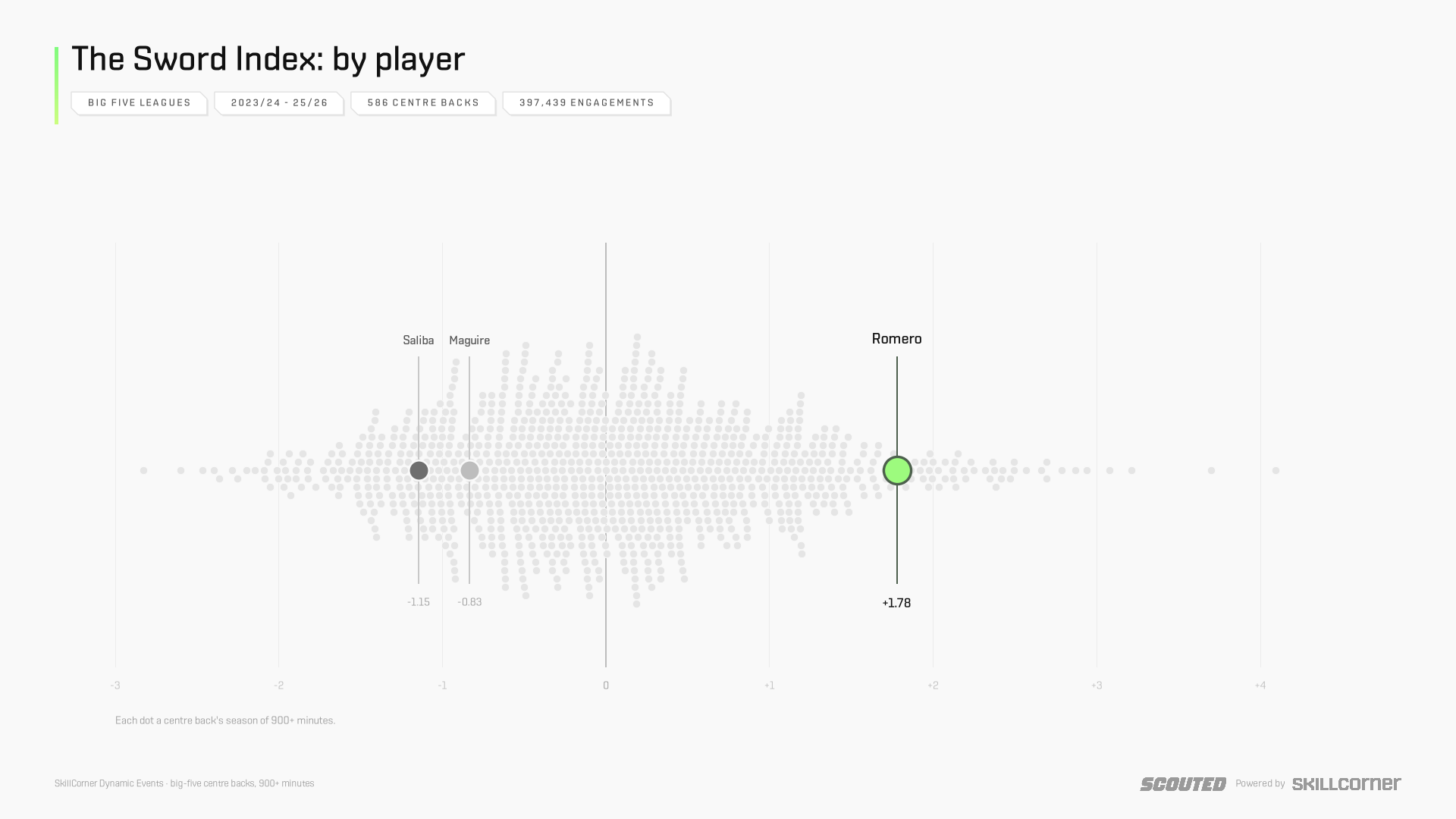
Harry Maguire is a Shield because he avoids engagements as much as possible while commanding the skies. William Saliba is a Spear because he controls space by matching the speed of attackers, waiting for the perfect moment to strike. Cristian Romero is a Sword because he goes out on his own, closing distance at speed to steam into his opponents, taking the ball, the man, or both. This is the distinction that was lacking.
When plotting Big Five League centre-backs across a three-season sample, Romero emerges has one of the sharpest Swords.
Using a combination of SkillCorner’s physical, tracking and Game Intelligence data, we have captured this behaviour with five key metrics:
- Closing Distance - the share of engagements that start 8 metres or more from the ball-carrier.
- Steaming In - the share of engagements where he arrives 3 km/h faster than his target.
- Solo Missions - the share of engagements classified by SkillCorner as a Pressure: individual pressure applied directly to the ball-carrier, independent of any coordinated chain
- Ball or Man - the share of engagements that end in a direct regain, a direct disruption, or a foul.
- Repeat Bites - the share of engagements that are a second engagement at the same possession. If he doesn’t get the ball or man, he tries again.
The Sword is not a better defender than the Spear or Shield, and vice versa. The Sword is simply a defender who resolves rather than contains. Which leads us to a wider question: to what extent can defensive behaviour be tied to national identity?
At the 2026 World Cup, Argentina became infamous for their approach to defending their crown, particularly in the final against Spain. In his pre-final column for the Guardian, 2014 winner Philipp Lahm described it perfectly:
“defensive, focused on physical duels and prioritising security. Football as an existential struggle, deeply rooted in the culture.”
It turns out he was impressed by something similar in 2022 also:
"All the players have mastered the basic virtue of football: one-on-one, defensively and offensively, aggressively but fairly. These individual skills, which have been lost sight of in the debates about tactics and systems, are what count if you want to win. The Argentinian players show unconditional intensity."
The existential struggle and the unconditional intensity captures the instinct of a Sword. These national stereotypes exist because the environment and culture shape the approach. But we must learn as much as we can about these environments to help understand why particular traits may develop, but also question whether these characteristics are as widespread as we think.
In this article, we are going to use SkillCorner data to find out if the fires of Argentina do forge the sharpest Swords and why that might be the case.
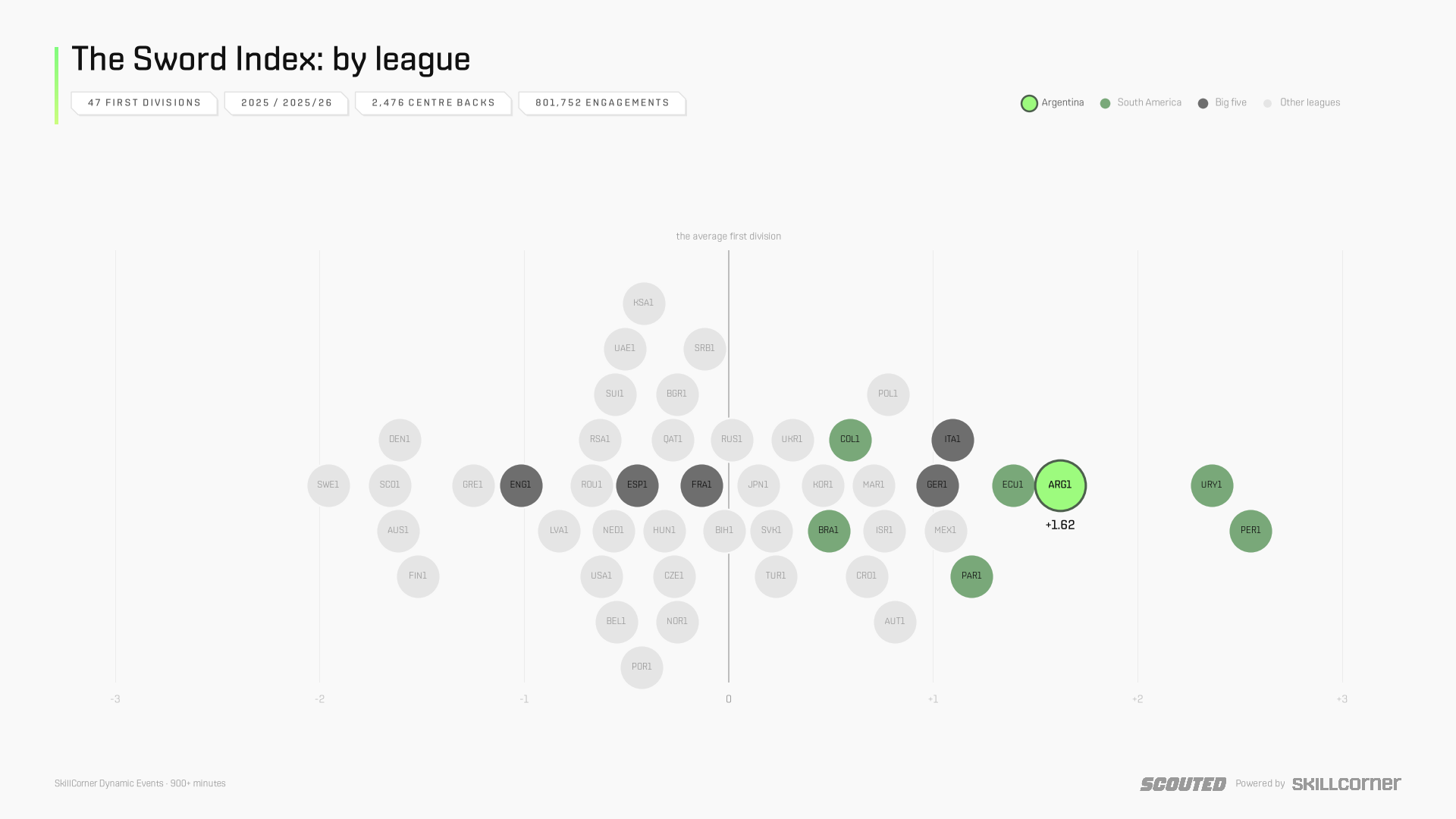
In a word, yes. Across 2,476 centre-backs in 47 global top flights, the average Primera División (ARG1) centre-back is above the median on all five Sword metrics and in the world's top three on two of them. Calculated as a singular Sword Performance Index, only Peru and Uruguay score higher than Argentina’s +1.62. We’ll come back to them later.
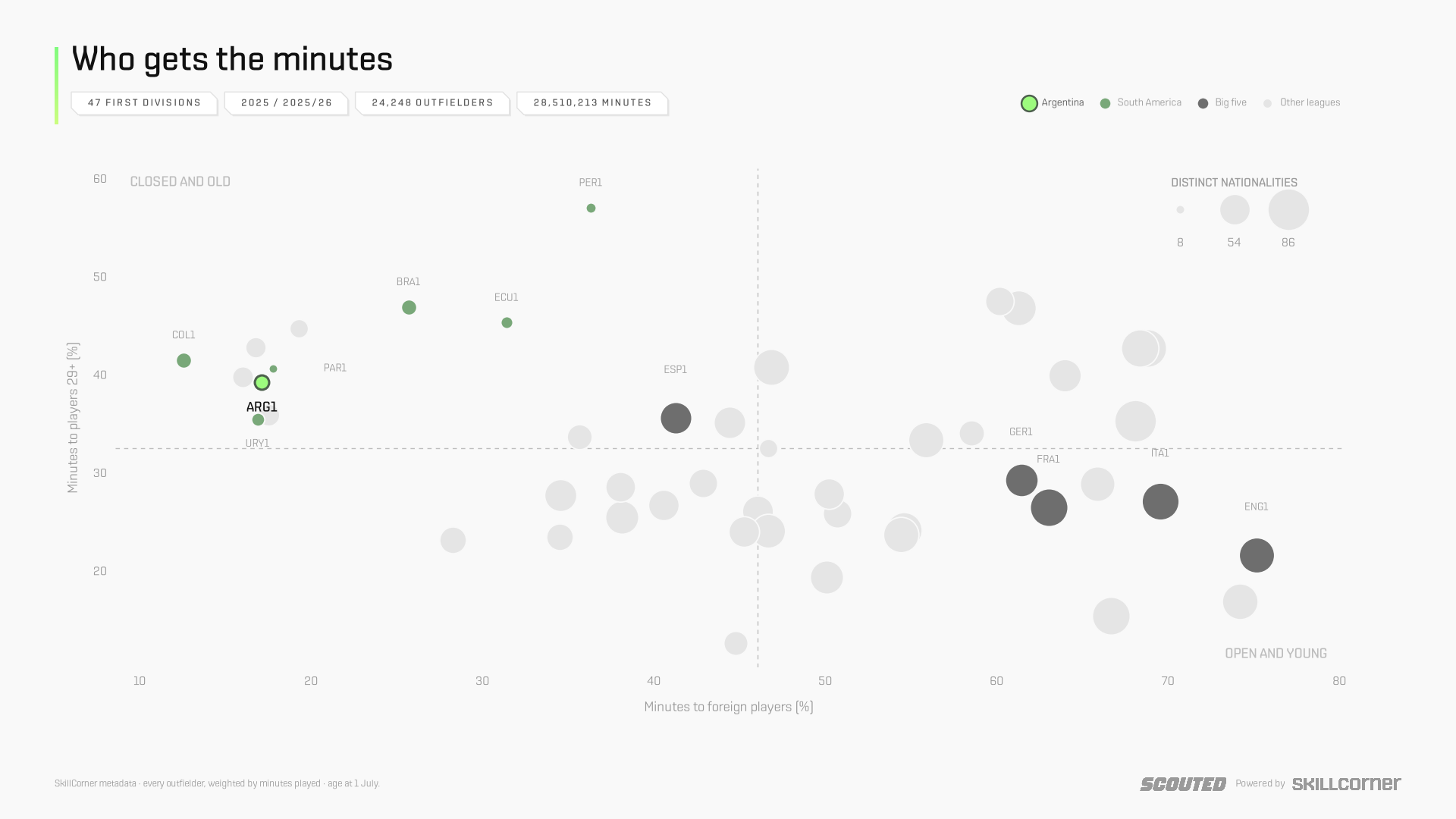
We can also be confident that this is a national culture rather than an inherited one. Argentina's Primera División is one of the five most closed-off leagues in the pool: foreigners take 17.1% of the minutes against a big-five average of 62.1%, and just 18 nationalities appear on the pitch all season - for context, that number is 67 in the Premier League. Only Colombia, Uruguay, Japan and South Africa are more closed. Whatever is being made here is being made here.
Also, UEFA's latest European Club Talent and Competition Landscape report shows Argentina invests 41% of its transfer spend into players aged 29 or older, with no other nation of the 25 included allocating more than 25%. That figure also excludes returning veterans like Nicolas Otamendi, who joined River Plate on a free following six seasons at Benfica.
Otamendi is an interesting name to build into this investigation because he has featured at the highest level - winning the Premier League twice, playing every single minute of Argentina’s triumphant 2022 World Cup campaign - despite standing at 183 cm tall, short by universal centre-back standards. Even Romero, who partnered Otamendi for the majority of that tournament, is billed at 185 cm. This is not illustrative of Argentina, but South America in general.
Within our global panel, centre-backs in Argentina’s top flight are one of the shortest collective groups at 185.1 cm - the Big Five average is 188.2. However, if we look at the volume and ratio of possessions that SkillCorner tag as a header, Argentina is towards the top end of both.
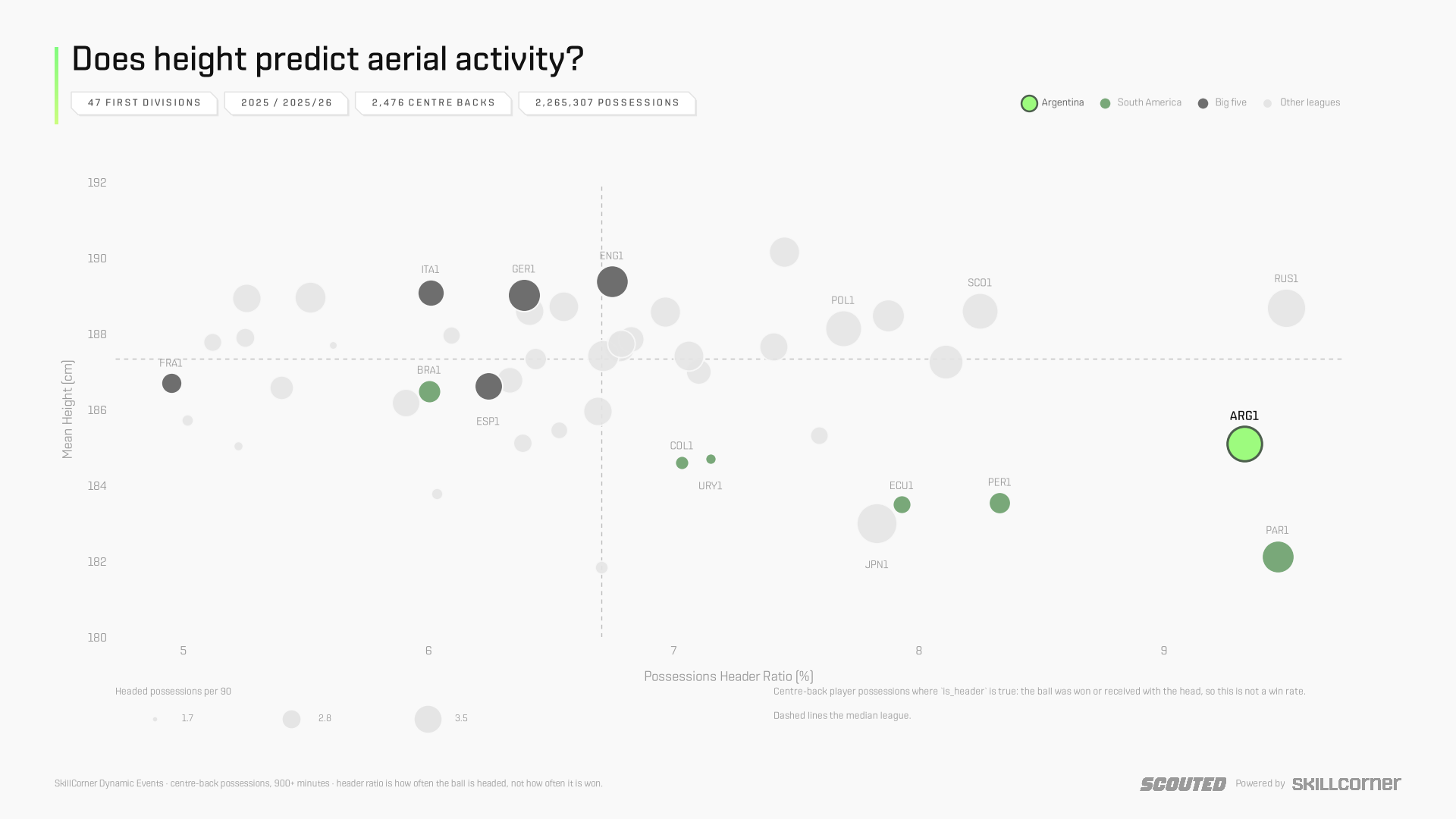
There’s more to this than a relative lack of height. We need to dive deeper.
If it’s not a foreign influence, a compensation for height or even young whippersnappers boosting Argentina’s signal, is it an in-game influence that platforms these Sword-coded tendencies? Breaking down Phases of Play suggests that Argentine Swords could be forged in Chaos.
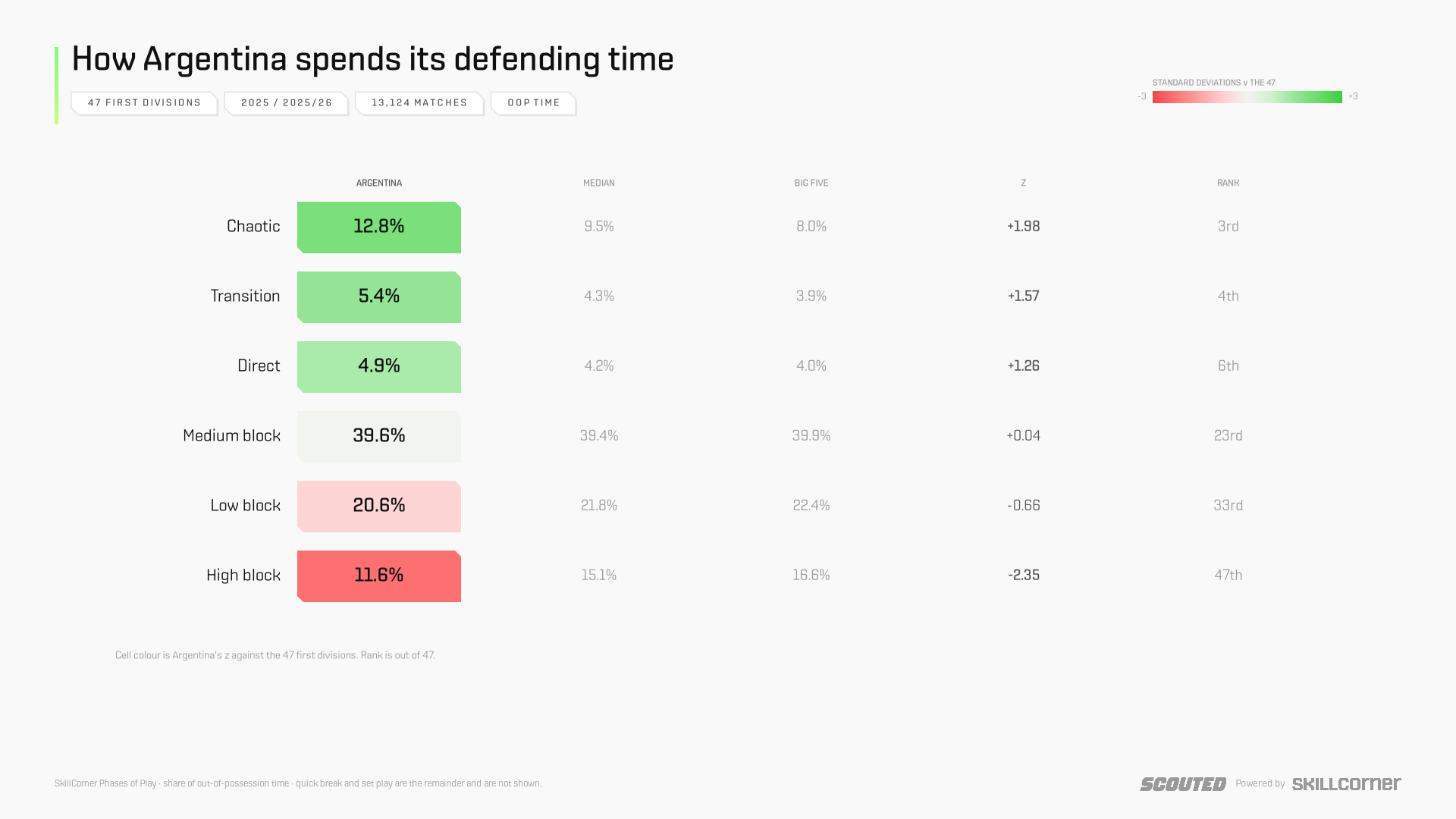
It is this Chaos that part explains the head tennis we saw earlier. There is a strong correlation between share of possessions as headers and share of time in Chaos. But it does not explain the sharpening of the Sword. When looking at the behaviour within each phase, we see that Chaos does not induce the aggression we associate with this Archetype.
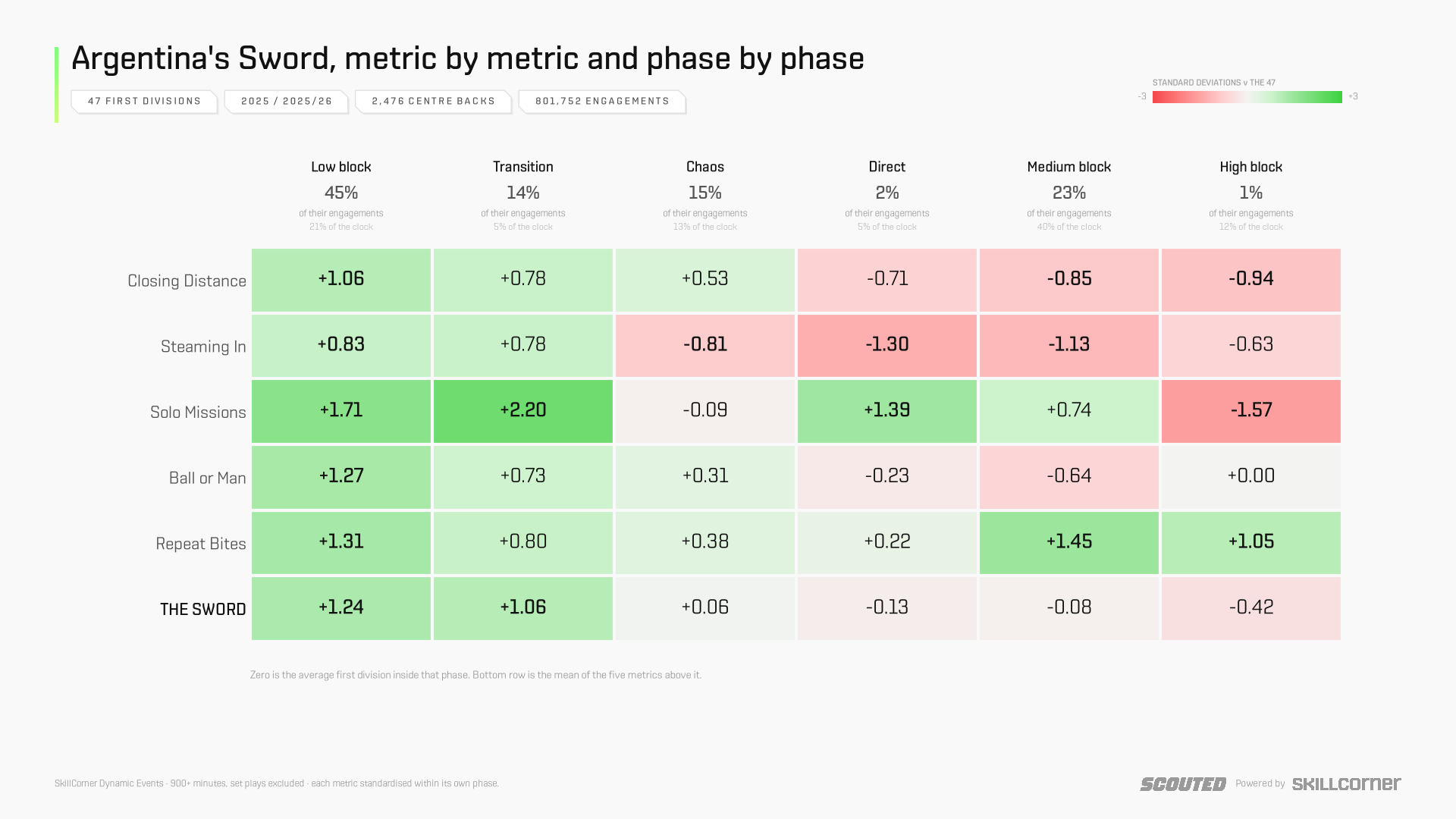
Now we have something to build on. The average Argentine centre-back is most Sword-like when defending in a Low Block, with all five metrics a positive deviation away from the average.
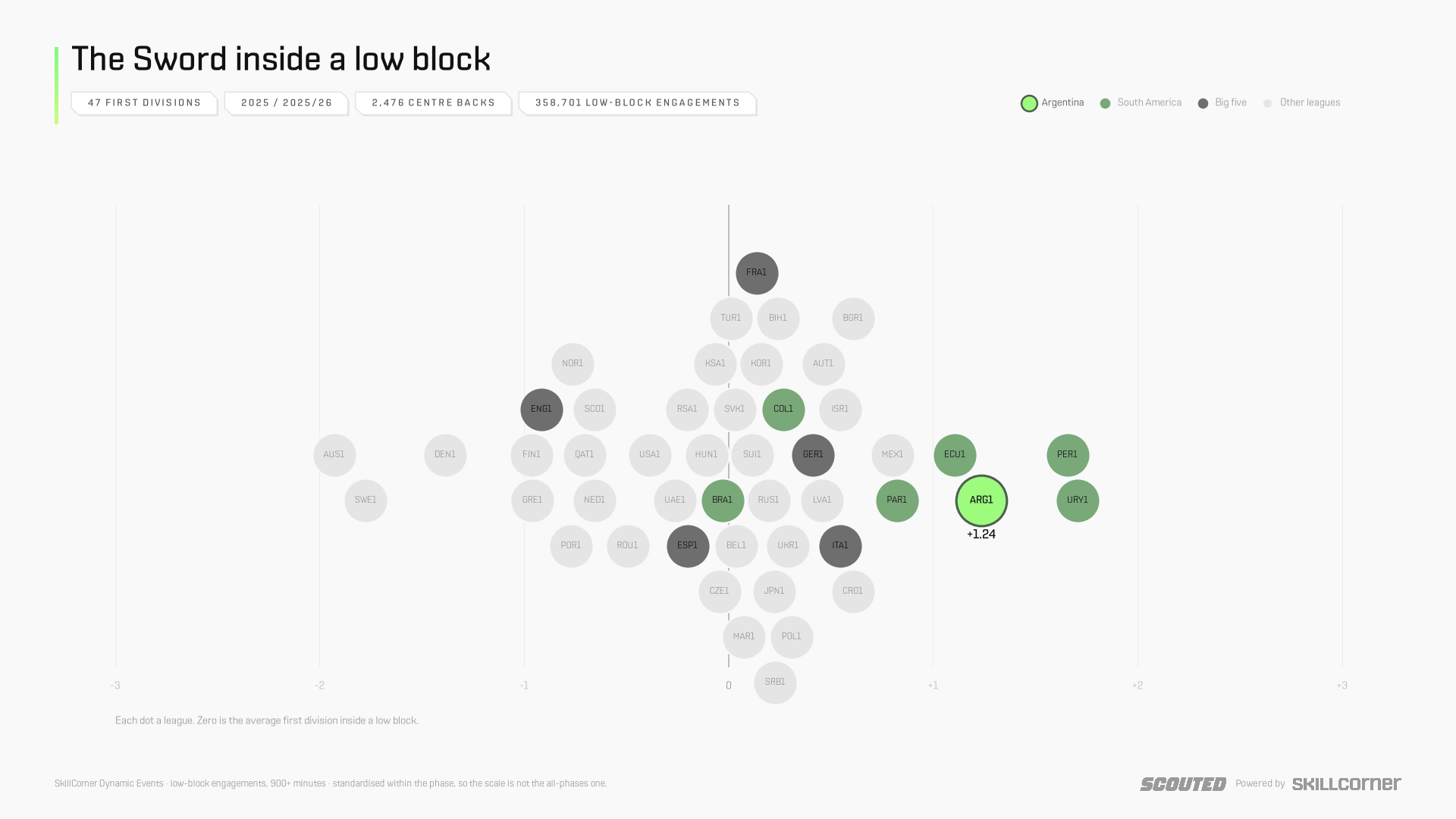
We can now pull harder on this thread.
At first glance, the Argentina Low Block is very ordinary. Argentina do not defend in a Low Block more often than other leagues and centre-backs do not perform a larger share of their engagements within it. So what is it about this particular Low Block that turns centre-backs into bloodthirsty Swords?
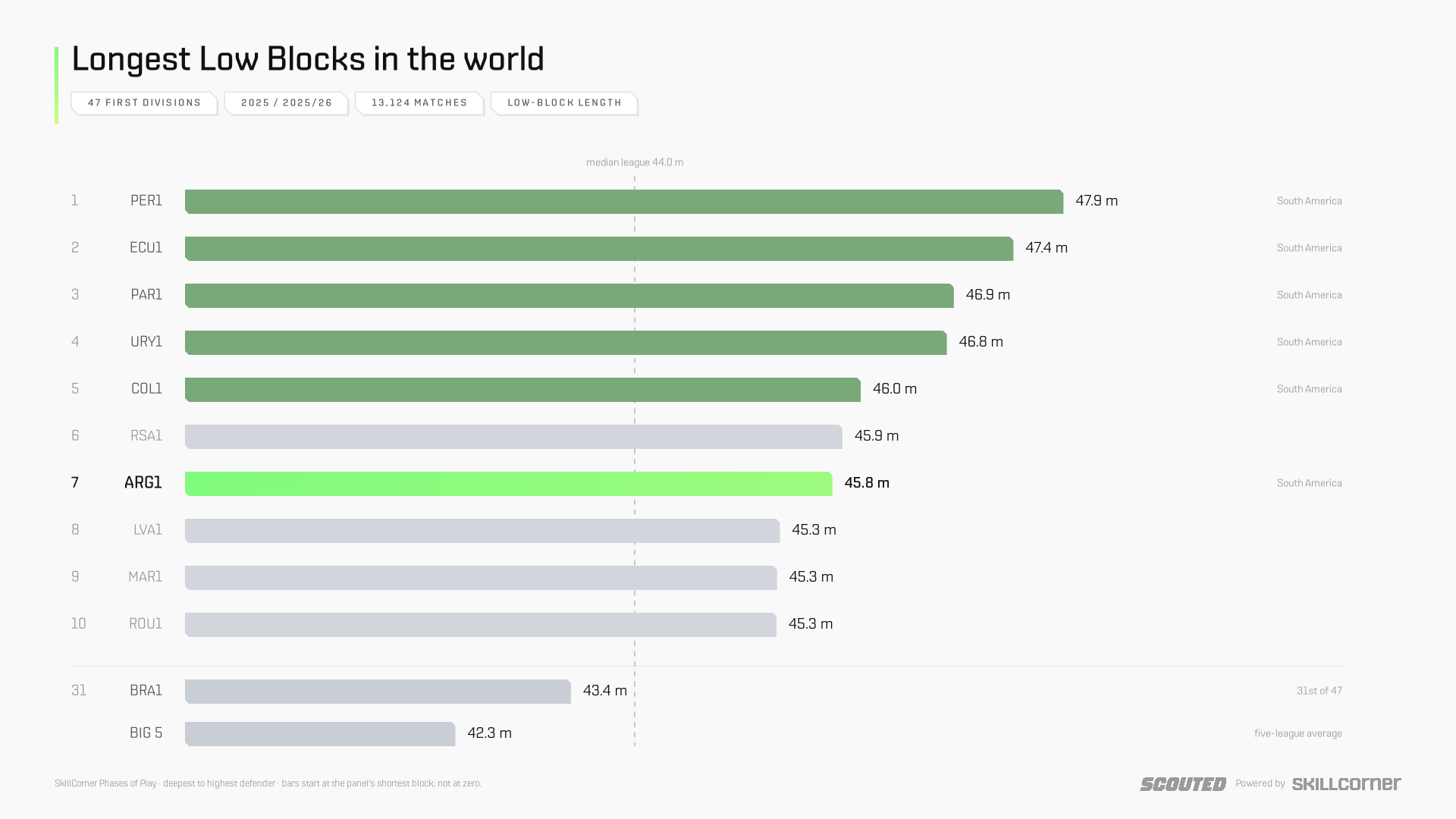
Well, Argentina, and South America in general, have the longest Low Blocks in the world. Six of the top seven are Spanish-speaking South American leagues. That means, of course, that when engaging within it, there is more space to close.
Although the centre-backs in these long Low Block leagues are naturally further away when they choose to engage, the choice to go more often is a behavioural instinct rather than a structural one. Colombia has the fifth-longest Low Block in the world and starts its engagements just as far out, but goes only 1.35 times per minute within it, compared to Argentina’s 1.75 and Uruguay’s 2.26.
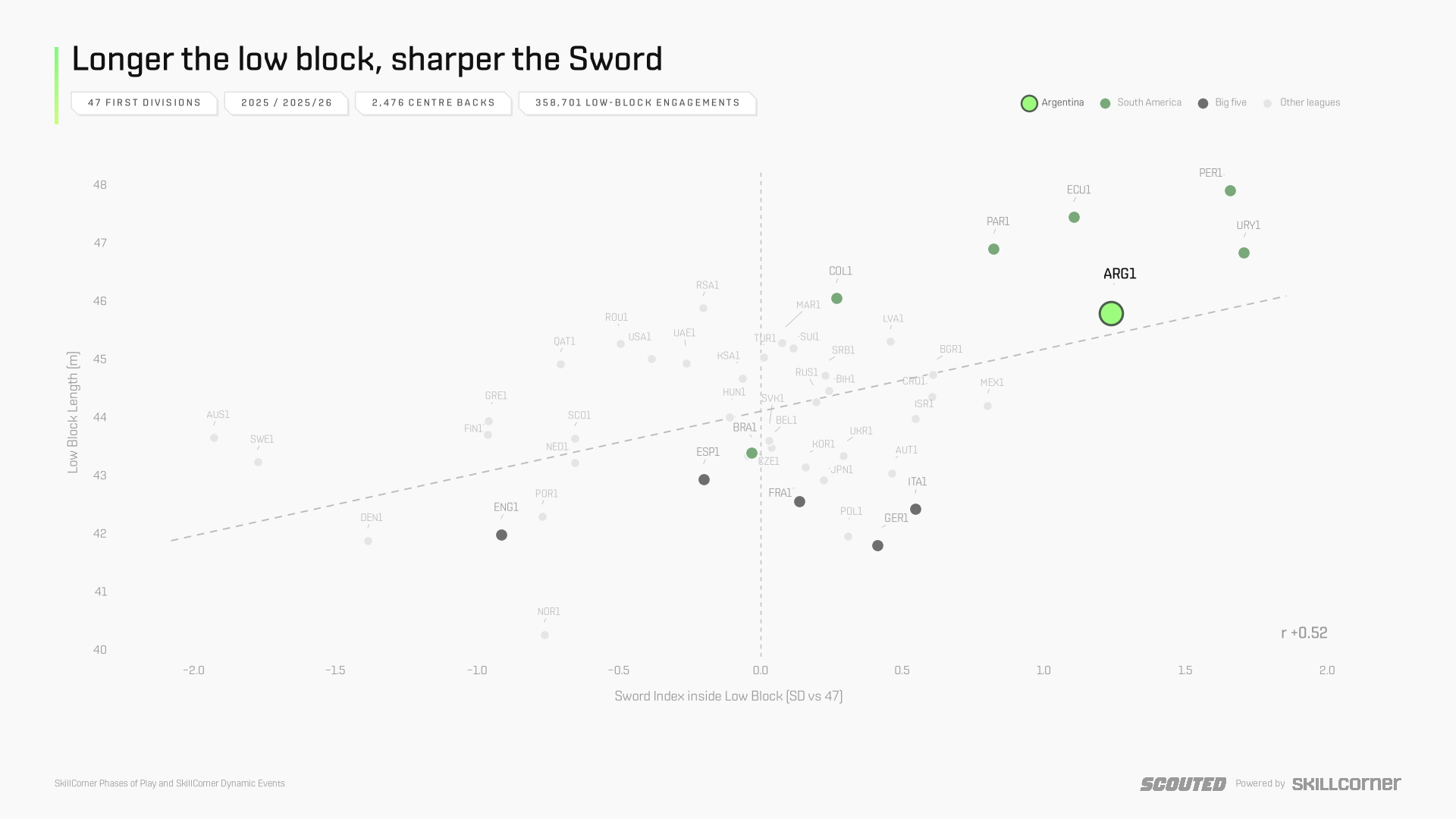
When discussing potential reasons for aggressive defending with SCOUTED’s resident scouts, the hypothesis was that ‘behavioural instinct’ was born out of isolation in the face of danger. But the data disagrees. The increased danger is a perception based on the amount of space in which these engagements take place.
When a centre-back engages in Argentina, the possession he is engaging on not only carries an xShot of 9.2%, third-lowest of the 47 leagues in our pool, but the possession’s peak danger also reaches the third-lowest figure while the escalation between those two figures during the possession is the outright lowest in our dataset. Their share of On Ball Engagements outside their own box is the third-highest, which is similar information communicated by a different metric.
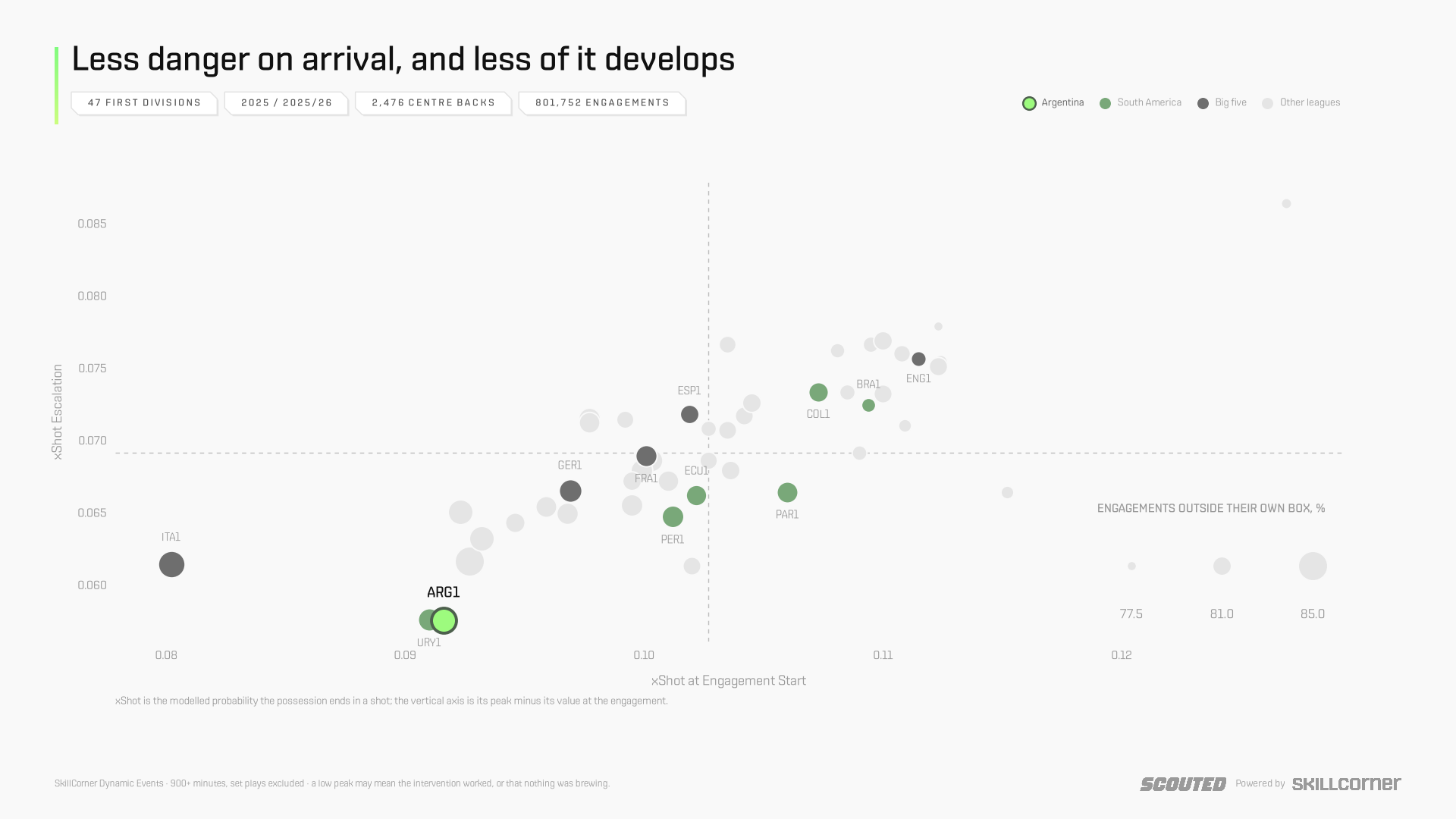
So, by every measure, SkillCorner data tells us that Argentina’s centre-backs do not engage in more dangerous situations. Inside a Low Block, where danger increases for everyone, the possessions they choose to engage in reach the lowest peak danger in the entire pool, and still escalate the least.
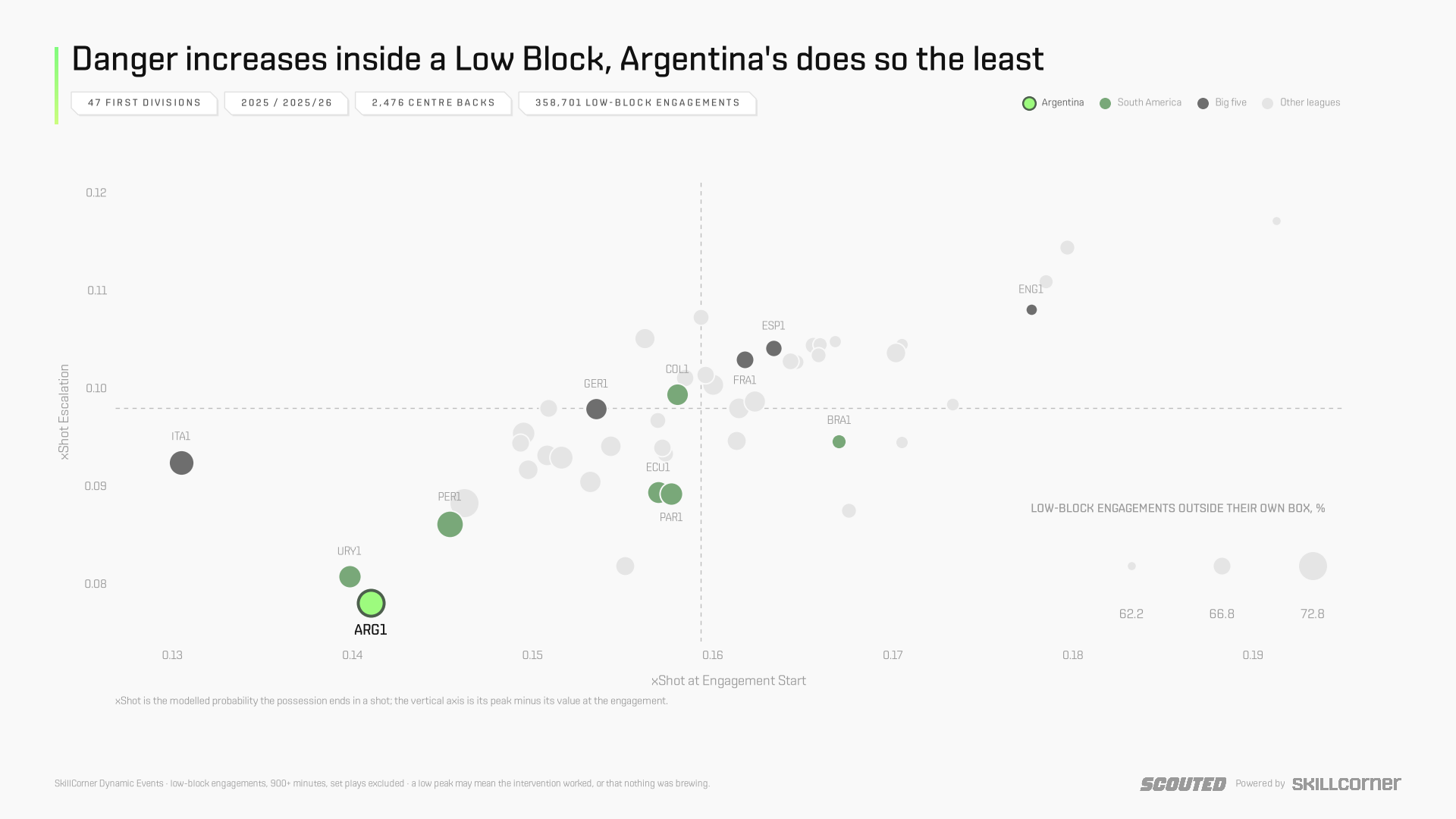
Their aggression is not a reaction to threat, it is a quest to remove it from the equation before it even appears. And that is the definition of a Sword.
The fact that Low Block length is consistent across all Spanish-speaking South American leagues suggests this is the main trigger for these Sword-like instincts to kick in. However, Colombia’s relative restraint shows that it is not a guarantee of it. Even then, it’s safe to say that Hispanic South America is the Sword armoury, not solely Argentina. Peru and Uruguay are even more extreme in exhibiting these traits.

Centre-backs in Hispanic South America are the sharpest Swords in the world: they take each of the top five spots. If you’re looking for aggression, it’s the clear place to go. Within that group, the Argentine variants are among the most polished, carrying the Sword instincts without abandoning the principles that govern Spear and Shield.
So, to finish, we scouted three young centre-backs forged in these fires, highlighting why they may soon arm a European defence.

First up is a SCOUTED favourite and the least extreme profile of the three young centre-backs we have picked out. Rosario Central’s Ignacio Ovando is typically Argentine in that he is on the shorter side (181 cm) and carries that Repeat Bite gene. When he does apply pressure, he is a hands-on, harassing defender, using his speed and mobility to be reactive and to continuously challenge for the ball.
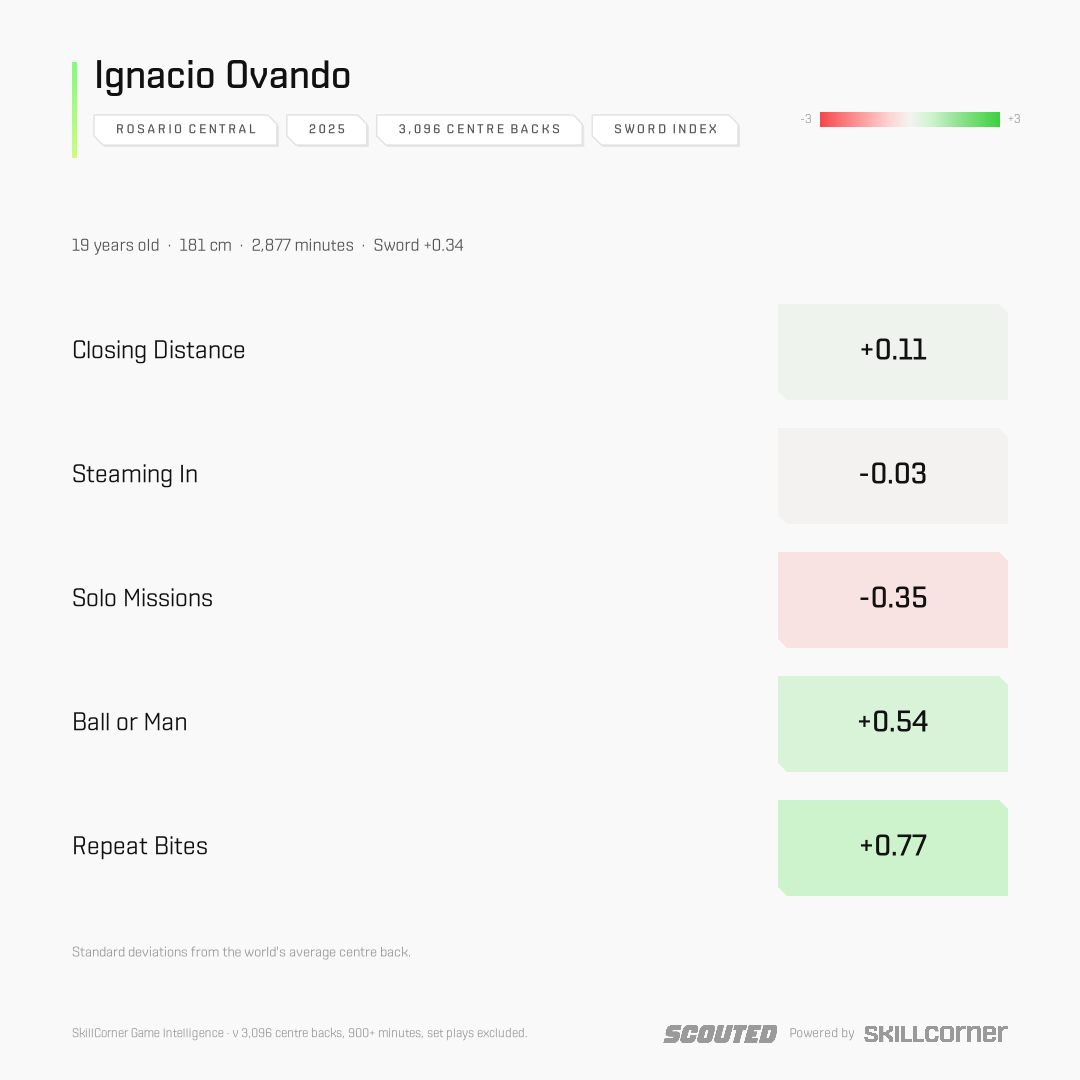
There are some more developments that he needs to make as a box defender and as an aerial duellist, but he has a great feel and timing as a ground duellist/tackler and makes up for a lack of size with competitiveness and aggression.
Next up is a delightful defensive prospect that blends all three Archetypes together. Vélez Sarsfield’s Thiago Silvero stands at 188 cm tall and although he does not steam in at the speed his passport would predict, he takes the ball or man more efficiently than most. This sharp timing is a result of his exceptional reading of the game.
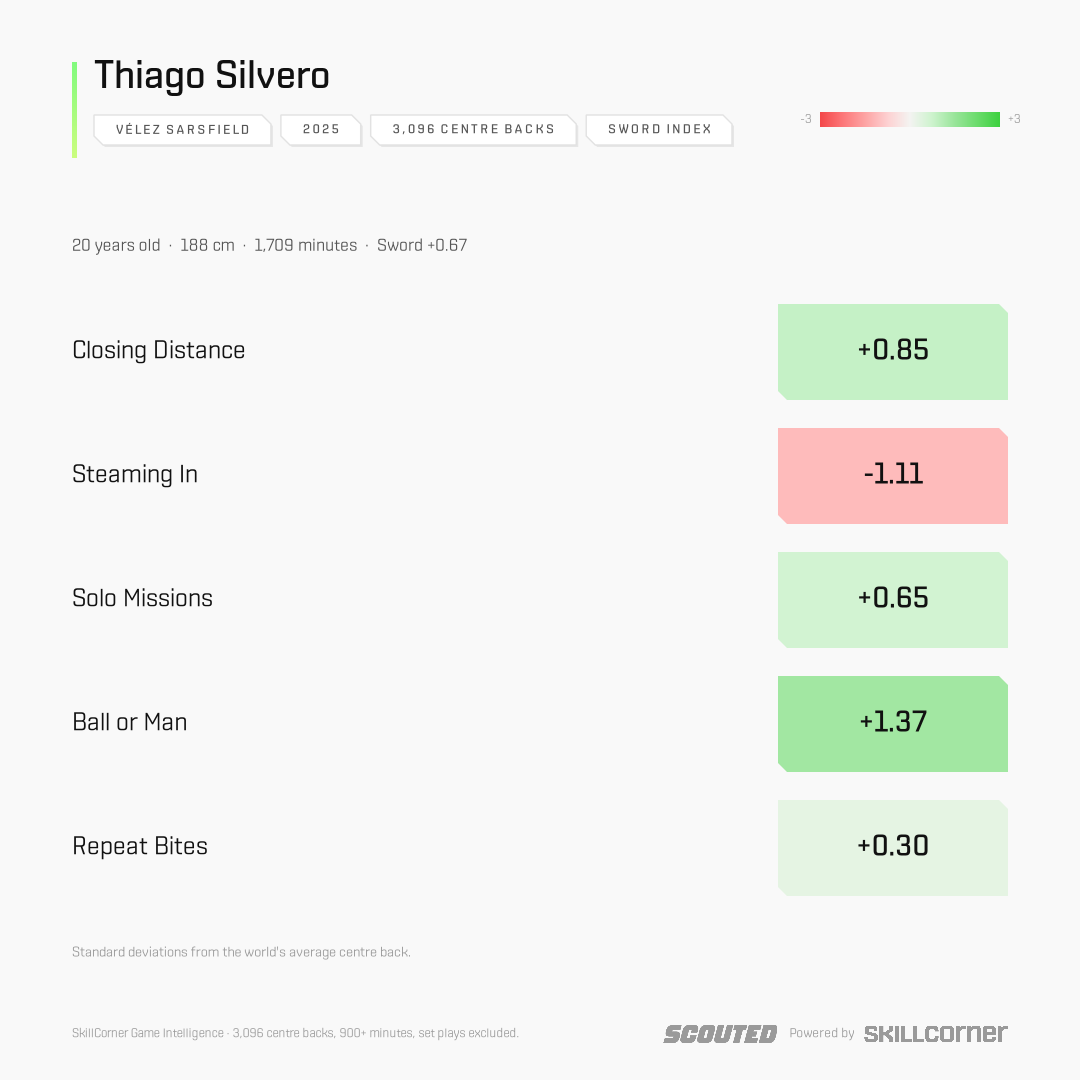
Perhaps the elegance of Silvero’s game isn’t stereotypically Argentine, but he is exposed to a variety of situations. He is left to fend for himself in space, as expected of a Spear, but also ranks above average for goal-side engagements within his own box, like a Shield. Even then, he still exhibits the Sword traits through Pressure Ratio and Closing Distance. Almost a perfect coincidence considering he holds a Paraguayan passport alongside his Argentine one, and Paraguay happens to be the one South American league that keeps the Shield while carrying the Sword.
The new kid on the block in Argentina is also the sharpest blade in the armoury. Mateo Martínez has become a regular with Racing Club over the last few months, personifying the Sword Archetype in the extreme. The 2008-born defender ranks three standard deviations above the world’s average for Closing Distance and amplifies that by Steaming In.
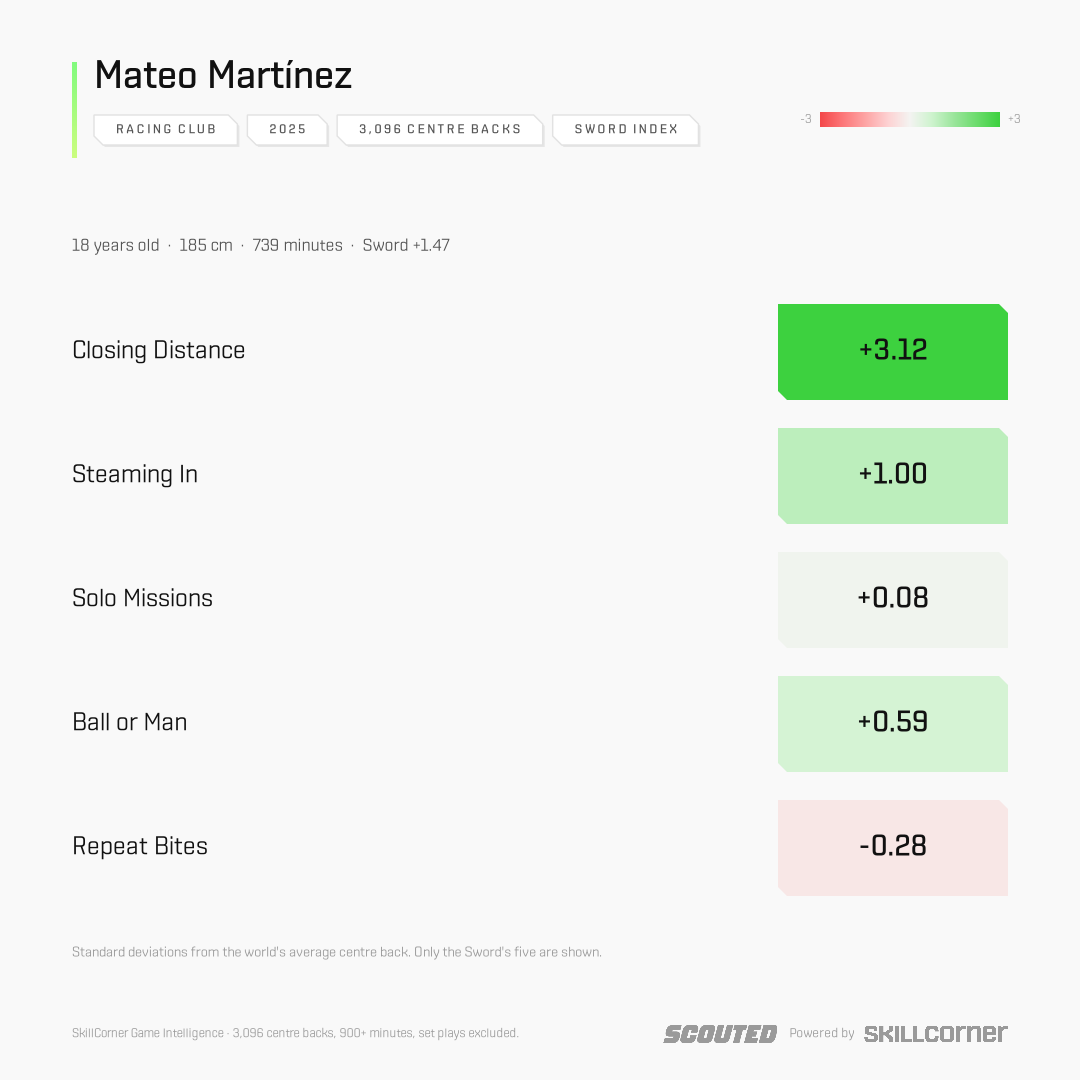
He’s a touch clumsy at times, perhaps still requiring some work on his co-ordination, but he’s physically imposing. He’s billed at 185 cm, but he looks a fair bit taller than that, plus he’s got broad shoulders and a big upper body. For clubs looking for a centre-back fuelled by the famous Argentine fire, Martínez is the standout.

This newsletter was produced in collaboration with SkillCorner, SCOUTED’s official data partners. Their tracking, physical and performance data is used by more than 350 of the world’s biggest clubs, leagues and confederations.

Member discussion