
Scouting Asia for the Championship
How AFC competitions became recruitment hotspots for US-backed English Football League clubs


The EFL Championship is famously one of the most volatile leagues in the world. Now, the ever-increasing US investment across the entire English Football League is making it one of the most global.
As reported by Matt Hughes in the Observer in May 2025:
“All four clubs promoted automatically from the Championship and League One – Leeds and Burnley, and Birmingham and Wrexham respectively – are American owned, while both League One play-off finalists, Charlton and Leyton Orient, have American investors.”
As Hughes highlights, 22 EFL clubs in the 2024/25 season were in American hands. These hands bring budgets for significant player investment - but they’re not building squads with the pieces you might expect. Increasingly, US-backed EFL recruitment teams are finding players in the Asian Confederation, where talent is abundant and value profound.

Support SCOUTED
This analytical epic is free to read courtesy of SkillCorner, our data partners. Subscribe now to keep in-depth content like this coming your way.
Subscribe for freeHow US investment led to AFC recruitment
Following promotion from League One with an EFL-record-breaking points tally, US-based Shelby Companies Limited (SCL) completed a full takeover of Birmingham City in November 2025. The ownership smashed the League One transfer record by signing Jay Stansfield for an initial £15m at the start of that 111-point campaign, and substantial investment continued this summer.
Their most expensive signing this time around was the €9m acquisition of Kyogo Furuhashi from Rennes, a season after his €12m switch to Ligue 1 from Celtic. He was the third Japanese player the Blues had signed since the start of last season.
This is representative of a wider Championship trend. While American multi-millionaires are taking advantage of the accessible entry to club ownership the EFL presents, the transfer budgets they provide are increasingly invested into FIFA’s AFC nations.
As per Transfermarkt, Japanese players represent 0.6% of the EFL Championship’s non-English player pool since the start of the 2004/05 season. In 2025/26, this figure stands at 2.7%.
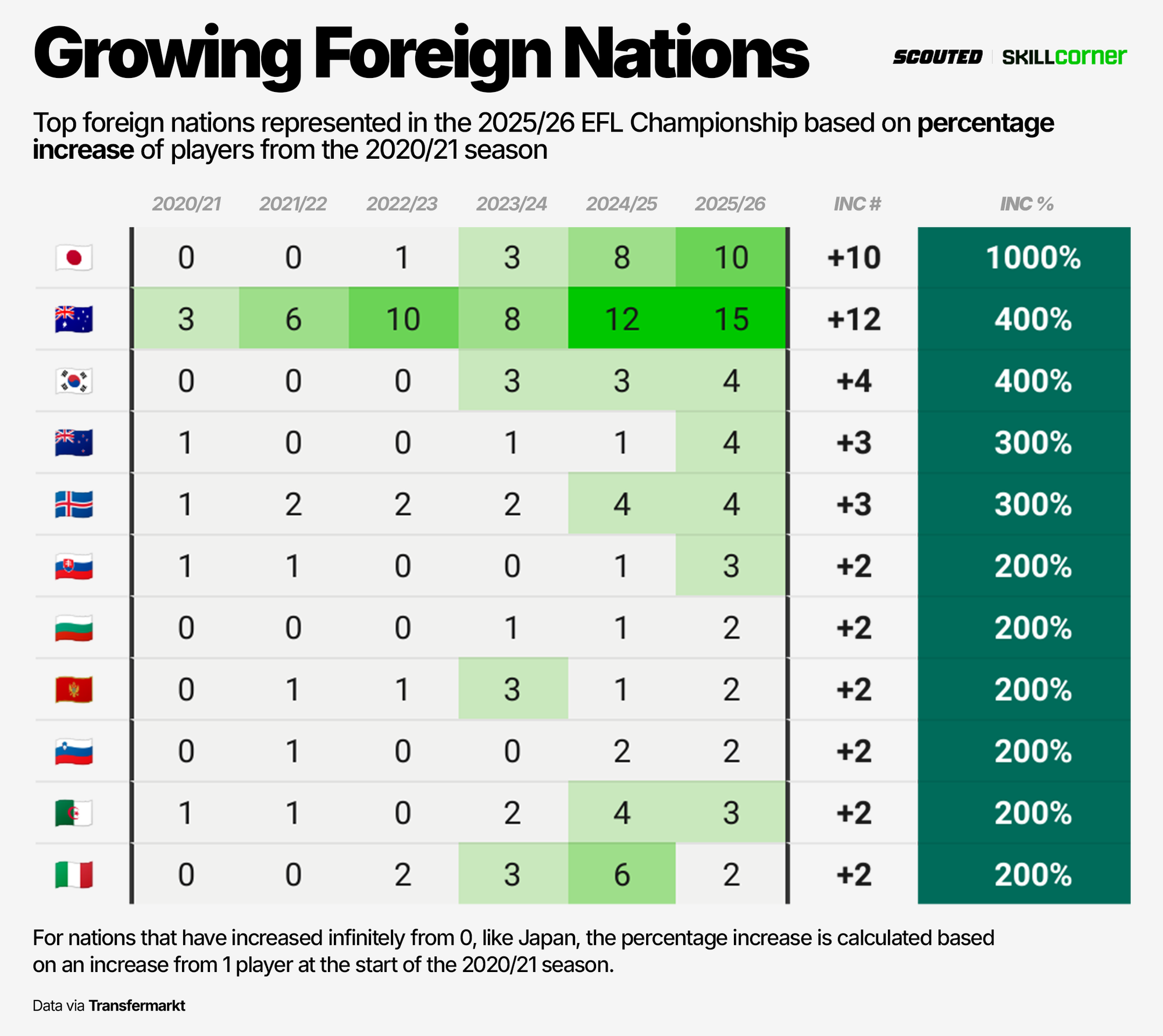
If Americans are the most trendy EFL owners, AFC players - particularly Japanese - are the most trendy transfer targets. How did that happen?
Belgian clubs, as is becoming a theme, were ahead of the curve. The EFL’s awareness of Japanese players in Belgium might be traced back to Vincent Kompany’s mass introduction of Pro League players in 2023/24. His 103-point Burnley side - backed by Velocity Sports Partners, the sports investment arm of American management firm ALK Capital - signed nine Pro League players during Kompany’s two seasons in the Championship.
In 2024/25, only France (6.5%) represented a larger share of the Pro League’s foreign talent pool than Japan (6.2%).
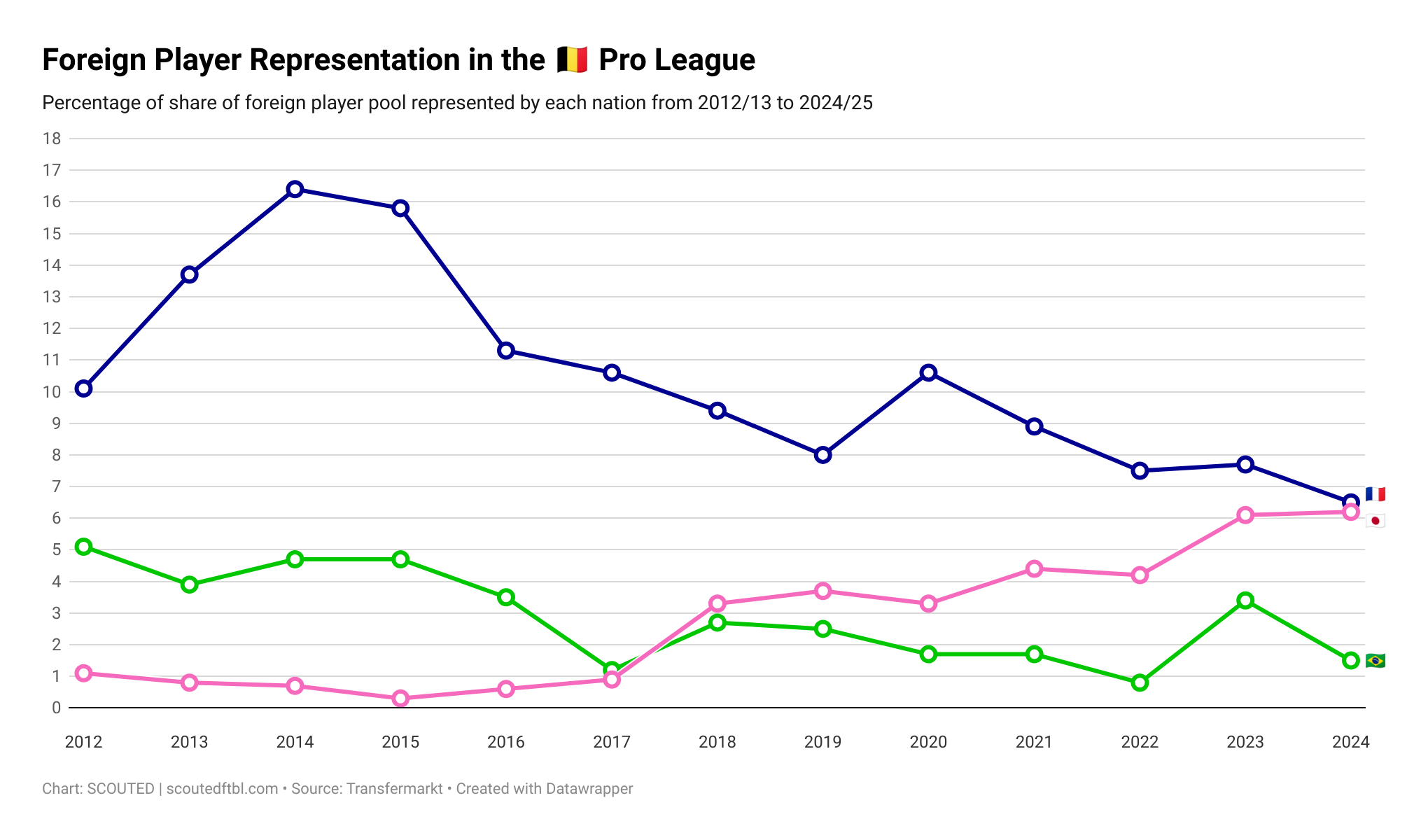
Belgium’s recruitment there reflects the rapid development of the J1, J2 and J3 Leagues. Japan is the confederation’s closest match to Europe’s top five leagues, as SCOUTED has highlighted with SkillCorner data since April 2024. There is still a gap, but Japan’s effort to close it has transformed the J Leagues into trending recruitment hotspots.
We shouldn’t dismiss the rise of Australian and South Korean players in the Championship, either. Although, the jump to the EFL is much bigger from the A and K leagues than it is from the J divisions.
Either way, if you own a team and have a bunch of U.S. investment to spend and you know to skip Belgium and look directly to the AFC. But how do you find the right players?
How to write a shopping list
To buy players for your team you must first understand it. Let’s take a look at our three US-backed Premier League promotion-chasers: Millwall, Ipswich Town and Birmingham City. Plotting these clubs based on the Percentage of IP Time in Build Up and Percentage of IP Time in Direct phase creates a spectrum of styles. This is neither good nor bad. It’s purely stylistic.
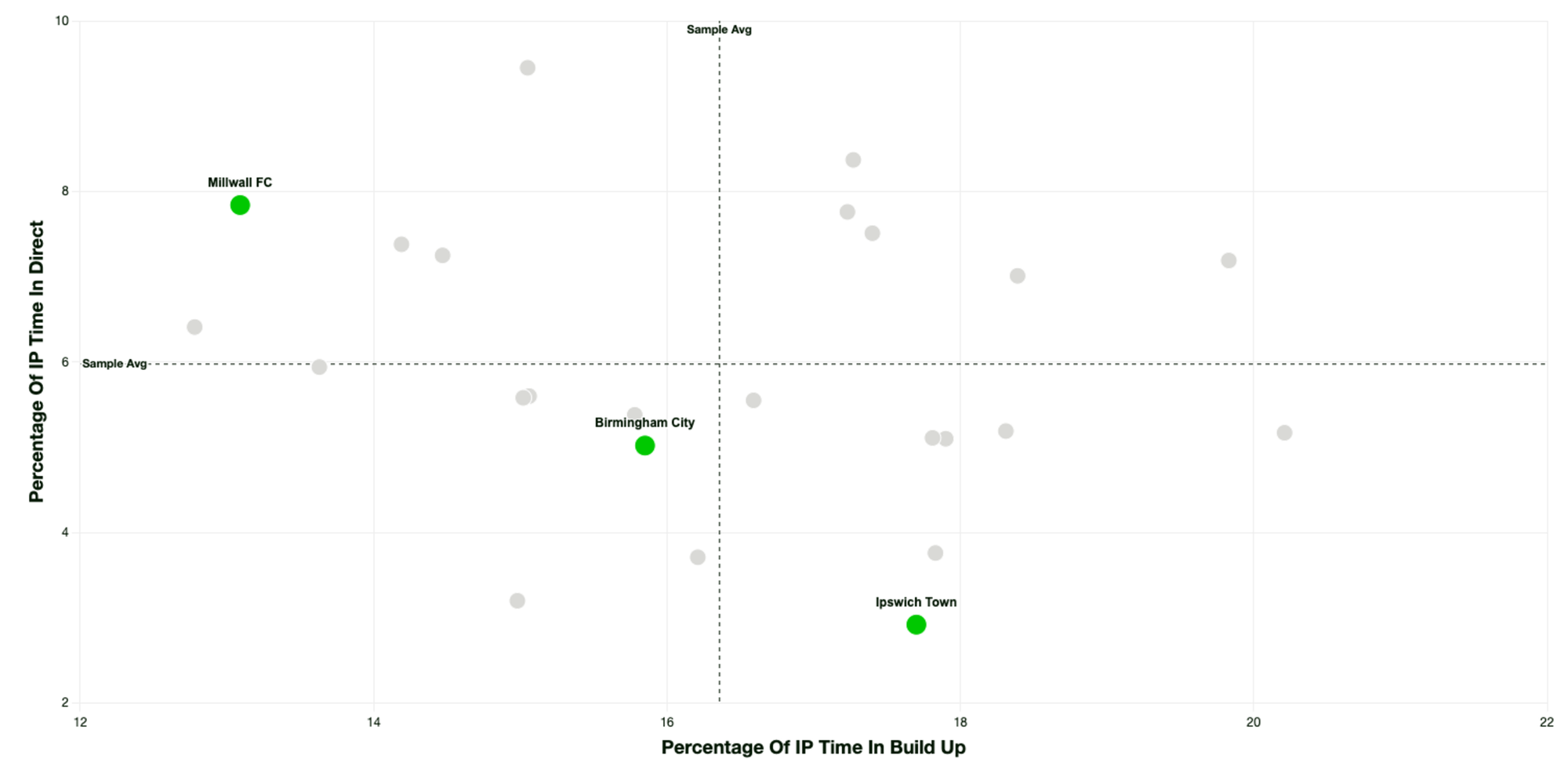
Ipswich, as the well-resourced, recently-relegated Premier League team, spend the most time in Build Up, stitching together moves in their own third. Meanwhile, Millwall profile as a more ‘traditional’ EFL club, spending a larger proportion of their time going Direct. Birmingham City sit somewhere in-between. However, a closer inspection of all IP phases helps us to build more robust team profiles.
In Possession (IP) Phase Definitions
- Build Up: Ball in possession in own third, opposition applying pressure / position high
- Create: Ball possession in middle, or attacking third, average position of opposing 3 defenders > 26.5m from their goal line
- Finish: Ball possession in middle or attacking third, average position of opposing 3 defenders < 26.5m from their goal line
Millwall rank first for percentage of IP time in Set Play and second for Quick Break and Chaotic phases. The Lions live for the second-ball, Ipswich and Birmingham are more controlled and more patient. In general, possession-orientated sides spend a larger majority of time in all three phases; the most dominant teams will be outliers for Percentage of Time in Create and Finish.
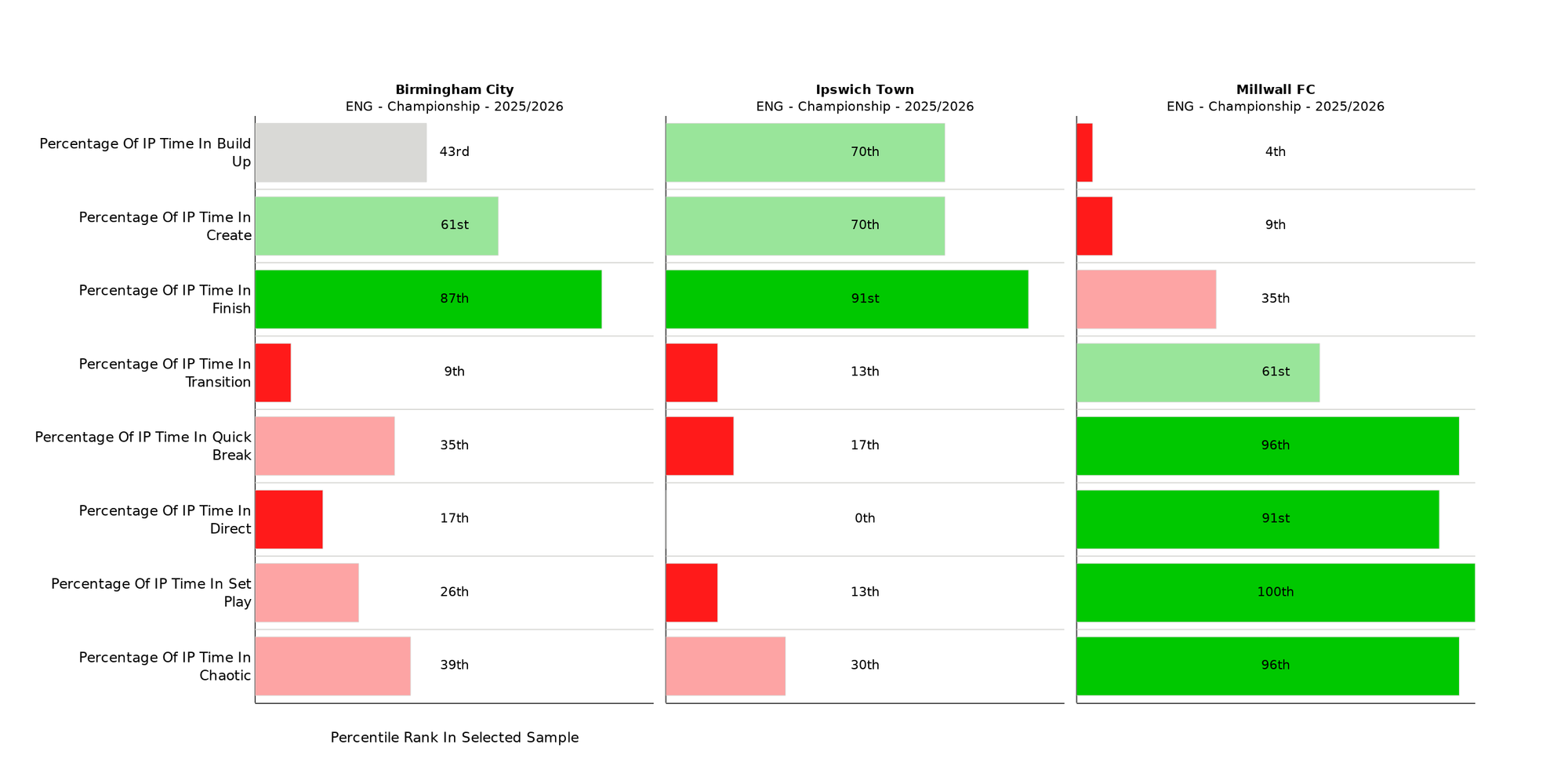
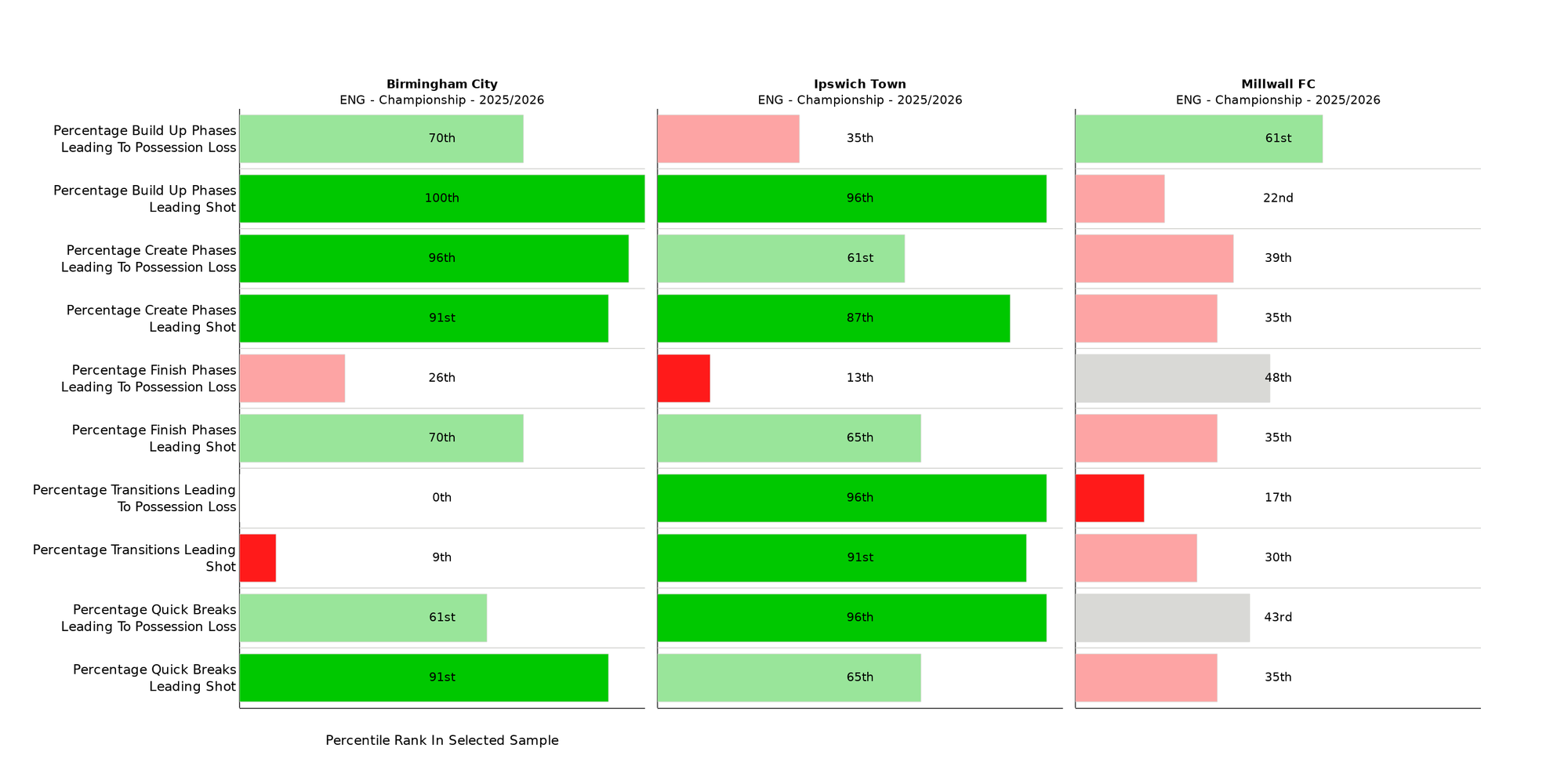
When looking at the outcomes of these IP Phases, Millwall's position as the lowest scorers in the top half of the table begins to make sense. Even when focussing on their outlying IP Phases (Quick Break, Set Play and Chaotic), they rank poorly for both Percentage Leading to Possession Loss and Percentage Leading to Shot. Here’s a problem area we can look to solve when we start scouting the AFC.
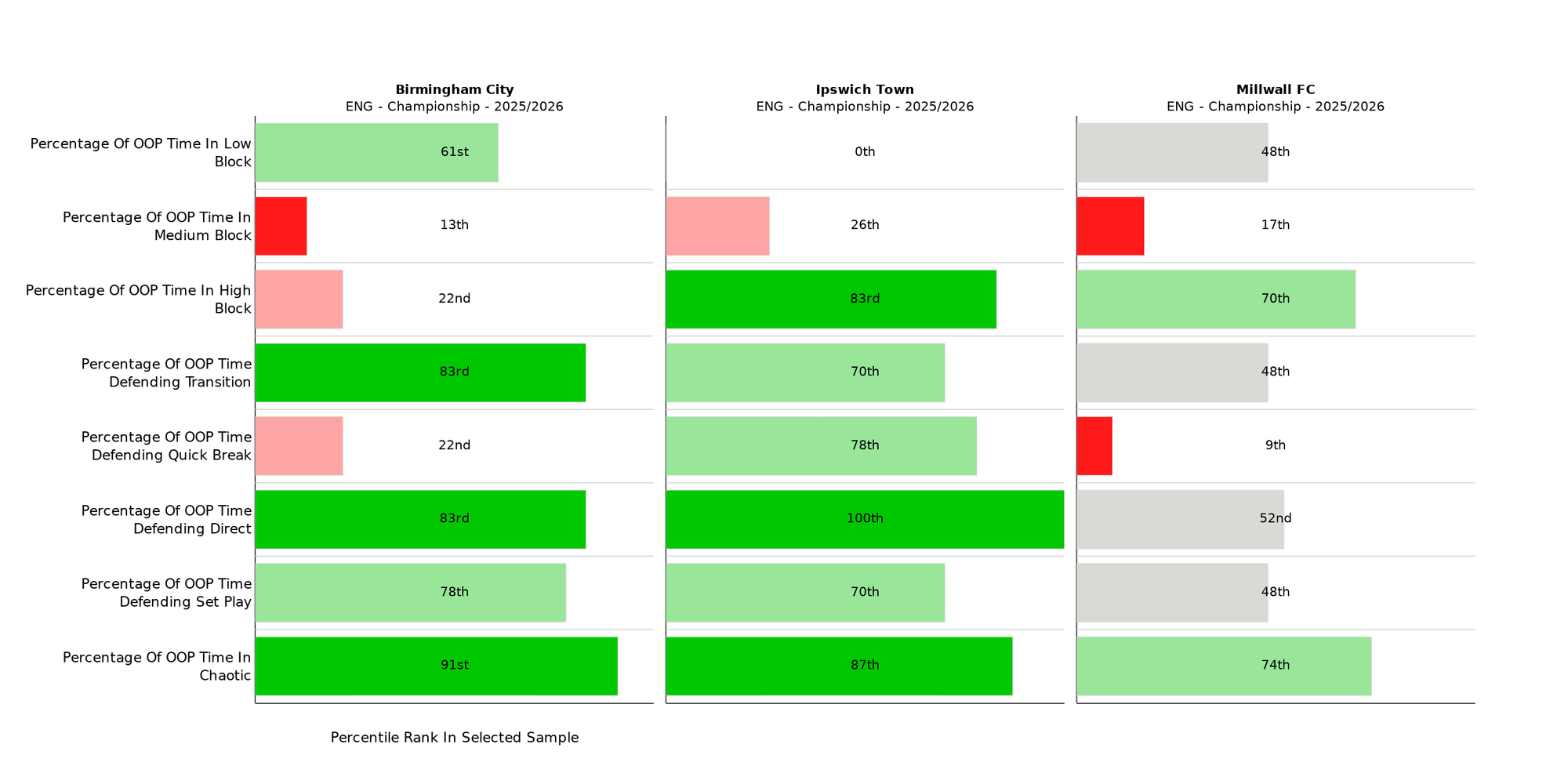
However, the Lions do dispel the myth that direct football is conservative by nature. They spend a similar amount of OOP Time in High Block as Ipswich (17.9% vs. 18.8%).
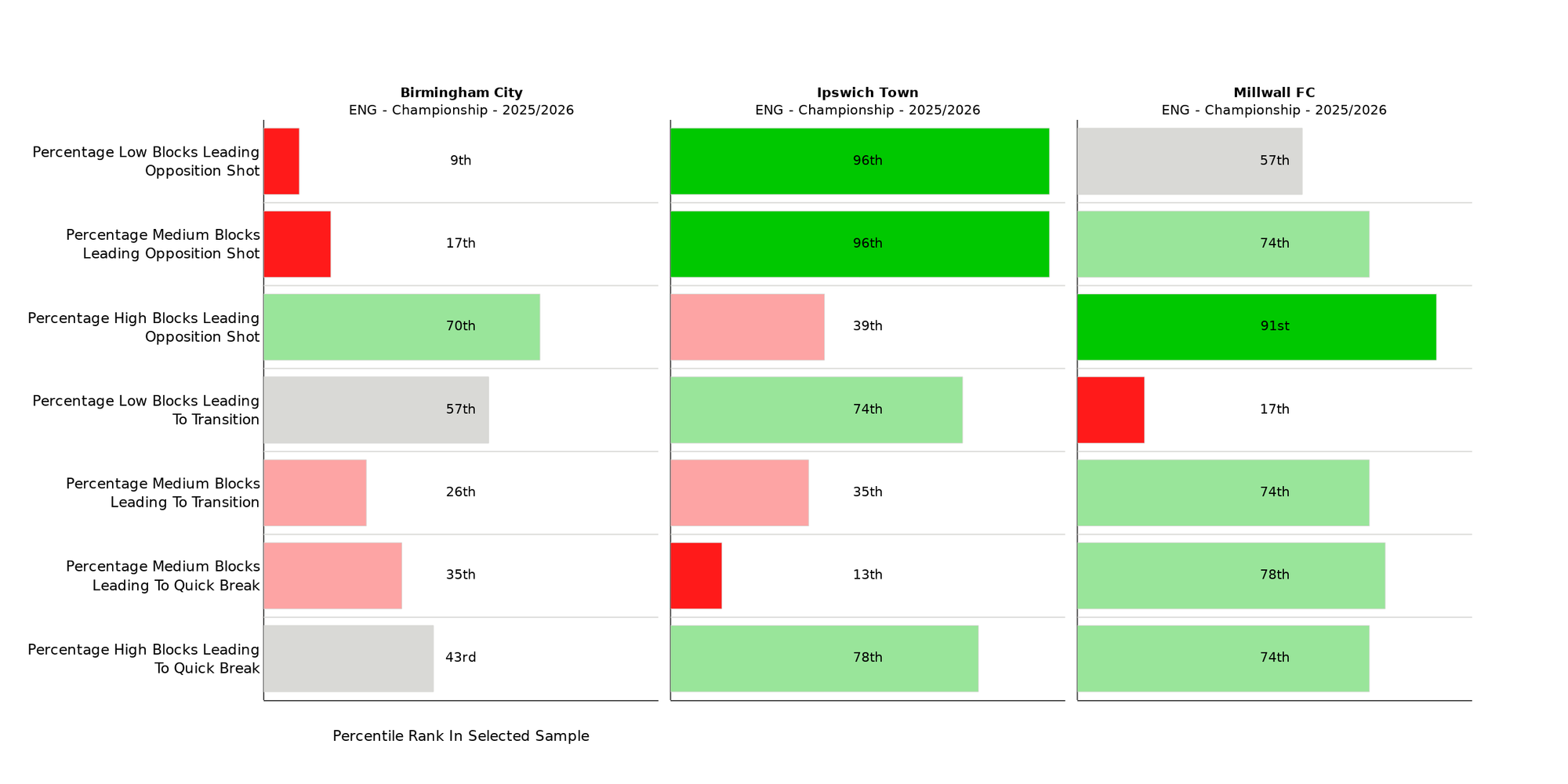
They are also efficient both in terms of preventing opposition shots when in High Block as well as turning them into Quick Break opportunities. Ironically, Ipswich are the second-most efficient team in the league at stopping opposition shots when parking the bus tractor.
A key question to ask when scouting, specifically data scouting, is: what type of situation am I expecting this player to find themselves in most often? That then enables you to focus on specific attributes and traits that will give them the advantage in that scenario; the rock to the scissors, the paper to the rock.
Based on these team profile snapshots, we can therefore go shopping in the AFC for three different profiles to address potential weaknesses:
- For Millwall, an effective and efficient player in Transition and Quick Break situations that will also help turn more successful High Blocks into Shots.
- For Birmingham City, a player that can control the chaos and help defend the larger proportion of transitional attacks they face.
- For Ipswich Town, a player able to resist opposition pressure in the Build Up phase and flip it into positives with passing.
Shopping for Millwall
Ota Yamamoto, who spent the 2025 season on loan at Renofa Yamaguchi in the J2 League, could be a suggestion for all three teams. His Physical output is incredible. The 21-year-old was one of three Midfielders across our sample to rack up 100+ High Intensity Actions per 90, a key Physical metric. But the truth is that he’s a standout player for almost every single Physical datapoint, even within the context of Pro League and Championship players.
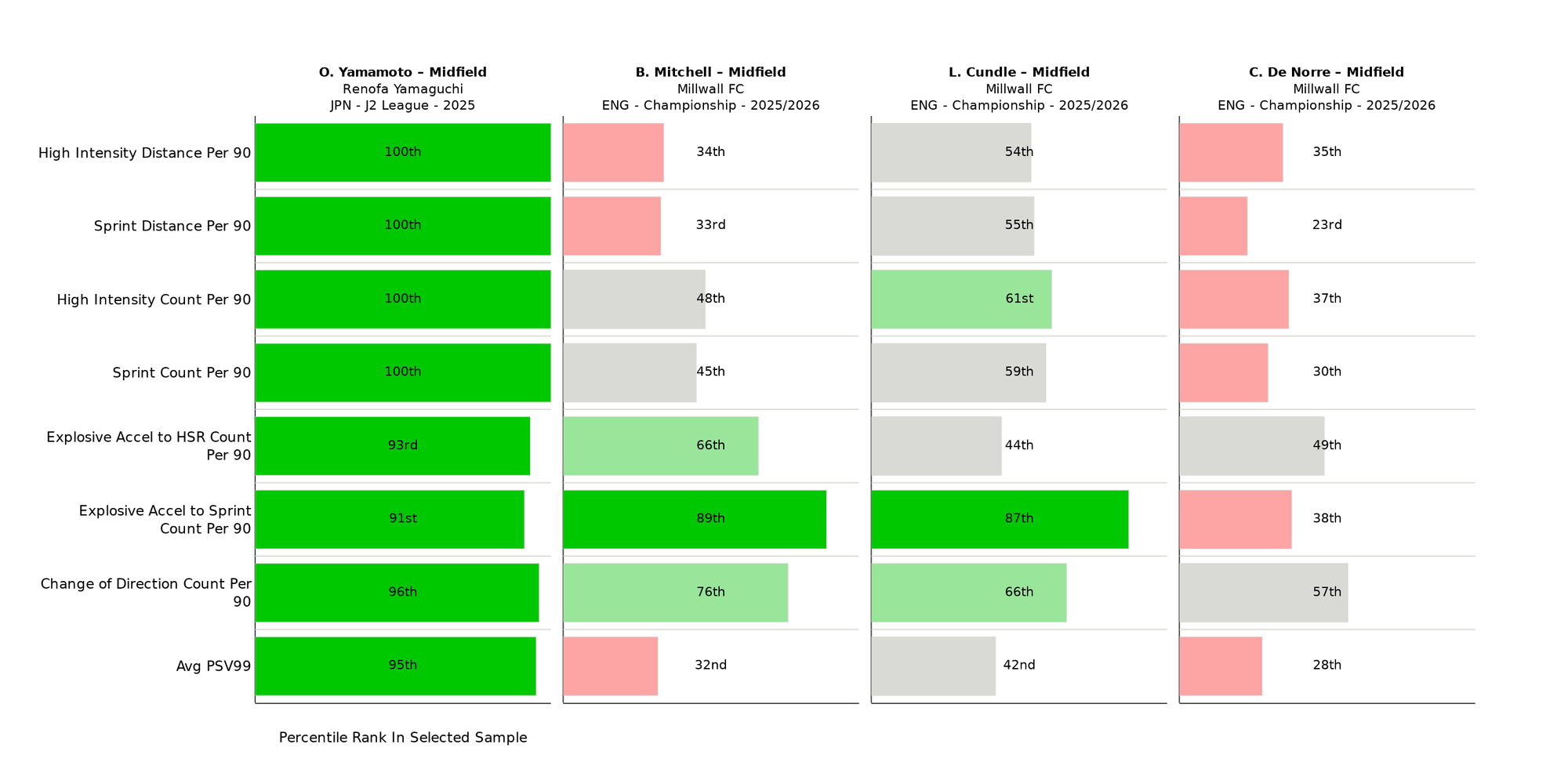
In terms of his stylistic fit to Millwall, his outlying IP Phase is Transition - that matches our search for a player that is used to transforming turnovers into attacks. Yamamoto is also a top 15% Midfielder for On Ball Engagements (OBE) in Low, Medium and High Block as well as for all OBE Types. He should be able to pick up Millwall’s pressing habits.
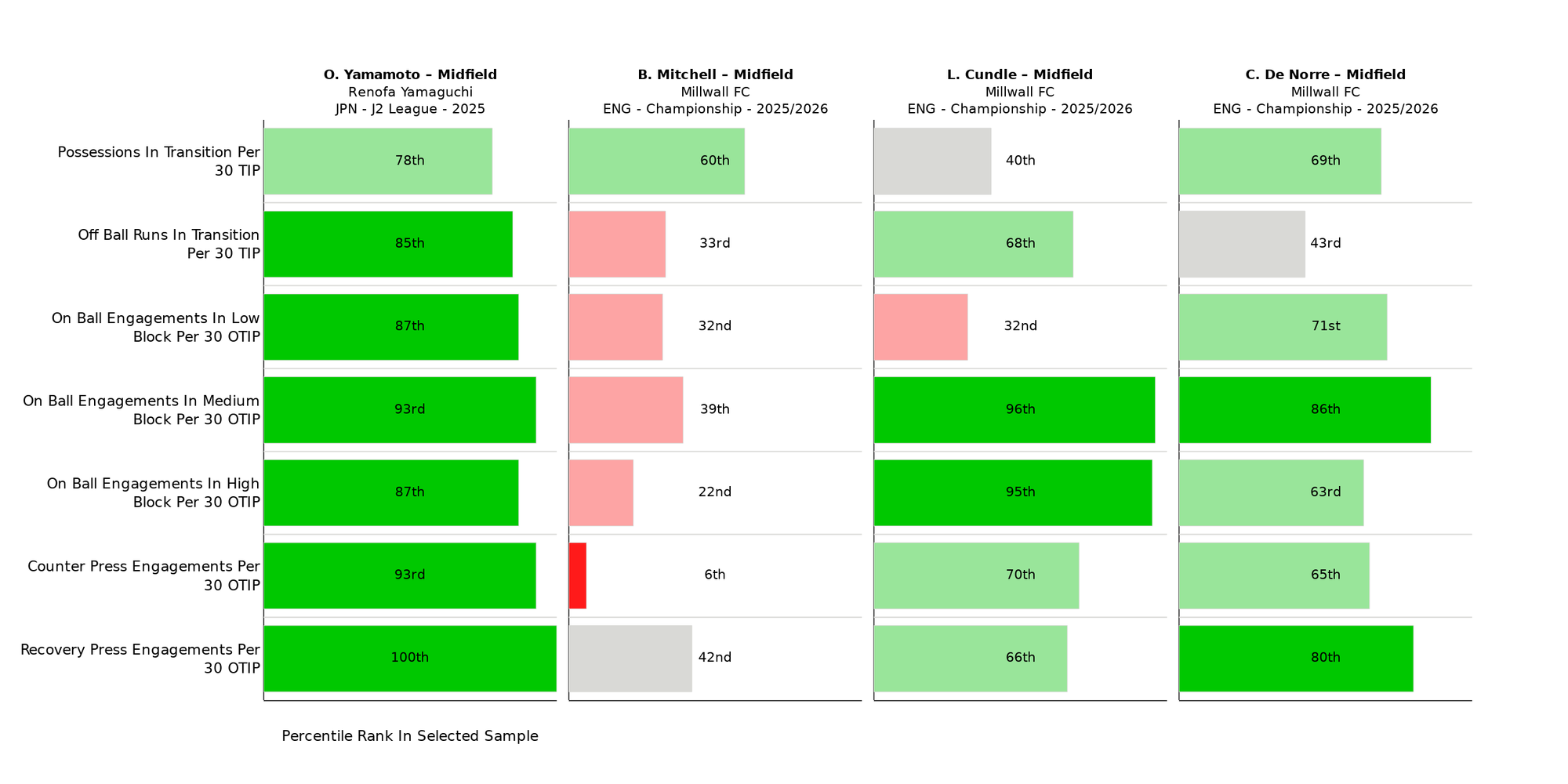
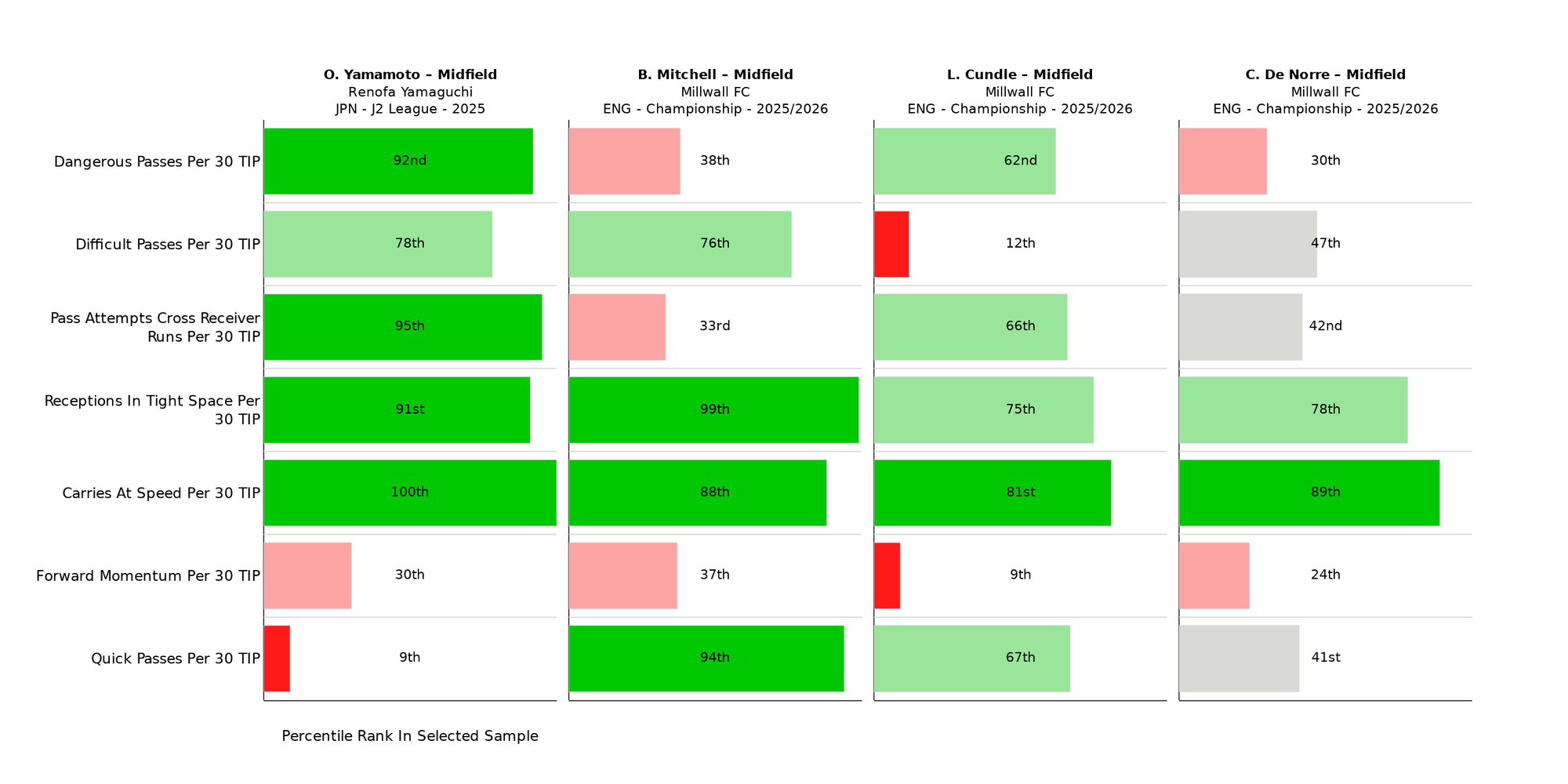
As for what he can add to the team, ranking in the top 5% for Dangerous Passes and Carries at Speed suggest he will add the required intent and threat in those Quick Break situations.
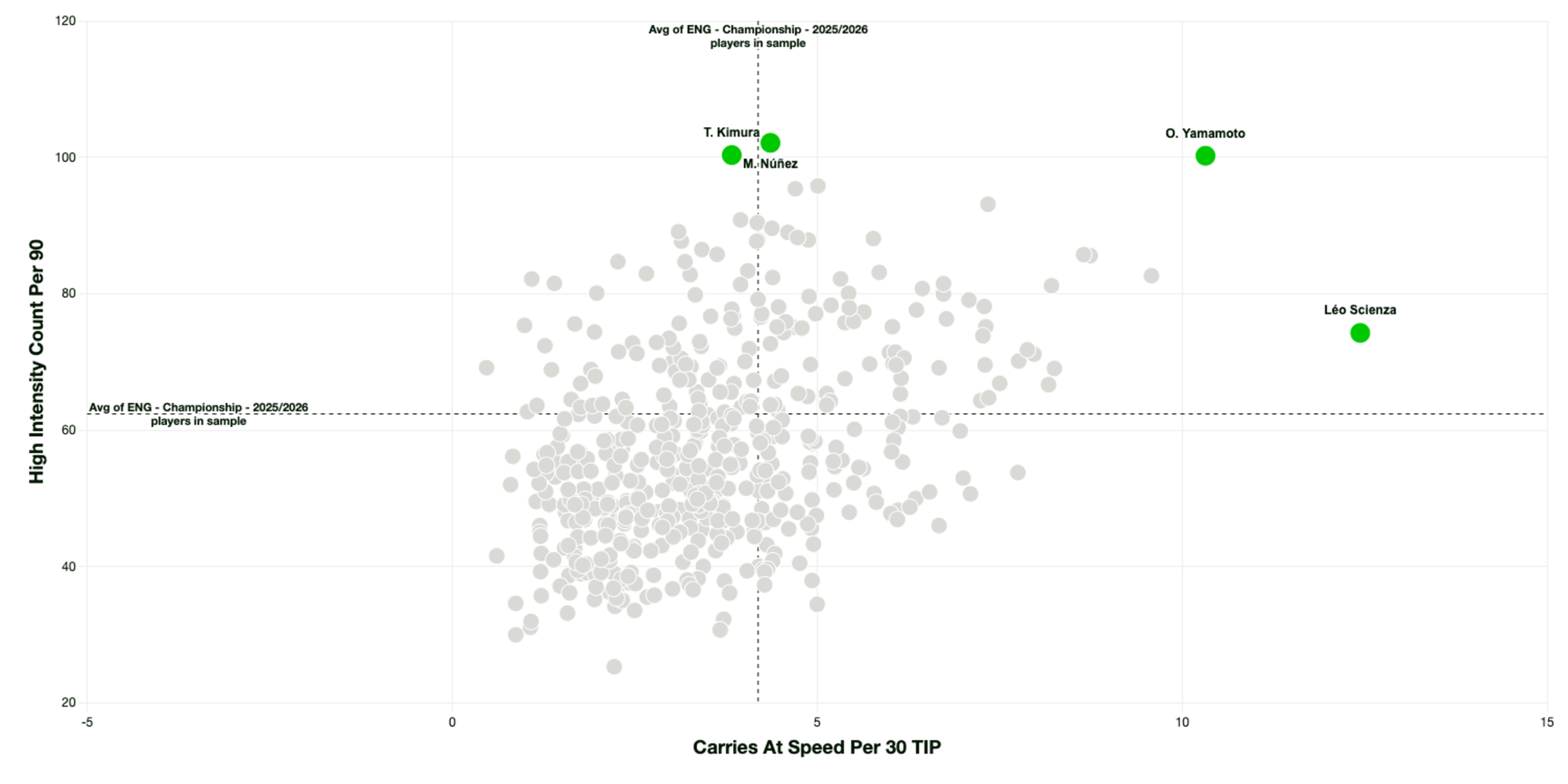
When compared to Midfielders across all leagues, only Léo Scienza - a successful summer recruit for Southampton - ranks above him for Carries at Speed per 30 TIP; these two are the only players that average 10+ Per 90. For High Intensity Count per 90, only Marcelino Núñez and Takaya Kimura rank above him.
Yamamoto is a fascinating prospect and would operate best as the attacking midfielder or advanced #8 for Millwall as they switch between a 4-2-3-1 and a 4-1-4-1. But he’s also logged performances on both wings and even up top - although this was part of a strike duo and he wouldn’t be suited to Millwall’s demanding lone centre-forward role.
Waiting for him to log a J1 League season at parent club Kashiwa Reysol may be a season too late.
Shopping for Birmingham City
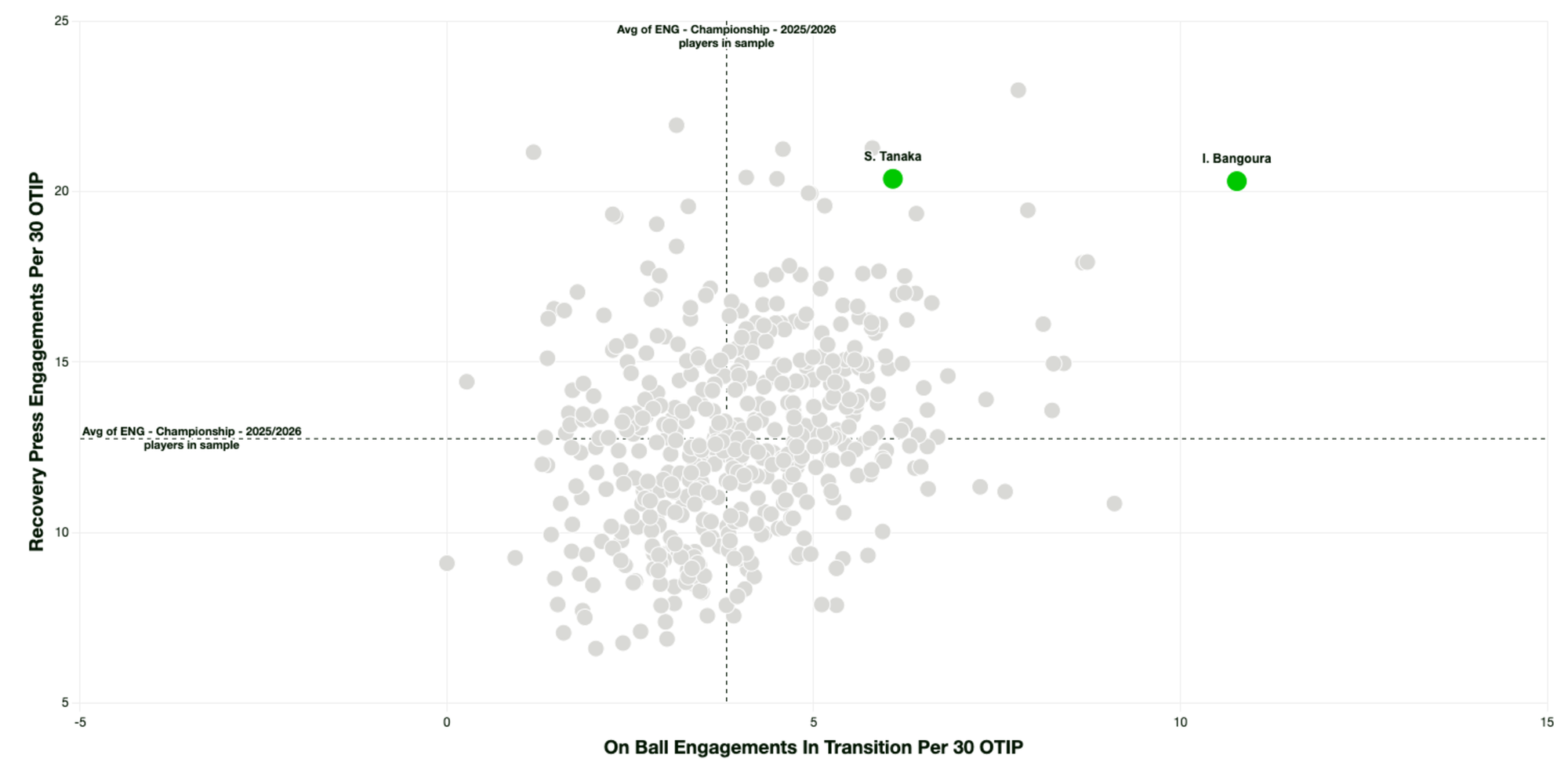
Satoshi Tanaka of J1 League’s Sanfrecce Hiroshima profiled as a fire-fighting Midfielder to help the Blues control the chaos. In the 2025 J1 League season, he ranked in the top 5% for OBEs in Transition and Recovery OBEs - he’s used to the situations we expect him to find OOP at Birmingham City.
As for his ability to deal with them, his top 10% value for PSV-99 suggests that he would be able to scale to the greater physical demands and it may also explain why he is able to consistently Get Close to opponents.
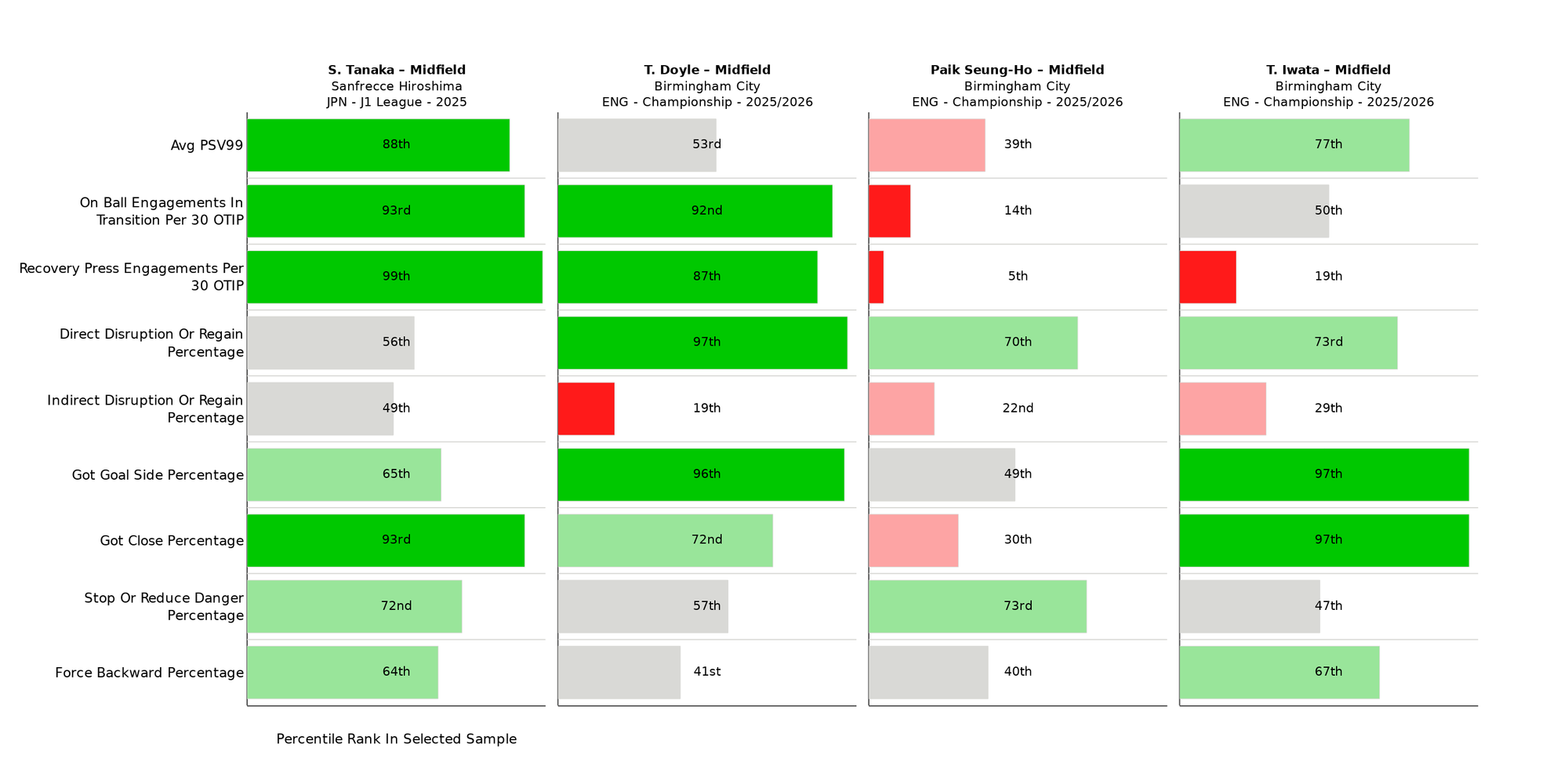
As a combined value, Tanaka either Directly Disrupts (4.53%), Indirectly Disrupts (19.53%), Stops or Reduces Danger (13.73%) or Forces Backwards (6.72%) with 44.5%. Those OBE Outcomes become even more impressive when you consider he ranks in the 94th percentile for OBE per 30 OTIP, recording 79.97. He’s effective and efficient.
The only issue is that during the editing process for this article, Tanaka was signed by Fortuna Düsseldorf at the start of the January window. Yes, you’re right, it was also Fortuna Düsseldorf that signed Ao Tanaka before he later moved to and won promotion to the Premier League with Leeds United. Perhaps Birmingham City could speed up the inevitable journey to the Championship by signing Tanaka 2.0 this summer.
Shopping for Ipswich Town
We’ve found two vogue Japanese players Championship clubs could target in January and beyond. But when trying to address Ipswich Town’s issue, the A-League came calling.
Paul Okon-Engstler is the son of former Australian international Paul Okon. Born in Belgium while Paul Sr was playing for Oostende, Paul Jr was recently capped at senior international level by Australia after an impressive showing at the base of the Young Socceroos’ midfield at the U-20 World Cup. His composure, assurance and technical execution on the ball are all hallmarks of a player that spent three years at S.L. Benfica’s esteemed Seixal academy.
So far in the 2025/26 Men’s A League, Okon-Engstler ranks first among Midfielders for Pass Attempts Through First Line per 30 TIP and Pass Attempts Around Second Last Line Per 30 TIP. When looking at Overcoming Pressure metrics specifically in the Middle Third, he is the only Midfielder averaging >90% for Ball Retentions under Pressure, only dropping slightly from 91.84% to 88.9% when cranking up to Ball Retentions under High Pressure.
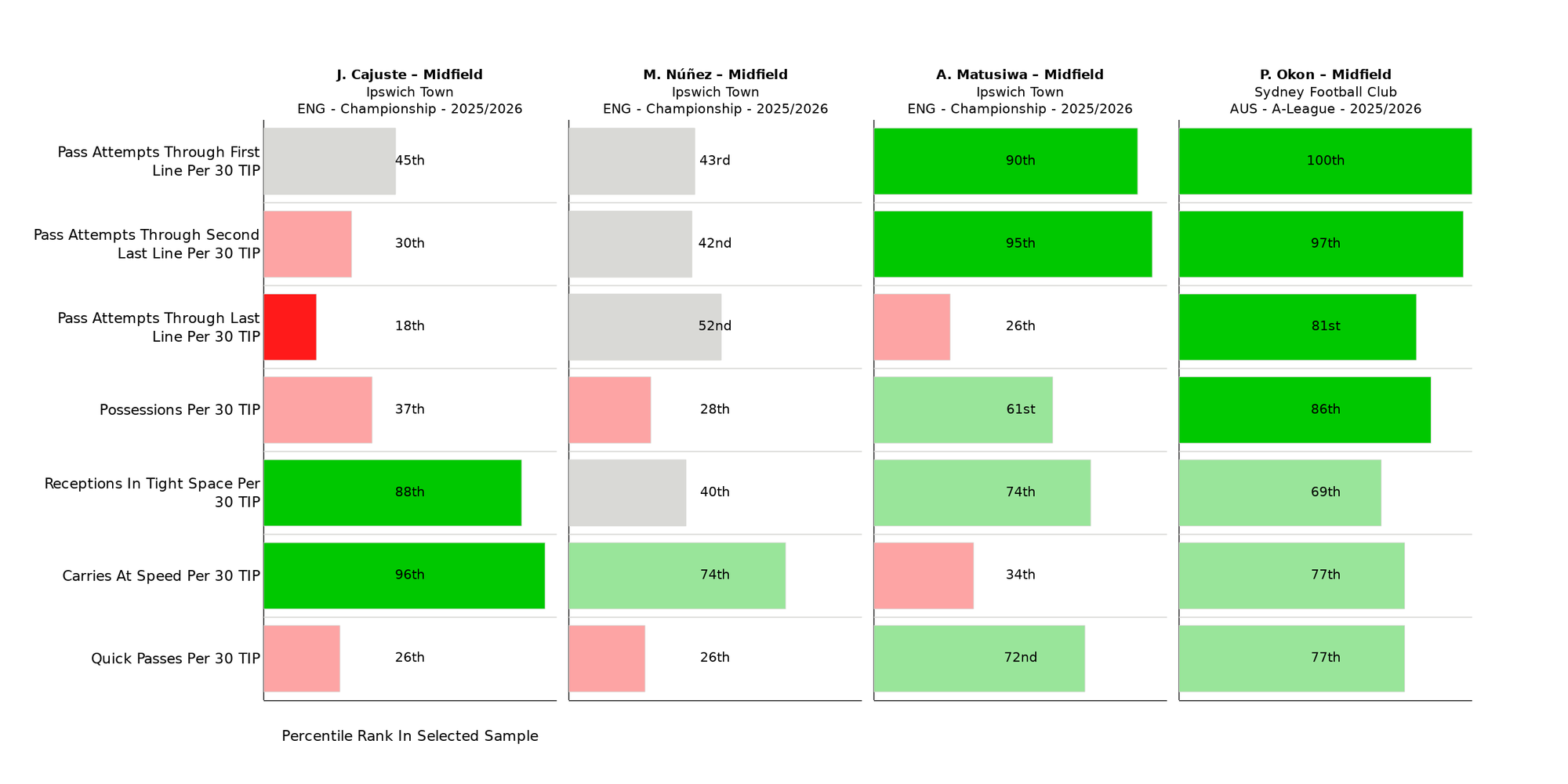
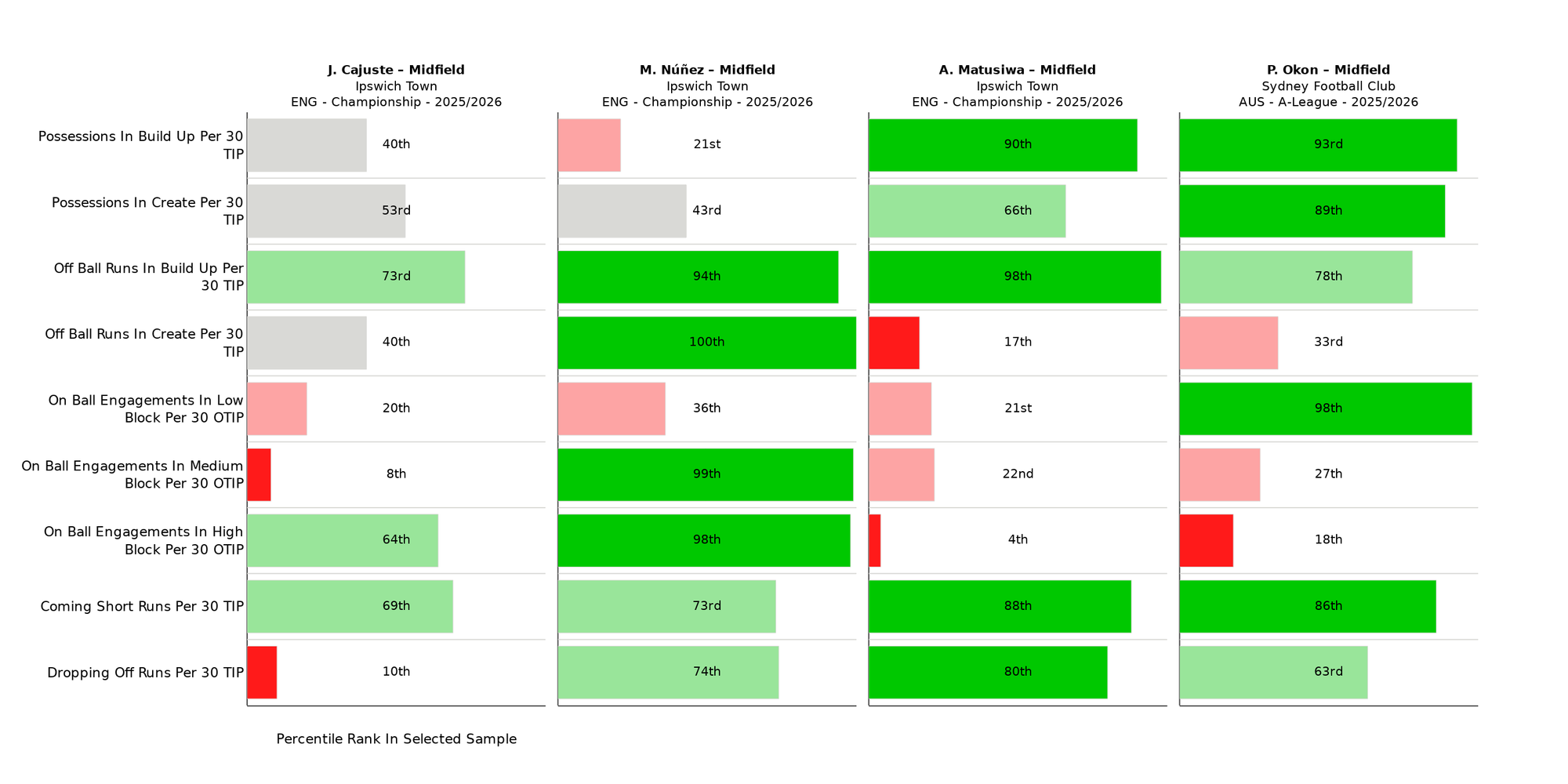
He’s also operating in a relatively similar environment to the one he’ll find at Ipswich. He ranks first among Midfielders for OBEs in Low Block Per 30 OTIP, which could boost their efficiency at disrupting opposition attacks in that shape. But, more importantly, he also ranks first for Recovery Press Engagements Per 30 OTIP - which highlights a familiarity with chasing back after turnovers.
In possession, he sees more of the ball than most Midfielders in the Create phase, but his combination of Coming Short Runs with the Passes Through the First Line highlighted earlier paint the picture of a player that can drop all the way into the Build Up phase to aid progression.
The main concern is physicality. As we have seen, the physical jump from the A League to the Championship is much bigger than the same leap from Japan. Ipswich, as expected from a recently-relegated Premier League side, are also one of the hardest running teams in the Championship this season. This would require some getting used to.
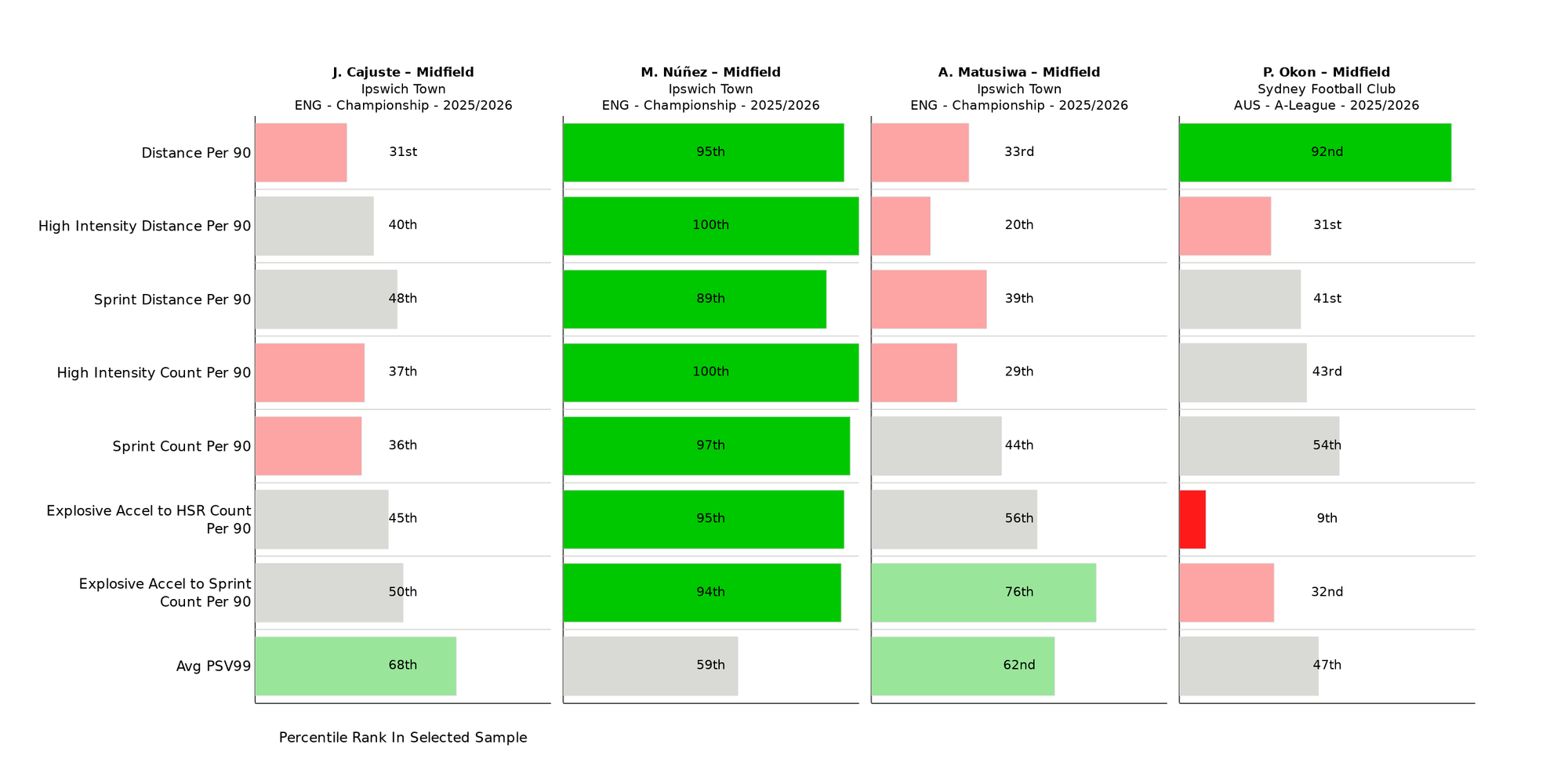
However, the style and substance of Okon-Engstler’s passing is exactly what Ipswich need and his ability to deal with pressure belies his age and relative lack of experience. At 1.86m, there is also plenty of potential to develop physically.
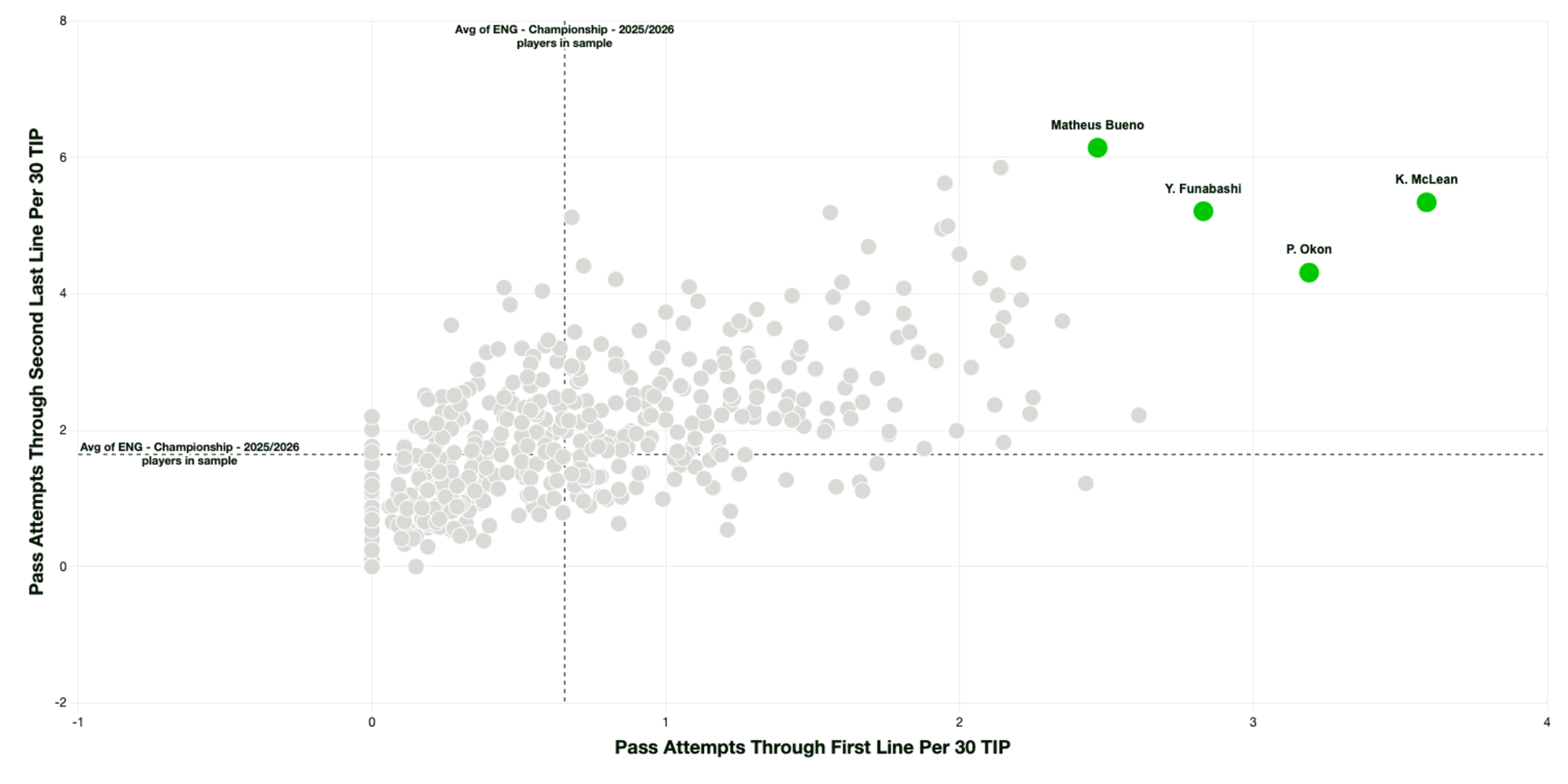
Throughout this section, we have also seen the making of a perfectly complementary midfield relationship. Playing Okon-Engstler with Marcelino Núñez would help cover physical deficiencies and supplement his comfort on the ball we were searching for with high-volume, high-intensity off-ball running ahead of him: a Platformer and a Developer. That’s intelligent squad building.
🎼 Platformer
The function of a Platformer is Possession and, to a lesser extent, Progression through metronomic Passing in the defensive and middle third, usually orchestrating build-up patterns from central zones. Most commonly associated to centre-midfielders. Evaluated based on effectiveness and efficiency.
📈 Developer
The function of a Developer is Progression through Moving ahead of the ball. They run behind and beyond lines in the middle and final third, across the width of the pitch, turning build-up into promising attacks. Augmented by high-intensity movement. Most commonly associated to midfielders. Evaluated based on effectiveness.
Where next?
After identifying three interesting prospects in the AFC each with their own superpowers suitable for varying styles of play, a final question remains. As the world wakes up to this recruitment hotspot, where will Belgium’s Pro League clubs flock to next?
Morocco is undergoing a similar international transformation to Japan and has emerged as the second-most prominent foreign nation in the Pro League this season, perhaps influenced by the Atlas Lions convincing more of the European diaspora to pledge their international allegiance to Morocco. Either way, Morocco is one to watch. As is Ecuador.
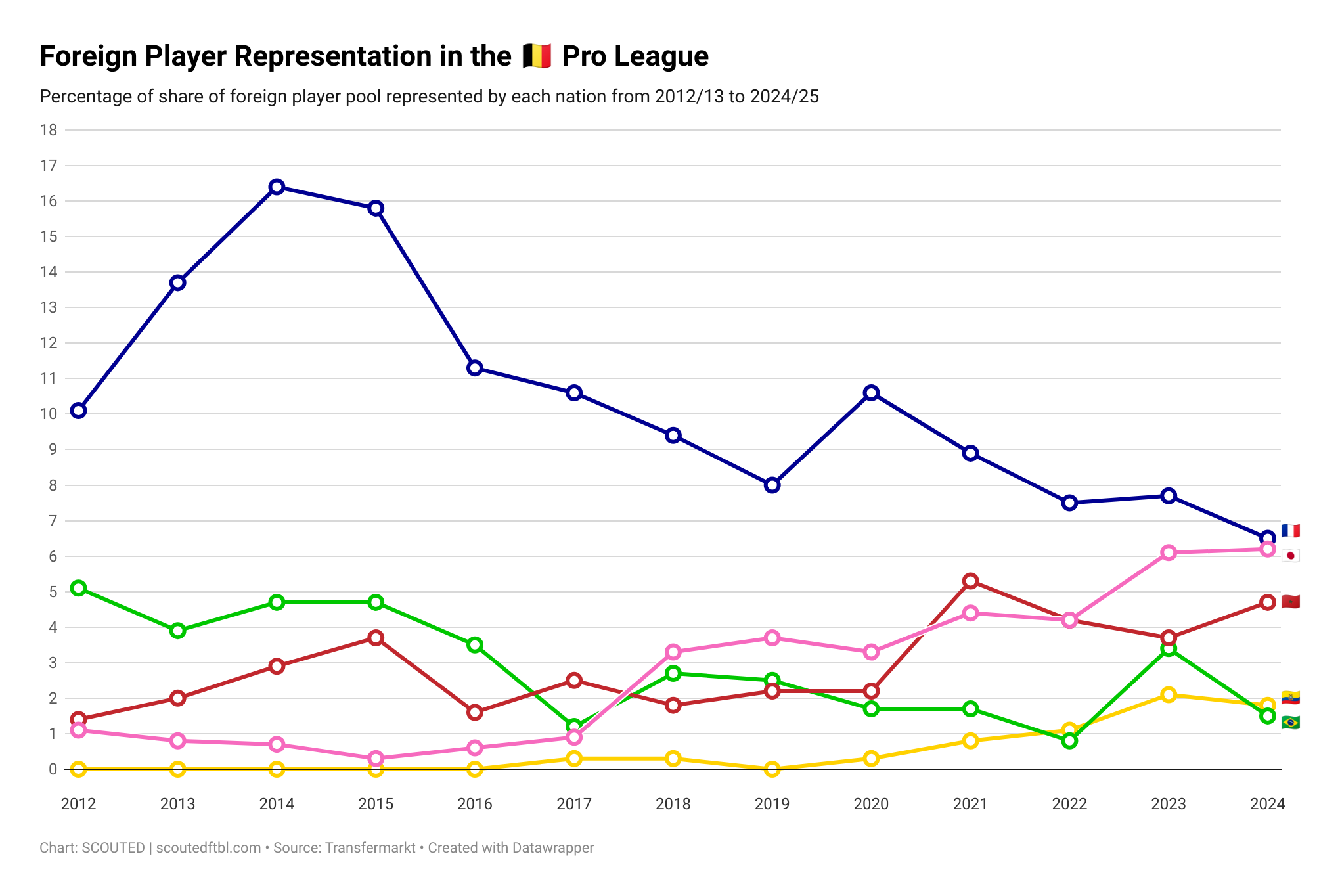
Similar to both Japan and Morocco, Ecuador is entering a period of unprecedented success at international level while domestic talent is being hoovered up by European clubs with a breadcrumb trail leading all the way to Belgium. The Pro League is once again ahead of the curve. We know where to go shopping next time.

This newsletter was produced under a commercial collaboration with SkillCorner, SCOUTED’s official data partners. Their tracking and performance data is used by more than 150 of the world’s biggest clubs, leagues and confederations.