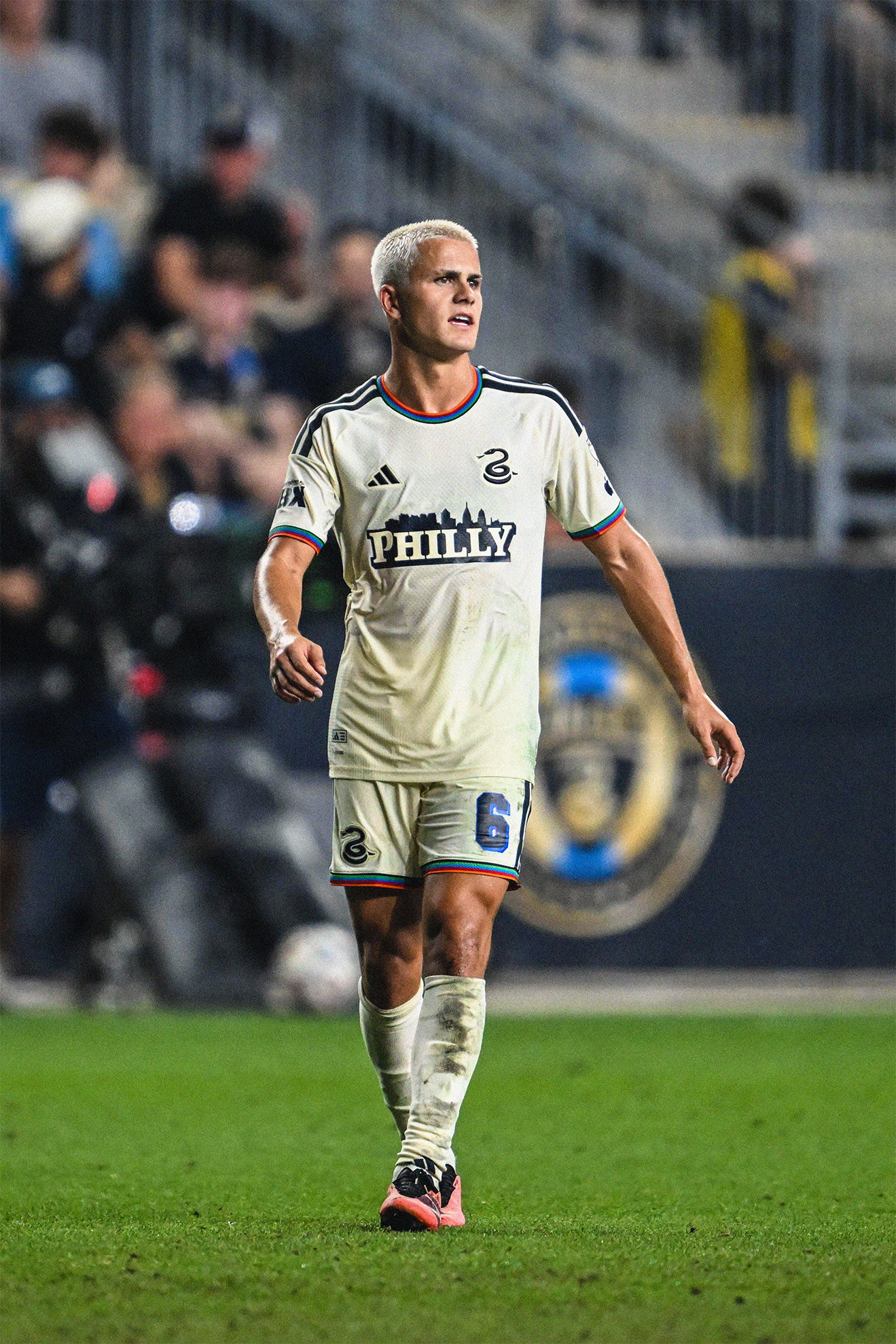
Cavan Sullivan, American mythmaker
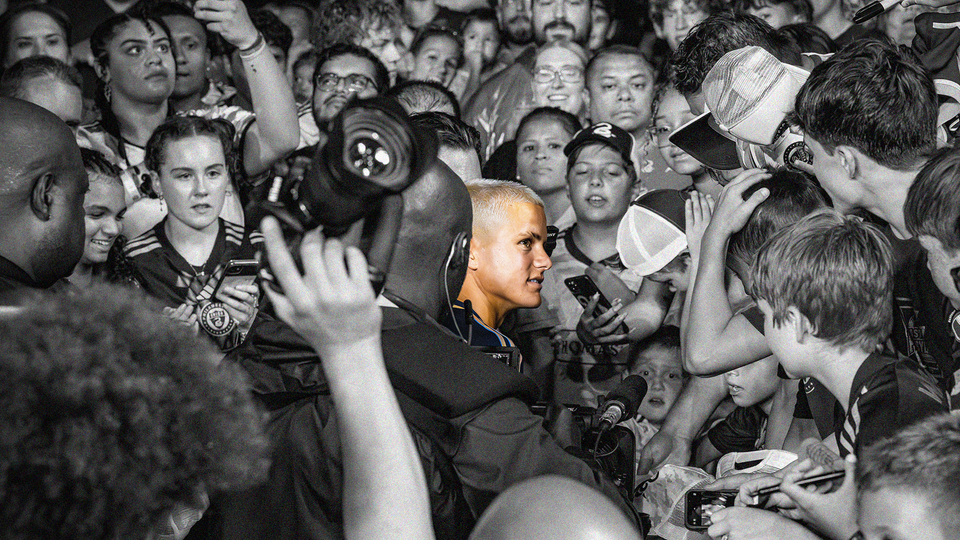
The 18,554 people at Subaru Park in Chester, P.A. were already on their feet. His substitution was cheered as if the Philadelphia Union had scored and, as he jogged onto the pitch to make his MLS debut, the cocky, boisterous smile he’d been sporting just twenty minutes prior, as the stadium cameras followed his warm-ups, gave way to something else: the face a 14-year-old makes when he’s nervous and trying to hide it.
The first thing you must know about Cavan Sullivan is that although he plays for the Union, he no longer belongs entirely to them. A stipulation in his first professional contract, signed the spring before his debut, guaranteed a move to Manchester City upon his 18th birthday, which at the time was still four years away. The second thing you must know is that he is the youngest of four children, the son of two football players, and the second Sullivan to play for the Philadelphia Union, after his brother Quinn. He has followed strict family regimens since middle school: 4:00am alarms, extra training with his dad, and an emphasis on education. Sullivan joined YSC Academy, a soccer-focused private school that works closely with the Philadelphia Union, in 2020, jumping from 4th to 7th grade in the process. Skipping two grades isn’t usual, especially for a footballer, but according to a 2023 interview with the then-14-year-old, “it really wasn’t that difficult.” The third thing you should know about Cavan is that he aspires to play like Lionel Messi.
Now 17, Sullivan is brash, competitive, and incredibly confident. He has every right to be. After being controversially sidelined by a now-fired coach, Sullivan is finally playing first-team football consistently; he’s accumulated over 1,600 minutes this season, with most of those coming in his last ten games, in which he’s logged seven goals and five assists. In that stretch, he’s become one of the best players in the league. Every week his legend grows. He used one of LeBron James’ celebrations after scoring. Against Messi’s Inter Miami, Sullivan received a red card after defending his brother in a fight, and became the youngest player to be dismissed in league history. The red card was later rescinded. Then, when the U.S. Men’s National Team roster was released for the September international break, Sullivan’s name was on the list for the first time, and immediately eclipsed those of Christian Pulisic, Weston McKennie and others of the ‘golden generation’ in strength of discourse. His family has been profiled in The Athletic, he’s appeared in national newspapers, garnered comparisons to Michael Olise, and even been the center of Real Madrid and Barcelona transfer rumours, despite the Manchester City agreement. No one knows what to do with him, how to define his role with the Union, or how to talk about him. Even the data analysts like me are stumped — Sullivan’s closest statistical comparison is Lamine Yamal.
All this confusion becomes understandable in the light of American soccer’s history. There are things we can say about Cavan Sullivan that are true. That he is better than anyone to emerge from the nation in the past 20 years, for example; that he is one of the best prospects the United States has ever produced. He’s already the face of the national team. Every step of his journey has felt unbelievably monumental and entirely inevitable. He is American soccer’s prince, destined to fulfil a prophecy he wasn’t alive to see written. He has a fuzzy beach-blonde buzz cut. He’s widely considered a saviour, a demigod, a superstar. He’s a teenager with three eyebrow slits who listens to The Smiths.
All of these truths are difficult to speak, as if we might ruin them if we do. This is the final thing you must know about Cavan Sullivan: his story is not his own. It belongs to America, to the millions who have watched their domestic football crash, burn, and rise from the ashes, and the stories they have told to construct a national identity around a sport that has always felt imported. Even this early, the two versions of Sullivan – the boy and the icon – face reconciliation by a nation who have written similar prophecies about staggeringly young sportspeople before and watched them do untold damage, and who have always longed for a homegrown superstar to call their own. Now he’s here, and to understand why America is having such a hard time deciding how to talk about him, you must understand all they have spoken about before.
PART I
The year is 2004. MLS is in its ninth season, and the SuperDraft is about to commence. Two months ago, the Dallas Burn were forced into trading the first overall pick to D.C. United; tonight is simply a formality. The moment comes, and MLS Commissioner Don Garber climbs the stage to pose with the chosen player and his newly official D.C. kit. History is made. The player is a 14-year-old called Freddy Adu, and his time has come.
Adu moved to the United States when he was eight. He joined a friend’s team on a whim, and instantly became the urban legend of D.C.’s youth soccer circuits. Coaches heard whispers of free kicks and hat-tricks, and his mysterious origin only helped grow his mystique. When he was ten, Adu traveled with the U.S. Olympic Development Program to a U-14 tournament in Italy, and played so well that Inter Milan made his mother a six-figure contract offer. They rejected it, and soon Adu was training at the premier U.S. soccer academy — IMG — in Florida. When he was 12, he was running circles around professional players; when he was 13, Sir Alex Ferguson was asking reporters for his phone number. When Nike signed Adu to a $1 million contract in 2003, Phil Knight claimed he could be bigger than LeBron James, Michael Jordan, or Tiger Woods.
Then came the 2003 U17 FIFA World Cup, where Adu scored four goals — more than David Silva and one less than Cesc Fàbregas — and soon after, the MLS contract. Then a Sierra Mist ad shoot with Pele, where the legend proclaimed “God gave Freddy the gift to play soccer.” The kid from Tema, Ghana, whose family won a coveted U.S. visa through a lottery, had made it. He was an immigrant child, a self-sufficient older brother, and had a $500,000-a-year contract. For a short while, he was the epitome of the American dream.
Many books have been written about American soccer’s long and winding journey. In today’s modern consciousness, American soccer begins in 1994, with the FIFA World Cup. Prior to the world’s biggest competition entering American borders, the only home for players hoping to compete in the U.S. was the North American Soccer League (NASL). NASL had begun operations in 1968, following the success of the ‘66 World Cup, with 17 teams. The league built legitimacy by engaging with the outside world — the year of its inception, one NASL team, the Dallas Tornado, toured the globe, playing friendlies against Aston Villa, Real Madrid, and Pele’s Santos. Manchester City came to the U.S. to play several friendlies, losing three times in three games. Few records remain of these fixtures, but we know the NASL began to struggle soon after.
Subsisting on $25,000 expansion fees to keep the league afloat, club owners did their best to sell soccer to American fans, often by changing the literal rules of the game. For a period, it began to work: by the 1970s, teams were beginning to average over 10,000 in attendance, and in 1975, Pele joined the New York Cosmos, rocketing the league into global notoriety. Other legends soon followed, like Johan Cruyff and George Best. So began American soccer’s love affair with the superstar. But by the ‘80s, a U.S. economic downturn and the over-expansion of the league meant the NASL was bleeding money. In 1984, the only remaining teams — there were nine — took the field for the last time. The NASL folded, and the ‘dark age’ of American soccer began.
Between 1984 and 1996, the only major professional leagues in the United States were the MISL (Major Indoor Soccer League) and the APSL (American Professional Soccer League, which would later become Division II). By the time the ‘94 World Cup rolled around, most of the USMNT’s players entered the tournament without a professional club contract. “The majority of the team was in camp for basically two years leading up to the World Cup,” Alexi Lalas told SB Nation in 2014. “We had only played international soccer so it was a very backwards way of doing things, but a necessity at the time.” The players were on monthly contracts, but were required to travel the globe eight months out of the year. Bora Milutinovic, the U.S. coach at the time, had to resort to alternative methods to scout players. He would attend high school games, rely on the U17 squad for talent, and hand out first-team caps like they were candy. In 1991, Milutinovic called up a trio of teenagers, Mike Silvinski, Mark Jonas, and Nelson Vargas, who all debuted for the national team in a friendly match. The three rank behind Freddy Adu as the youngest players to ever debut for the USMNT — Cavan Sullivan only surpassed one of them when he made his USMNT debut against Peru on September 26.
The U.S. bid to host the ‘94 World Cup was accepted by FIFA with a stipulation: a new professional league must be created in the country. That league became Major League Soccer, which kicked off in 1996 with ten teams. The original owners of MLS learned from the NASL’s mistakes, and pursued a single-entity structure, where clubs bought into a shared central league that managed all operations, including a salary cap. After the chaos of the NASL, the owners decided the clubs themselves could not be trusted to run sustainably; now, whenever a player signs with an MLS team, they technically sign a contract with MLS first, before being “allocated” to the particular club. This structure, though foreign to non-American sports fans, is the same structure that rocketed the NFL and NBA to their respective heights. It did not prove to be the same silver bullet for MLS. By 2002, only ten teams remained. By 2004, the year Freddy Adu was drafted, MLS had only been operating for eight years; David Beckham and the Designated Player rule were still three years away; average attendance remained just above 15,000.
When Freddy Adu joined D.C. United, he was a child who had been playing against inferior opponents for years. After joining MLS, he was forced into the spotlight at the professional level, playing against U.S. soccer veterans with chips on their shoulders. MLS was desperately in need of a superstar; the public yearned for a prodigy, too. Just two years prior, LeBron James had burst onto the scene in high school basketball, earning himself an infamous Sports Illustrated cover story titled The Chosen One by the late reporter Grant Wahl. Wahl would later reflect on his role in Adu’s own ascendancy in a 2020 podcast series called American Prodigy.
After the success of James, soccer turned its eyes towards Adu, willing him to take similar form. Though it’s common for young players in Europe and South America to be spotlighted far before maturity, the ‘prodigy’ feels like a distinctly American obsession. The weight of this national story was heavy. At D.C., Adu was a creative No.10 forced into a system that would not — could not — fully contort itself to his needs. He had never learned how to defend — he was the best player on every pitch before the professional level, and no coach would reasonably ask him to track back when he might instead score another hat-trick — and this irked his D.C. teammates. The American game was not built for a player like Freddy.
In the early MLS, a league wracked by turmoil and trying to escape a history of national failure, there was little room for the luxury players revered in Europe or South America. Grit, determination, and fight defined a player’s value, and the soft smile of a wizardly 14-year-old did not fit that definition. Famously, Adu struggled. Within two years he was traded to Real Salt Lake and failed a trial at Manchester United. Then he joined Benfica, where he hardly played. In four consecutive European loans across four seasons, he played just 34 games. When he returned to MLS in 2011, then 22, Adu was no longer a prodigy. From afar, it seemed the hope he would be soccer’s LeBron James had broken him. He last played in 2021 after making just 215 league appearances. Today, he is a cautionary tale for children, coaches, and journalists. Quietly, American soccer shrunk away from its idolisation complex.