
Back to the Balkans
SCOUTED returns to Serie A’s favourite supermarket


A year and a half ago, SCOUTED introduced the Balkan supermarket as a peculiar yet profitable market to go shopping in.
 Stephen Ganavas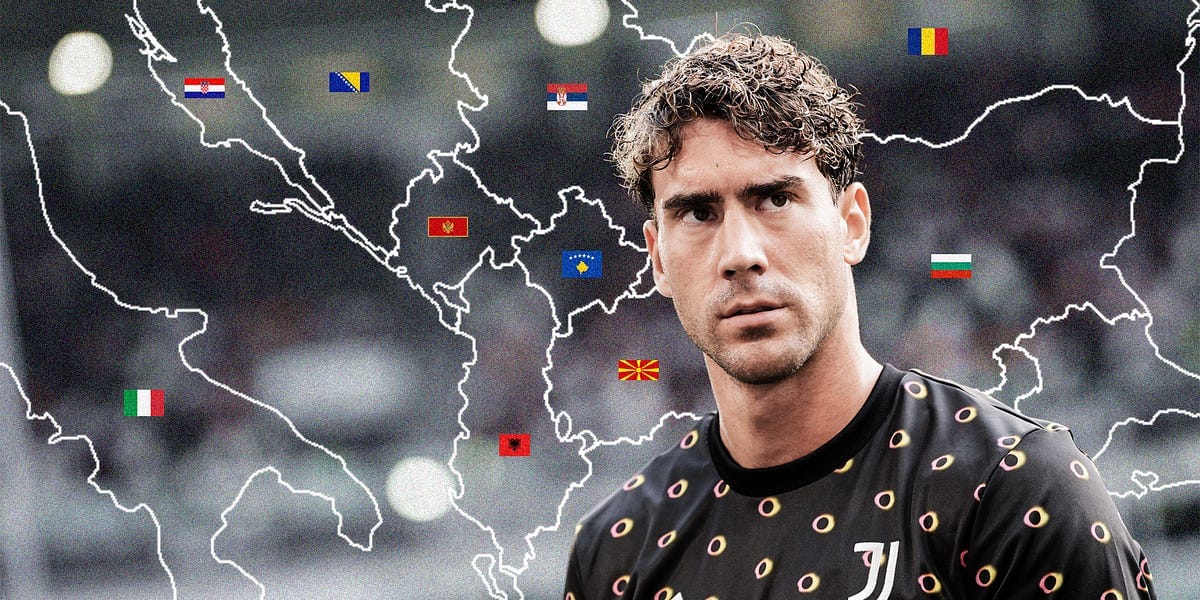
Now we are returning to Serie A’s favourite supermarket to reprofile the top-flight leagues in Serbia and Croatia while also adding Greece, Bulgaria and Bosnia and Herzegovina to the mix.
The questions we are asking:
- What type of playing environment are the next Balkan prodigies being developed in?
- What style of player is likely to be developed within that environment?
- What does it take for a prospect to break through? Does that differ in each league?
By better understanding the idiosyncrasies of each region, we are better informed to answer whether looking for a Luka Modrić regen in Croatia is a nostalgia-driven futile quest or a worthwhile scouting mission.
First, a refresh and an update via transfer trends.


Support SCOUTED
This analytical epic is free to read courtesy of SkillCorner, our data partners. Subscribe now to keep in-depth content like this coming your way.
Subscribe for freeMarket Trends
A combination of proximity to Italy and an ever-improving showing in youth competitions - the first article was published a few months after Olympiacos' maiden UEFA Youth League triumph - made the loosely-defined Balkan region an intriguing scouting spot. To this day, clubs continue to shop frequently.
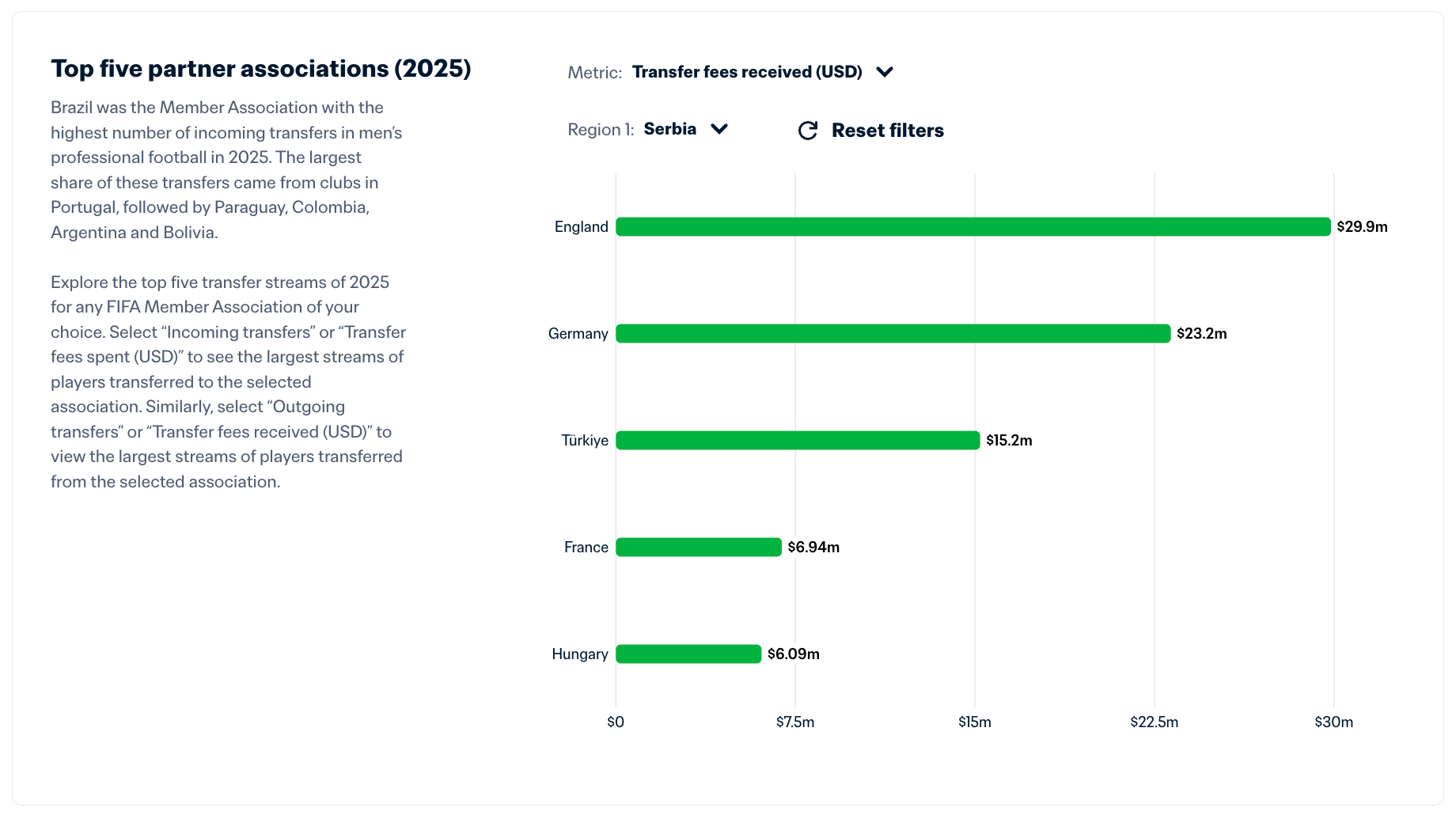
Serbian Superliga sides, mainly FK Crvena zvezda, are generating plenty of cash through player sales. In the past two windows, Veljko Milosavljevic joined Bournemouth for €15m, Andrija Maksimovic joined RB Leipzig for €14m, Lazar Jovanovic joined VfB Stuttgart for €5m and Strahinja Stojkovic joined Saint-Étienne for €2.8m. All four are teenagers. These sales are responsible for the bulk of transfer activity documented in the 2025 FIFA Men's Global Transfer Report in which three of the Big Five League nations featured in their top five for transfer fees received in 2025. Ironically, Italy was not one of them… they prefer a different country.
Another quick glance at the transfer report shows that Croatia is certainly Italy's favourite aisle. Dinamo Zagreb academy graduate Martin Baturina, who was profiled in the first edition of this article, has since joined Cesc Fábregas' UEFA Champions League hopefuls, Como, for €18m while Inter signed Petar Sučić from the same club for €14.6m. Serie A clubs are willing to spend big in Croatia. But midfielders are not their only export.
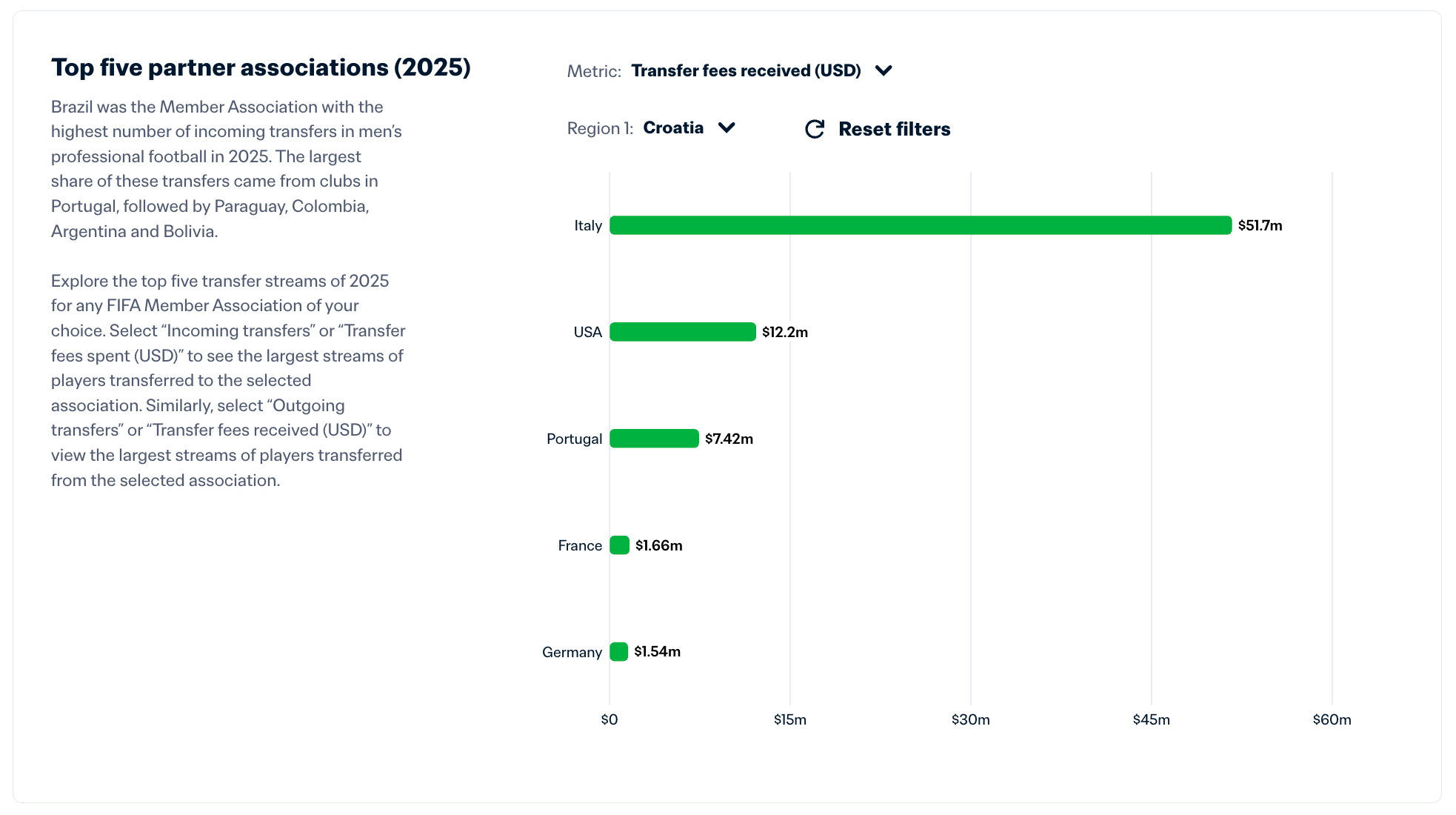
Hajduk Split have sold three U23 centre-backs in Luka Vuskovic (€11m to Spurs - although agreed in 2023), Branimir Mlacic (€4.5m to Udinese) and Dominik Prpić (€4.5m to FC Porto). This may come as a surprise, especially given how deeply football fans fell in love with Croatia’s midfield trios including the likes of Modrić, Ivan Rakitic, Marcelo Brozović and Mateo Kovacić over the past six major tournaments. However, centre-back sales should not be as shocking when you consider the literal stature of the 1.HNL. According to the CIES Football Observatory, both Croatia and Serbia sit in the top 10 leagues for average height, just below England. Italy, the Balkan specialists, are top.
When you think of Bulgaria, you think of Ballon d'Or winner Hristo Stoichkov or Dimitar Berbatov. However, the FIFA Transfer Report suggests that Igor Thiago may not be the last to walk the path from Bulgaria to the Brazilian national team. Bulgarian First League clubs only spent more in Germany than Brazil last year, but more players arrived from South America's largest country than any other nation.
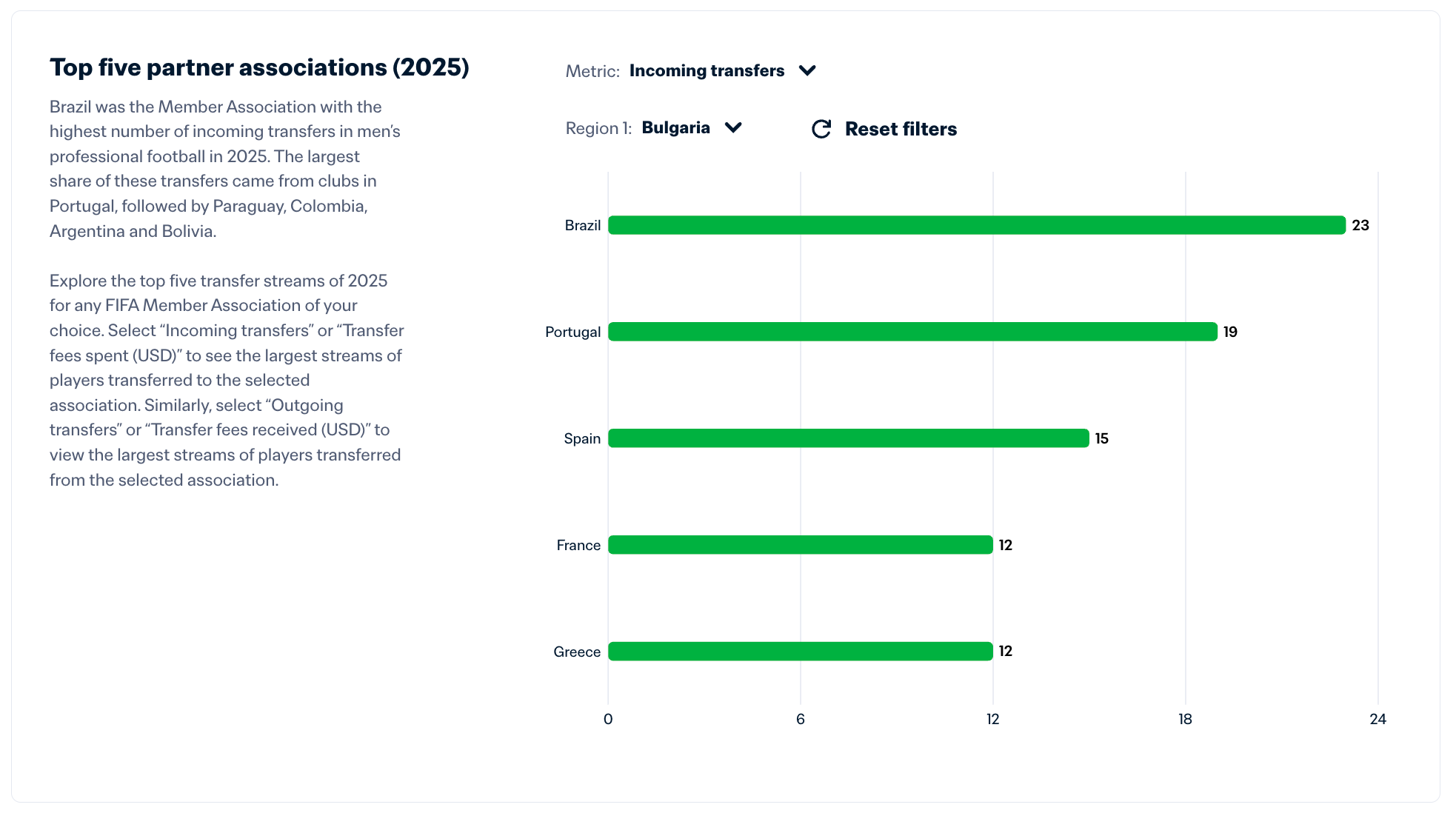
Per FBRef, 45 Brazilians have made an appearance in the First League this season, at least 27 more than the next best represented foreign nation (Portugal, 18).
Meanwhile, Bulgaria’s neighbours, Greece, have welcomed a host of young players into their national team. Three teenagers have featured in recent squads - Konstantinos Karetsas, Christos Mouzakitis and Charalamps Kostoulas - while Giannis Konstantelias, Konstantinos Koulierakis, Stefanos Tzimas and Christos Tzolis not only represent more talent born in 2002 or later, but also signal current league leaders PAOK as a must-track team for young first-team debutants. Should clubs pay more attention to the Greek Super League as a hotspot for high-potential prospects? And why might Portugal be partial to shopping there?
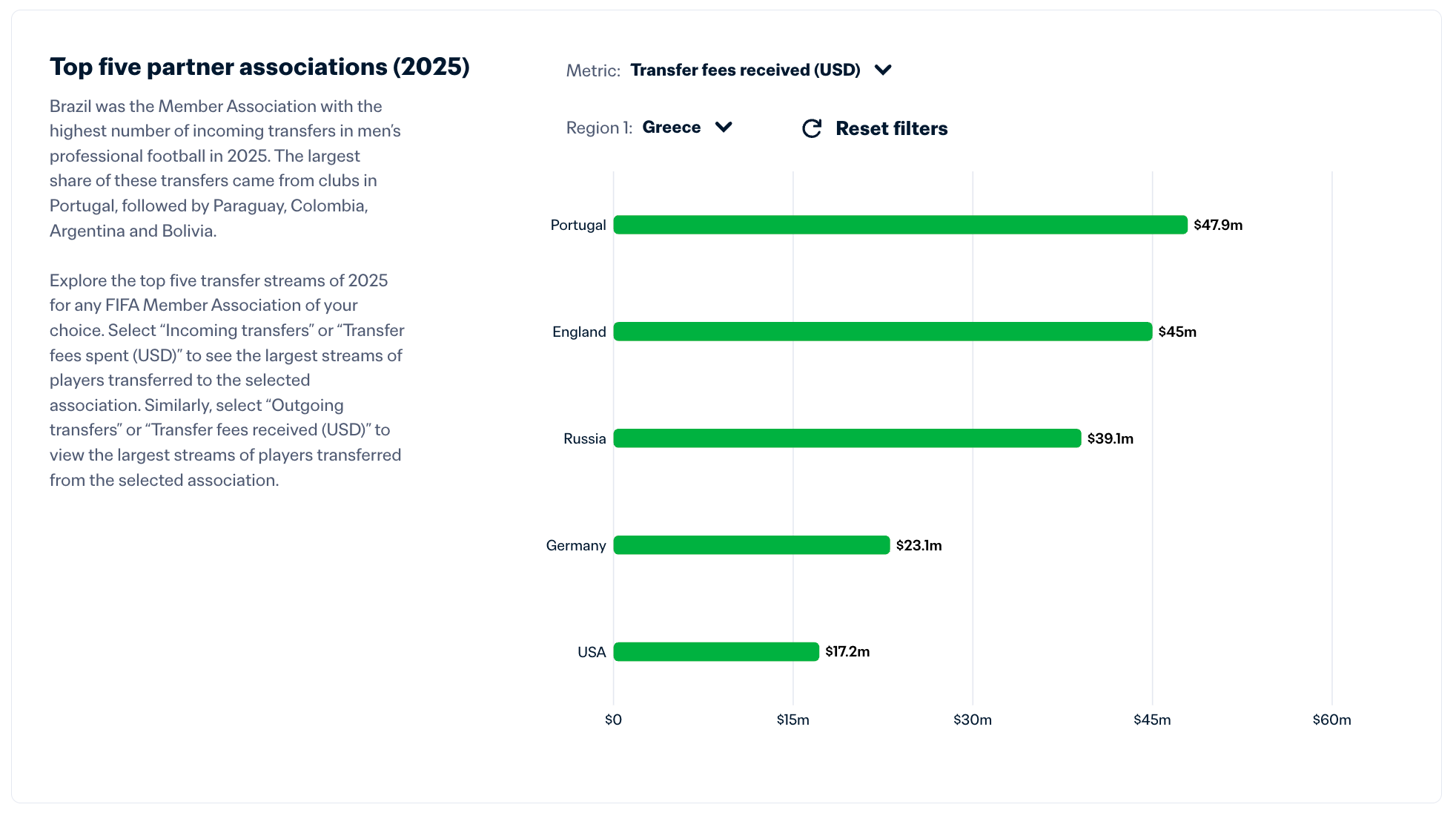
Even before we dive into SkillCorner data, we have challenged our perception of these leagues and what sort of players we might find. Next, armed with updated Physical Data and the new and improved Game Intelligence metrics, we can reprofile these Balkan regions to answer our questions more emphatically.
By benchmarking a selection of Balkan leagues against the top-flight divisions of the nations ranked 6-25 in the latest UEFA Ranking, we can better understand what each league (aisle) has to offer and therefore make our recruitment (shopping) more targeted. Why waste time looking for milk down the meat aisle?
Phase I: Age Profiling
From a SCOUTED perspective, we want to find out how much trust these leagues place in young players. This helps us twofold. Principally, it helps identify competitions that provide exposure to a greater number of prospects. On the flip side, it also helps build a knowledge base of leagues in which it’s rare for a teenage talent to play plenty of matches. This is beneficial as although your checks may be less frequent, any anomalies based on age alone would deserve extra attention for simply breaking the mould.
In fact, we used this very concept to accelerate our scouting of Olympiacos’ UEFA Youth League winning duo Christos Mouzakitis and Charalamps Kostoulas at the start of the 2024/25 season. Their involvement in the first team stood out because it's rare to see young players playing in the Greek Super League, especially a pair of teenagers for the eventual champions, as you can see from this graph.
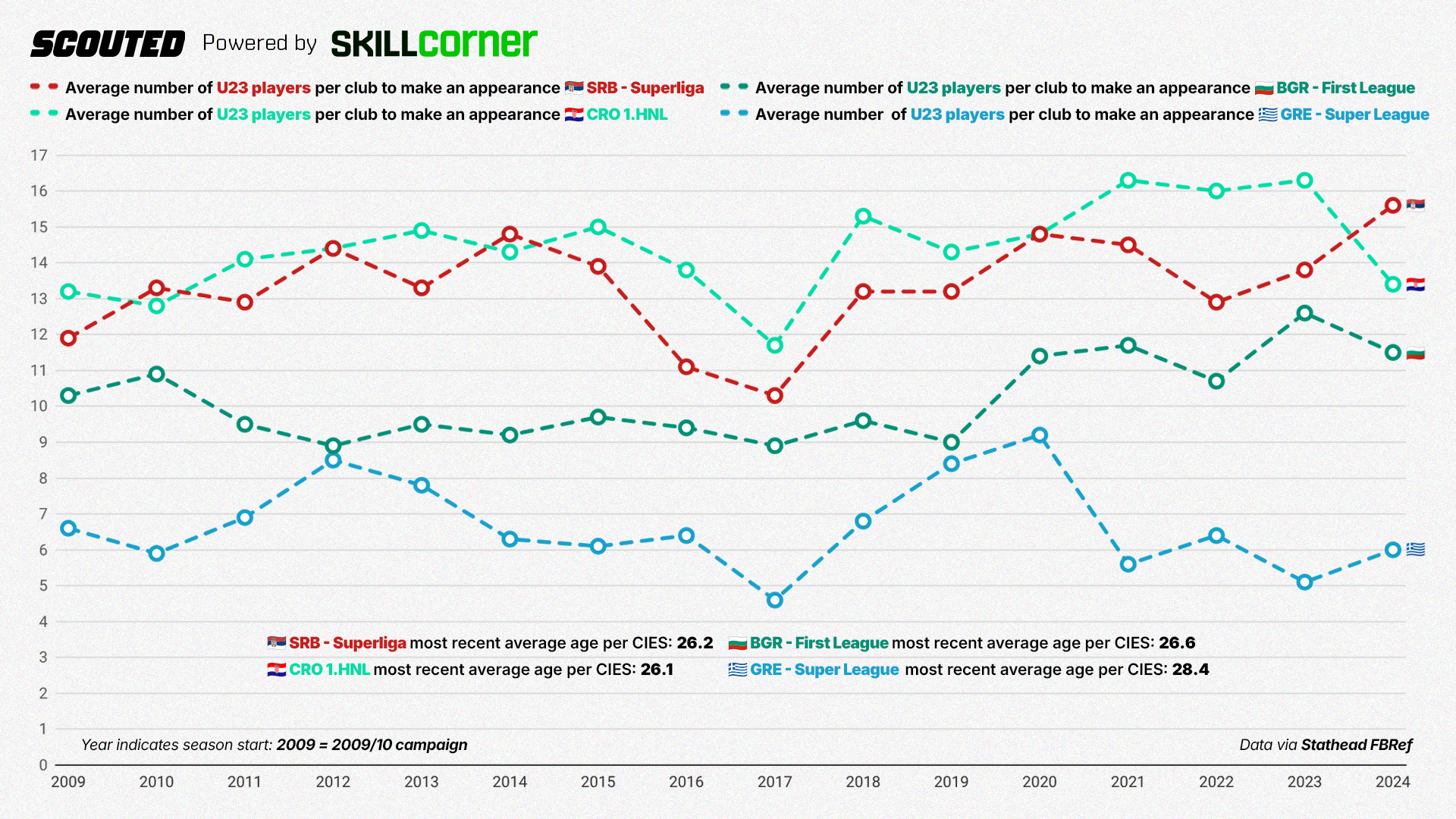
In 2024/25, 84 players under the age of 23 made an appearance in the Greek Super League, averaging just six per club across the 14-team competition. The shelves down the Greek Super League aisle are the most sparse, so finding out what makes the young players that do break through so special is the key discovery we should aim to make.
Serbia, though, is a prime region to monitor when it comes to scouting young players. The Superliga ranks first among these four leagues for the total number of U23 players in 2024/25 (249) as well as the team average (15.6).
Bizarrely, they have not qualified for the FIFA Under-20 World Cup since becoming champions in 2015, but the likes of Nikola Simić, Vasilije Kostov, Vasilije Novičić, Jovan Milosavljević, Luka Zarić and Mihajlo Cvetković in addition to the teenage sales mentioned earlier represent an exciting generation.
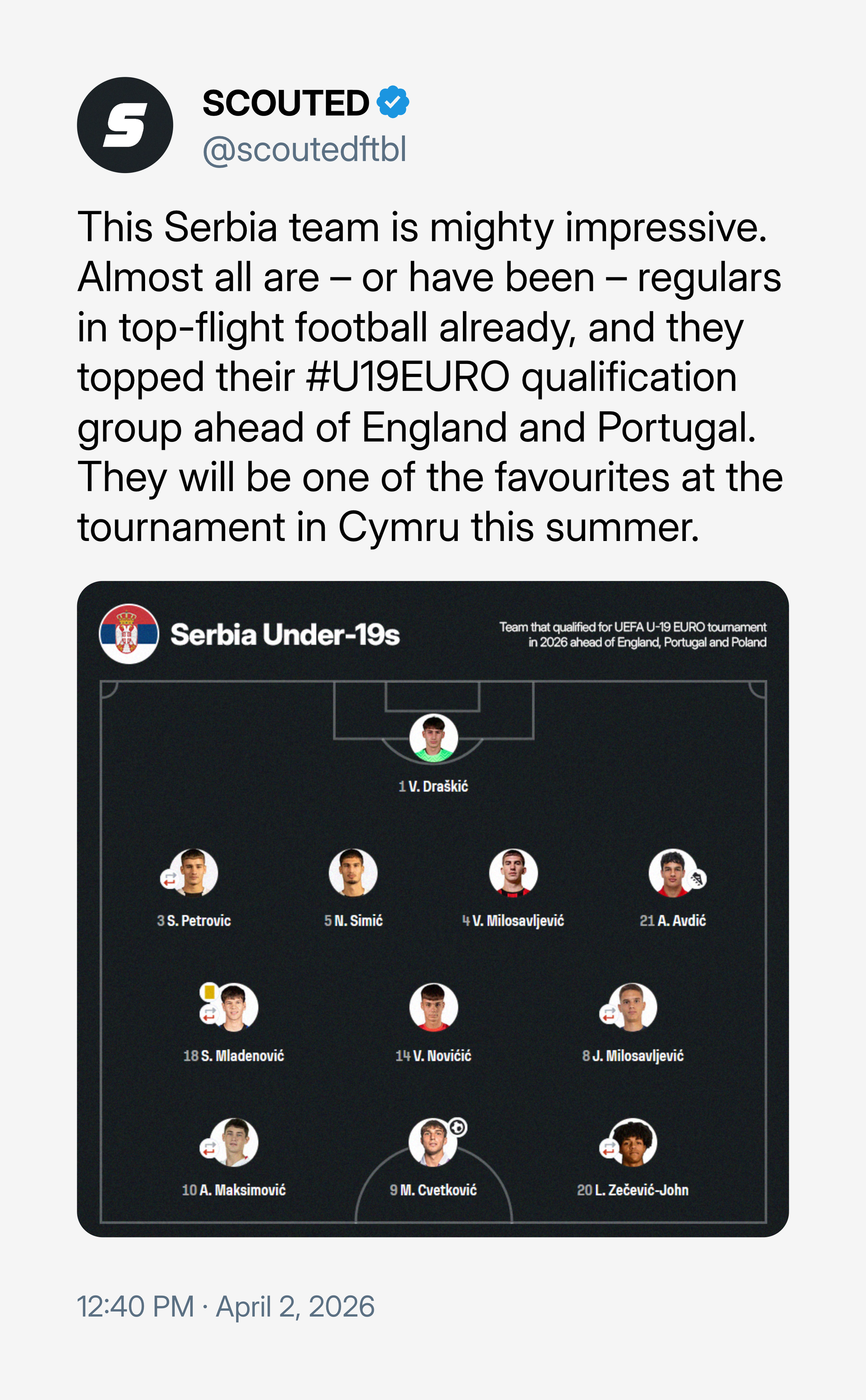
But what environment are they being exposed to? It's time to benchmark.
Phase II: Physical Benchmarking
The next step is to get a basic understanding of what physical demands are placed on the average player from each league. This looks to find out whether a league platforms any of the four physical characteristics: speed, explosivity, agility or endurance.
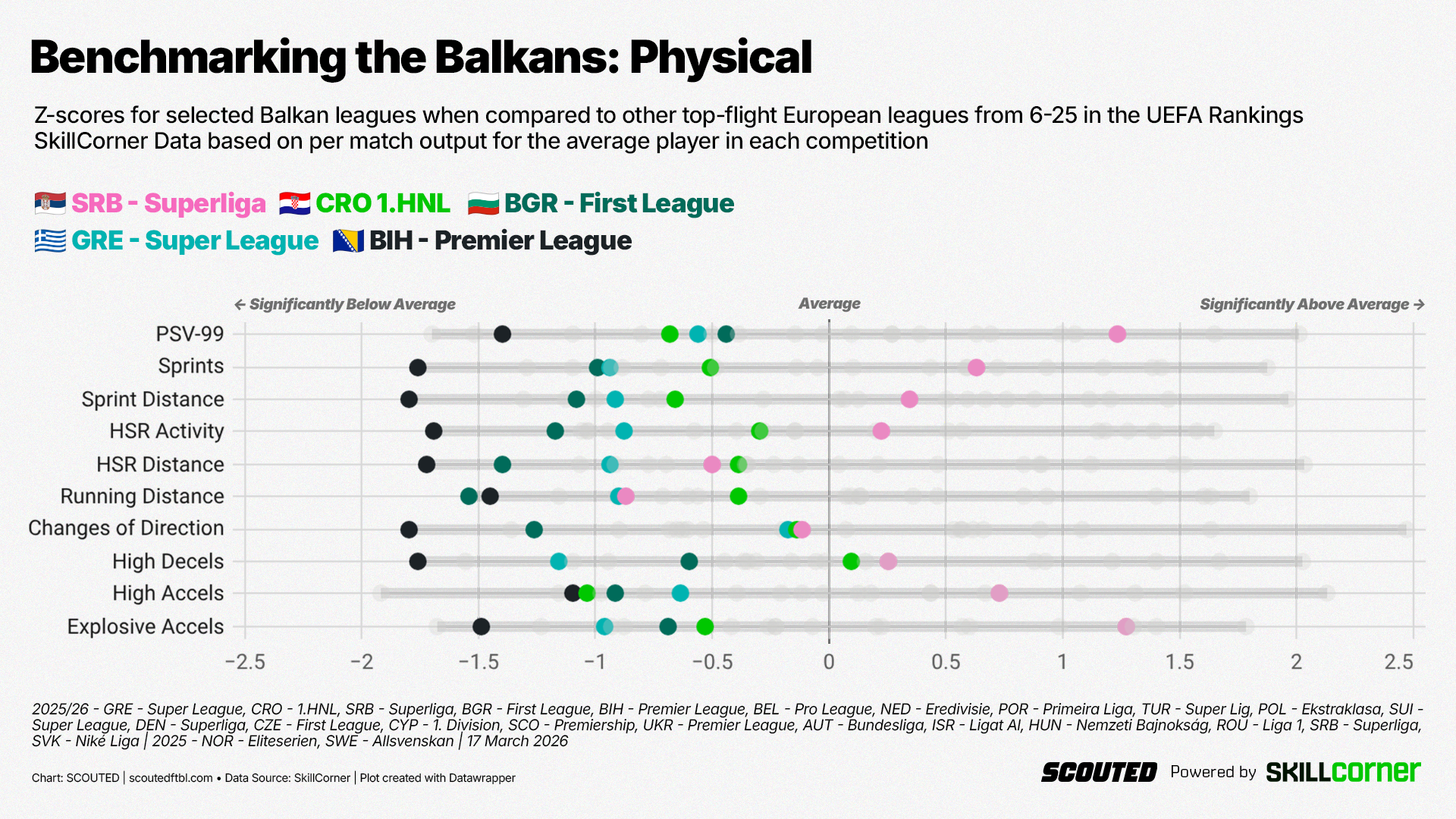
Serbia's Superliga is an outlier for speed and explosivity. This difference is further emphasised when plotting clubs from all five leagues for PSV-99 and Sprint Distance. Of the seven teams that rank above the Serbia Superliga average, only Bulgaria's CSKA Sofia are from another Balkan region.
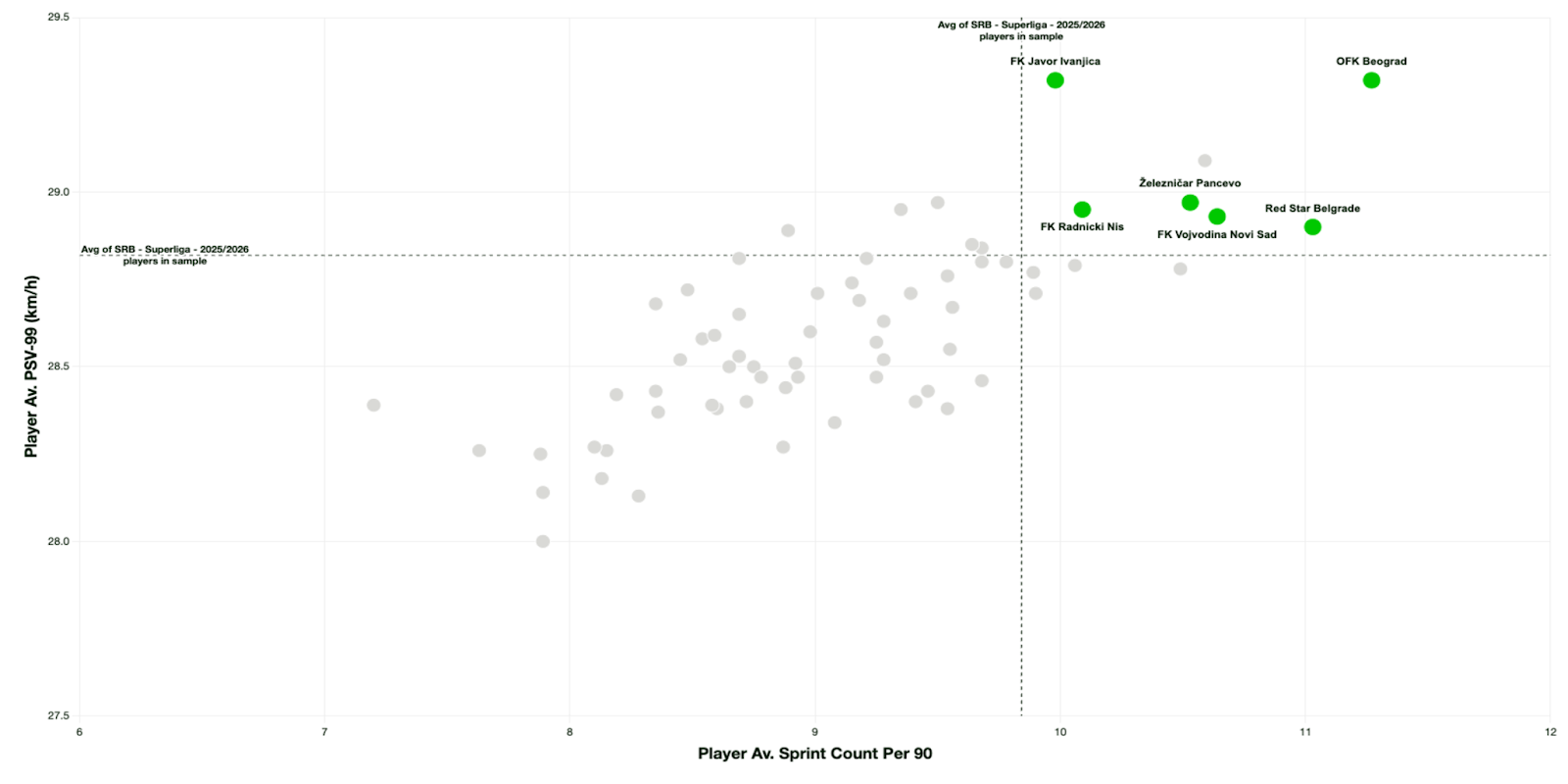
Already, we have a clear idea about what to look for down the Serbia aisle as well as a greater understanding of why big clubs are making the move for teenagers competing in this environment.
To learn more about the others, we need to move onto Game Intelligence.
Phase III: Style Benchmarking
The first stop is Passing. The latest Game Intelligence Data also incorporates Pressure metrics into this bucket.
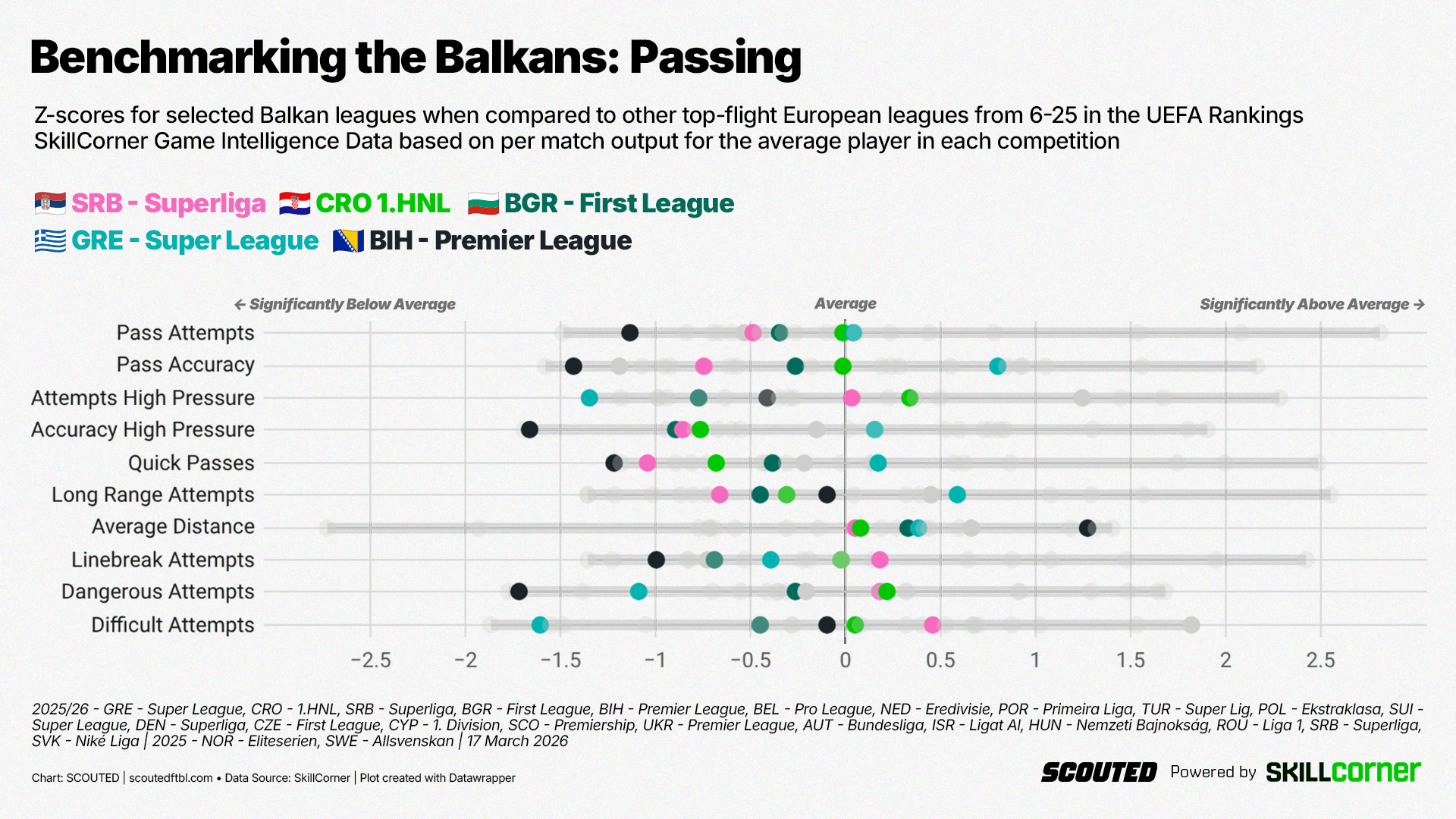
The standout story from this plot is that the average Greek Super League player attempts more passes and is more accurate than Balkan counterparts. Interestingly, though, they attempt far fewer under High Pressure and rank well below average for Difficult Attempts. Safe, quick, metronomic passing is our first defining characteristic making it a prime aisle when shopping for a Platformer. This technical security is also our first indicator of why teams from Portugal and Spain may be more frequent shoppers.
🎼 Platformer
The function of a Platformer is Possession and, to a lesser extent, Progression through metronomic Passing in the defensive and middle third, usually orchestrating build-up patterns from central zones. Most commonly associated to centre-midfielders. Evaluated based on effectiveness and efficiency.
Looking at Possessions further highlights Greece as a Platformer hotspot. It ranks well above average for all retention-based metrics listed - informed, in part, by the fact they don't receive as much pressure.
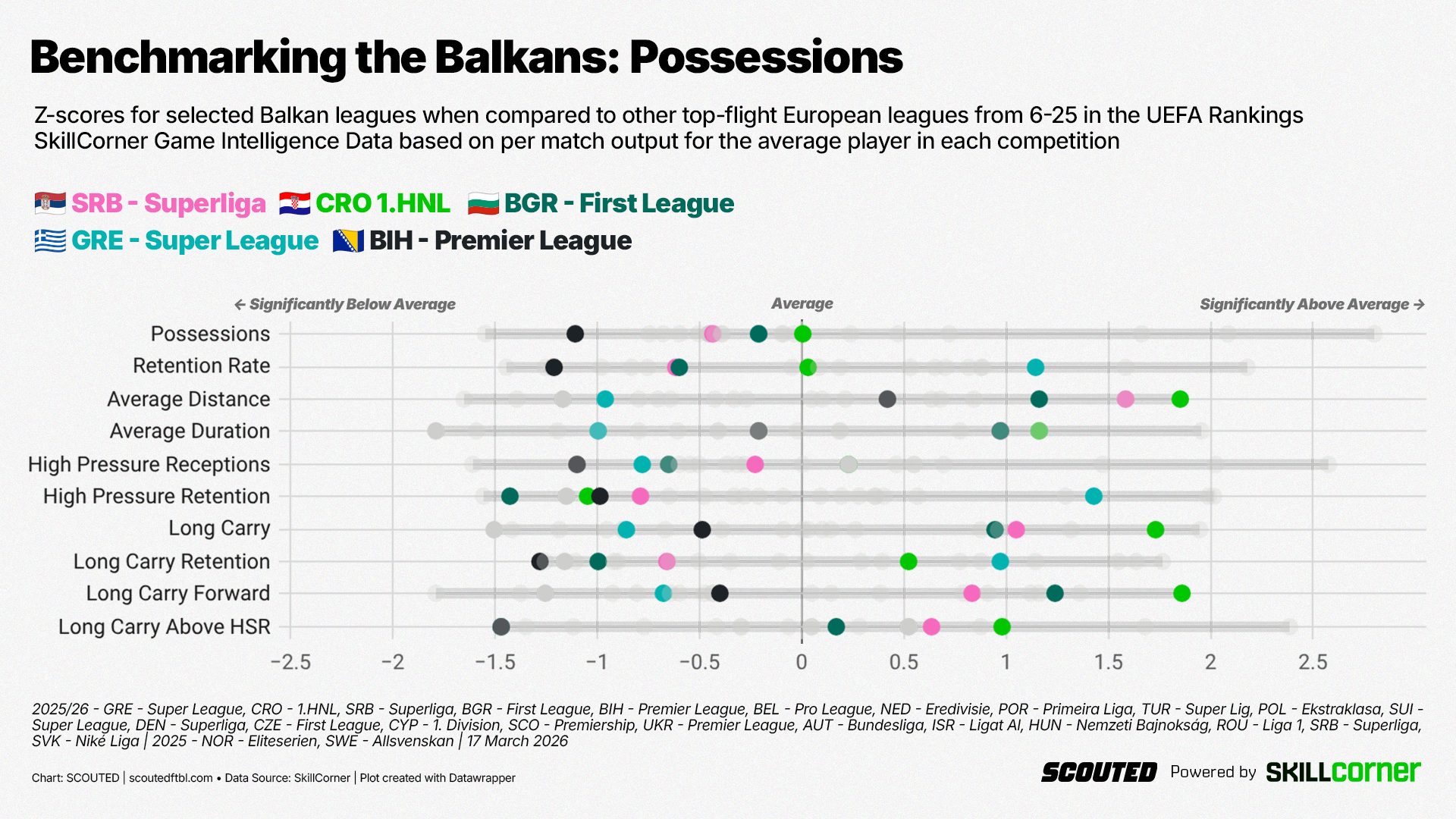
However, the most fascinating finding from this quick exercise is Croatia's carrying. The average 1.HNL player ranks first among all leagues for Average Distance per Carry and Long Carries Forward. Meanwhile, only the Swiss Super League and Dutch Eredivisie rank higher for Long Carries Above HSR. Combining this metric with the average height revelation could produce a pool of physically gifted and technically proficient centre-backs. This is what we’ll go shopping for later.
Switching to Off Ball Running confirms Serbia as the prime aisle for Power Forwards. The average Superliga player ranks above average for Runs In Behind despite ranking slightly below average for OBR overall. Augmented by the athletic prowess we highlighted earlier, not only does this suggest we will find a Power Forward prospect, but it also speaks to an environment that develops competent centre-backs; they are facing some of the fastest, most direct forwards in Europe. Young defenders that become a dominant force in this league will draw the gaze of recruitment teams.
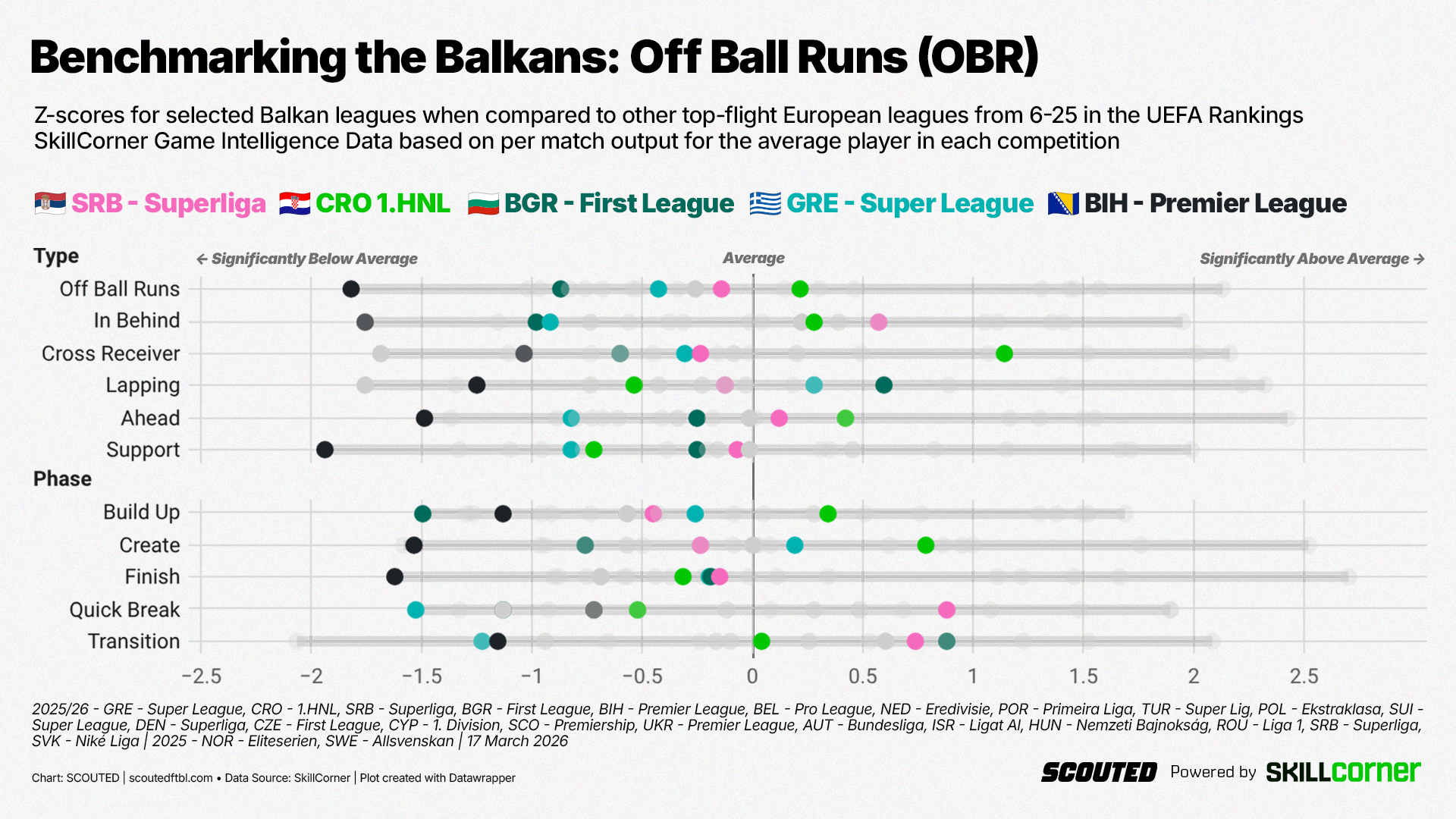
This is again compounded by the above average ranking for OBR in Quick Break and Transition Phases. The fact that Bulgaria ranks ahead of Serbia for the latter introduces our first major signal about the First League environment.
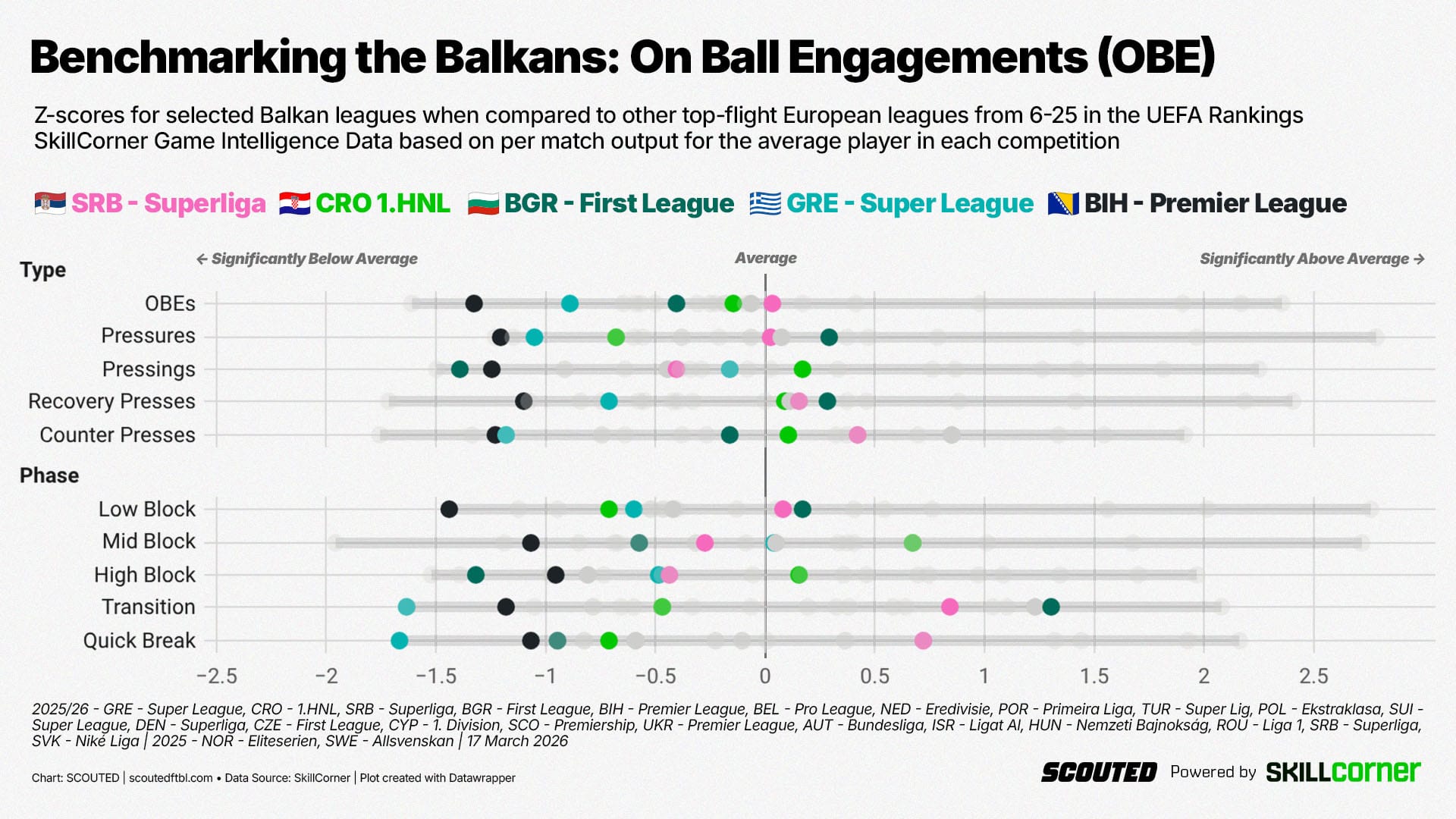
To build on it, we’ll look at On Ball Engagements. Only the average player in Switzerland's Super League makes more OBEs in Transition than a Bulgaria First League player. They also rank first among our highlighted Balkan leagues for Pressures and Recovery Presses; this is very much a surprise given the underwhelming Physical output we saw earlier. Are these Brazilians in Bulgaria built different?
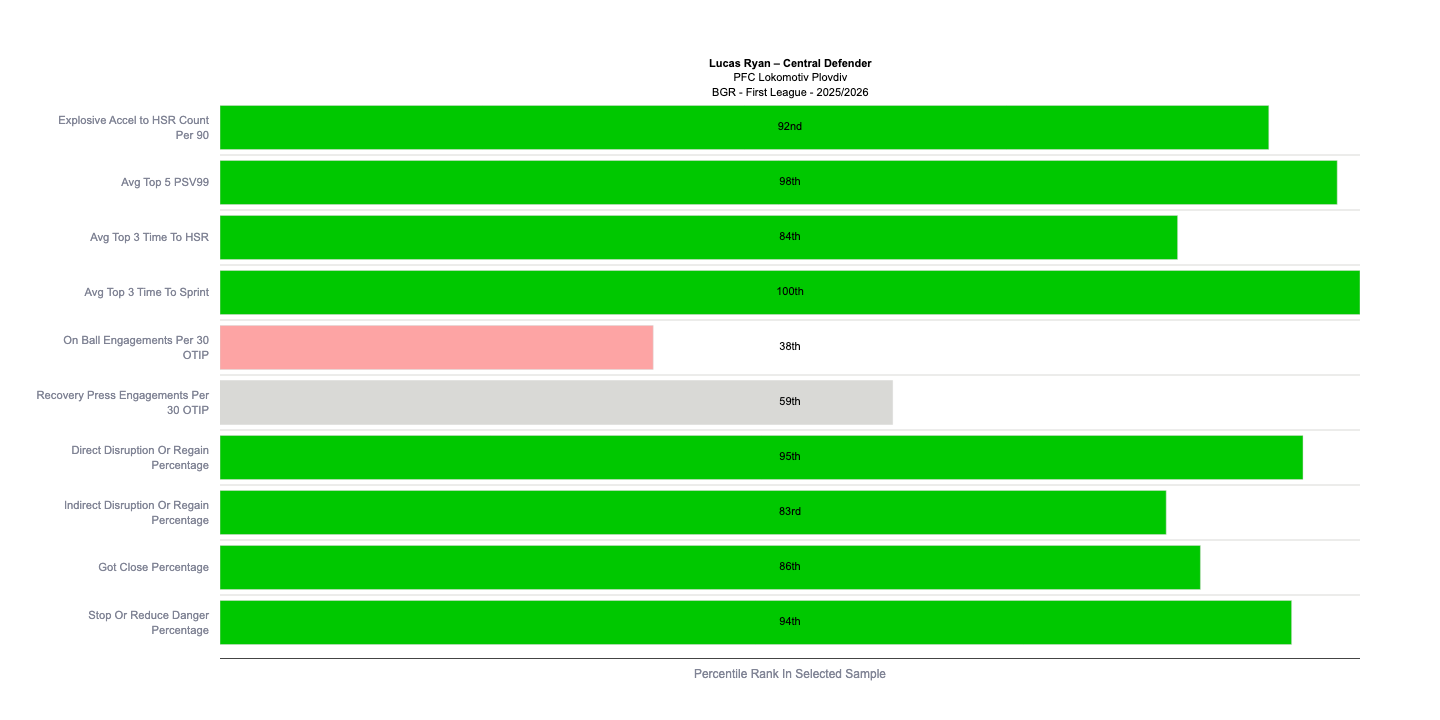
Well, it turns out that the majority of the Brazilians migrating to Bulgaria are attacking players, especially in the age bracket we focus on. Of the 10 Brazilians born in 2002 or later to make a First League appearance this season, seven are forwards. The other three are Defenders, but only centre-back Lucas Ryan has started at least five matches. That being said, he is the archetypal Brazilian centre-back I have championed before: he is almost unrivalled in the Balkans for his Physical output. A nice find even before we even start our shopping spree.
But now it's time to fill the trolley. Based on the transfer trends, age profiling and stylistic benchmarking of each league, we are going to look for the following profiles across all Balkan leagues, expecting to see them in specific regions.
Shopping Power Forwards in Serbia
When ranking for Centre Forwards across our five Balkan leagues using our Power Forward Index created in the SkillCorner Web App Lab, four of the top five hail from Serbia's Superliga. That's a good start. And the player at the top of this list is fascinating.
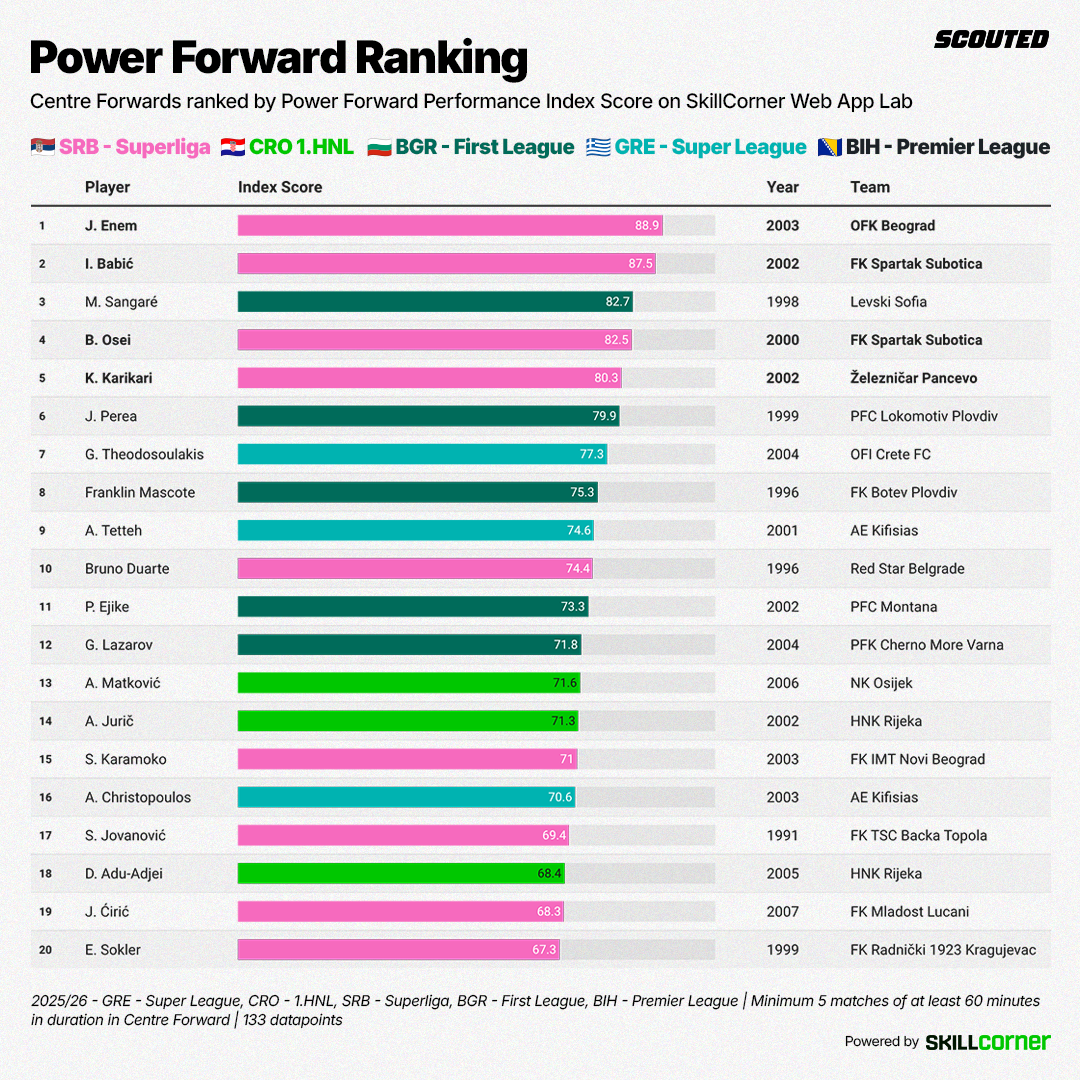
Jay Enem could not be further removed from the archetypal Ajax academy graduate. The 1.95m striker never made a senior appearance for his boyhood club and left to join Venezia in Serie B after six years in Amsterdam. Loans to Serie C clubs were followed by a loan to Cyprus before OFK Beograd signed him on a permanent deal at the start of the season.
The 2003-born forward scored 10 goals in 17 matches for OFK before Crvena zvezda stepped in to sign him on loan for no apparent reason beyond the fact he was dominating the division. The fast, explosive, transition-heavy nature of Serbia's Superliga provides the perfect environment to platform his superpower: speed.
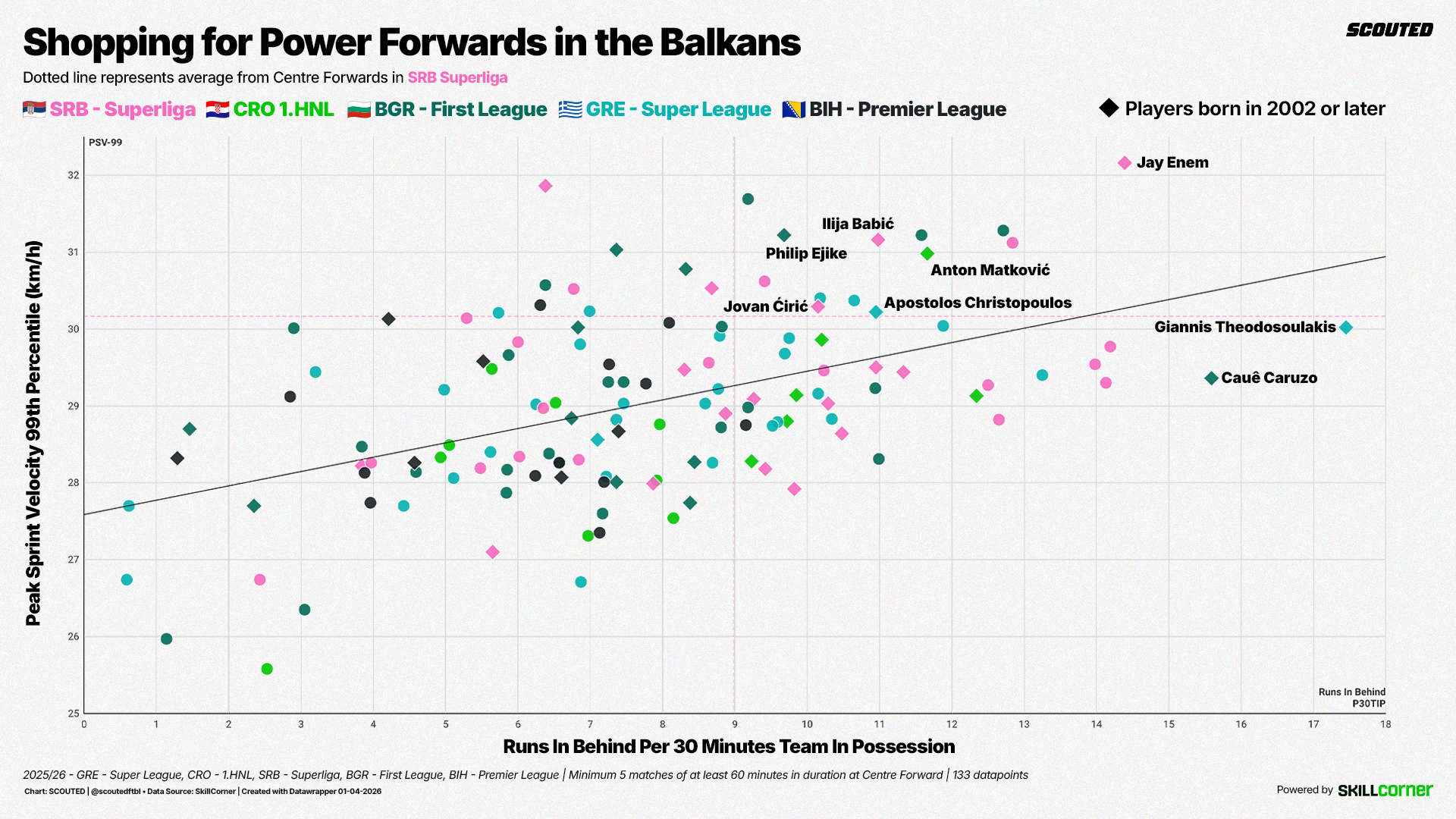
The final learning we can take from this is how league style can influence player output. We saw that the Superliga and the First League ranked above average for OBRs in Transition earlier: this environment seems to platform super quick strikers. Of the top 15 Centre Forwards for PSV-99 in this search, seven play in Serbia and seven play in Bulgaria.
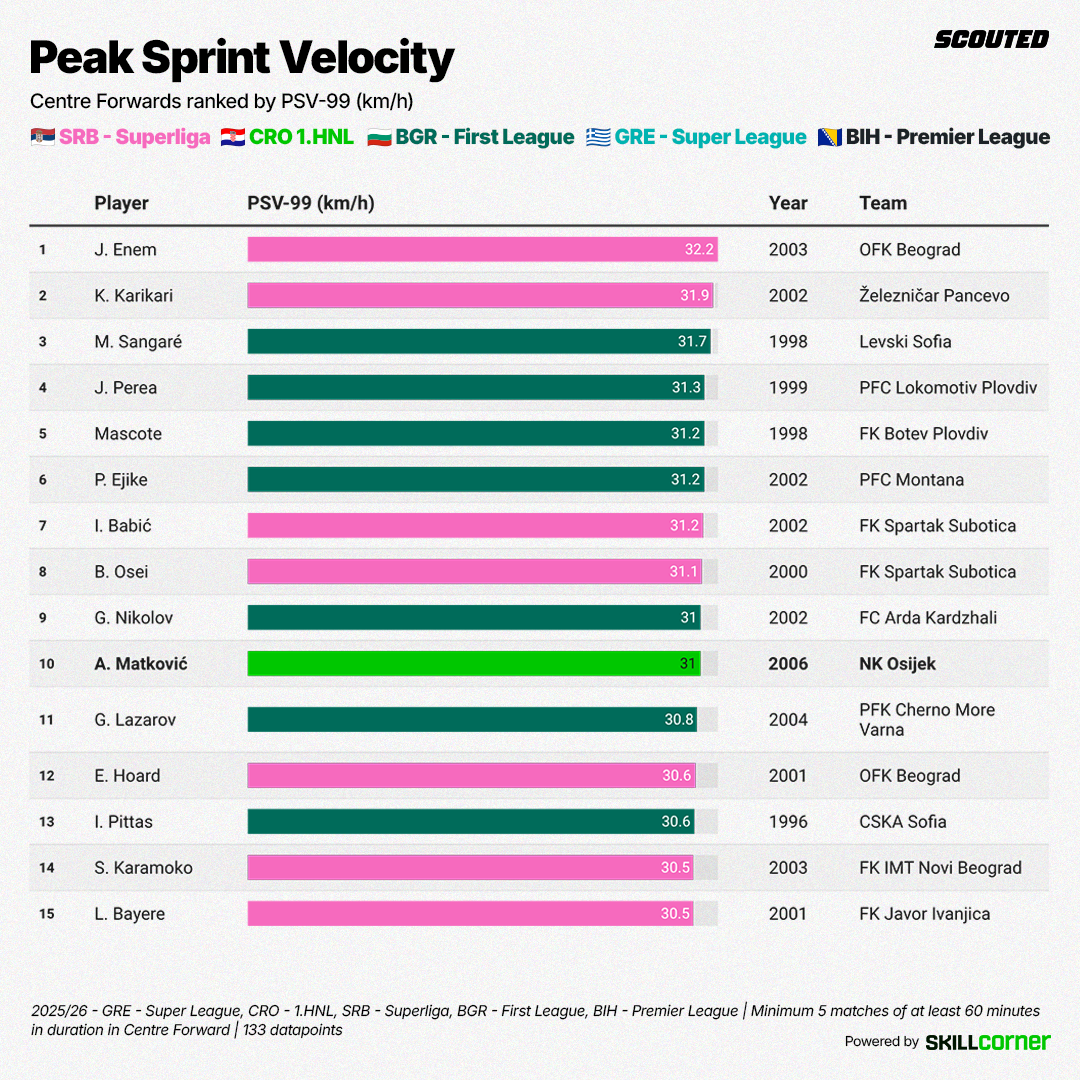
The fact that 2006-born Croatian forward Anton Matković has made this list deserves a quick mention. Like Enem, the 1.91m NK Osijek striker could see his output take off if he were to move to a more accommodating league like the Superliga. It’s also worth noting that he’s clocking these speeds after recovering from an ACL injury.
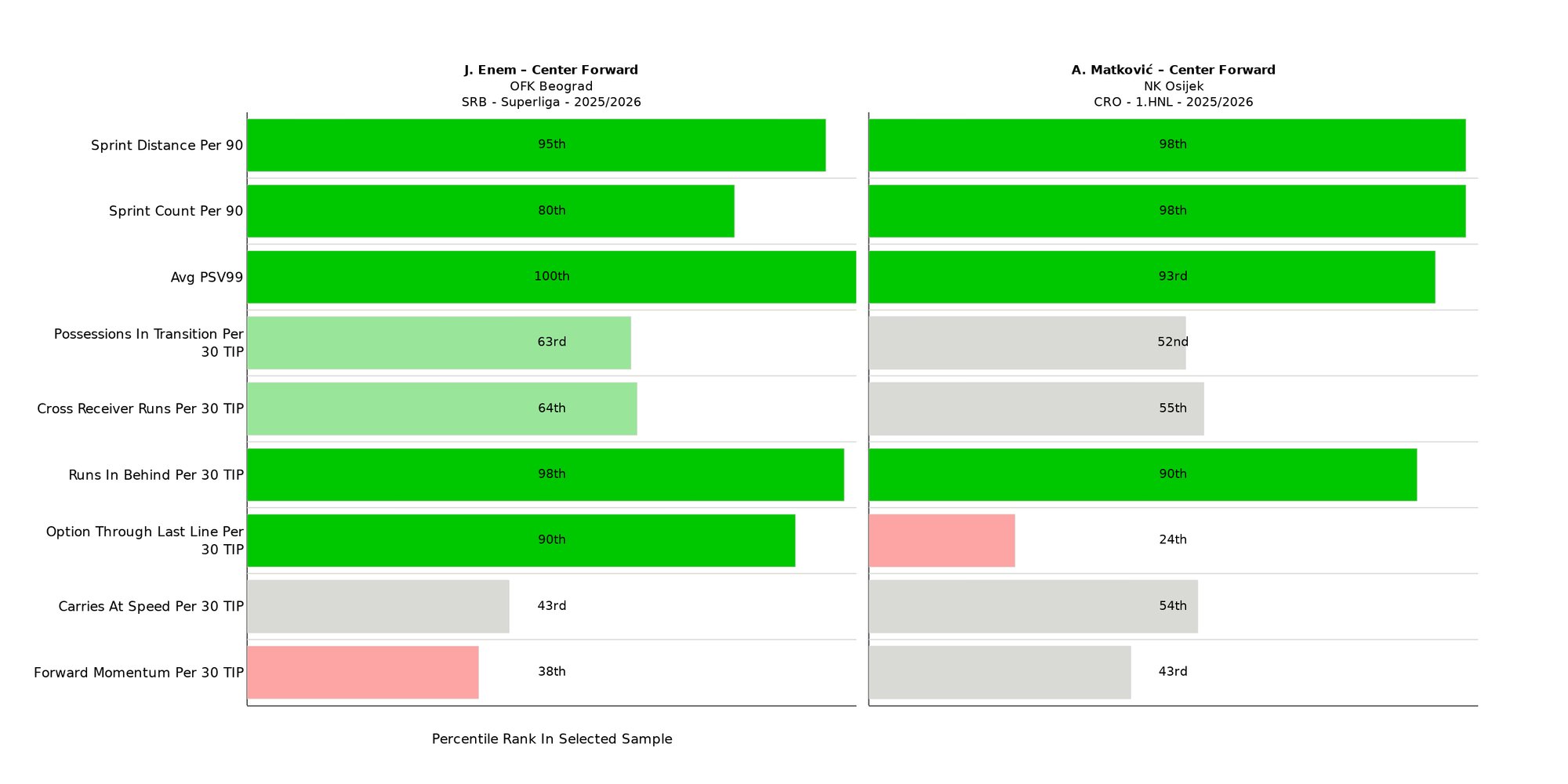
At that height, he also provides a window into another potential land of giants. But he does not quite have the carrying gene we were expecting to find in Croatia.
Croatia’s aisle of colossal carriers
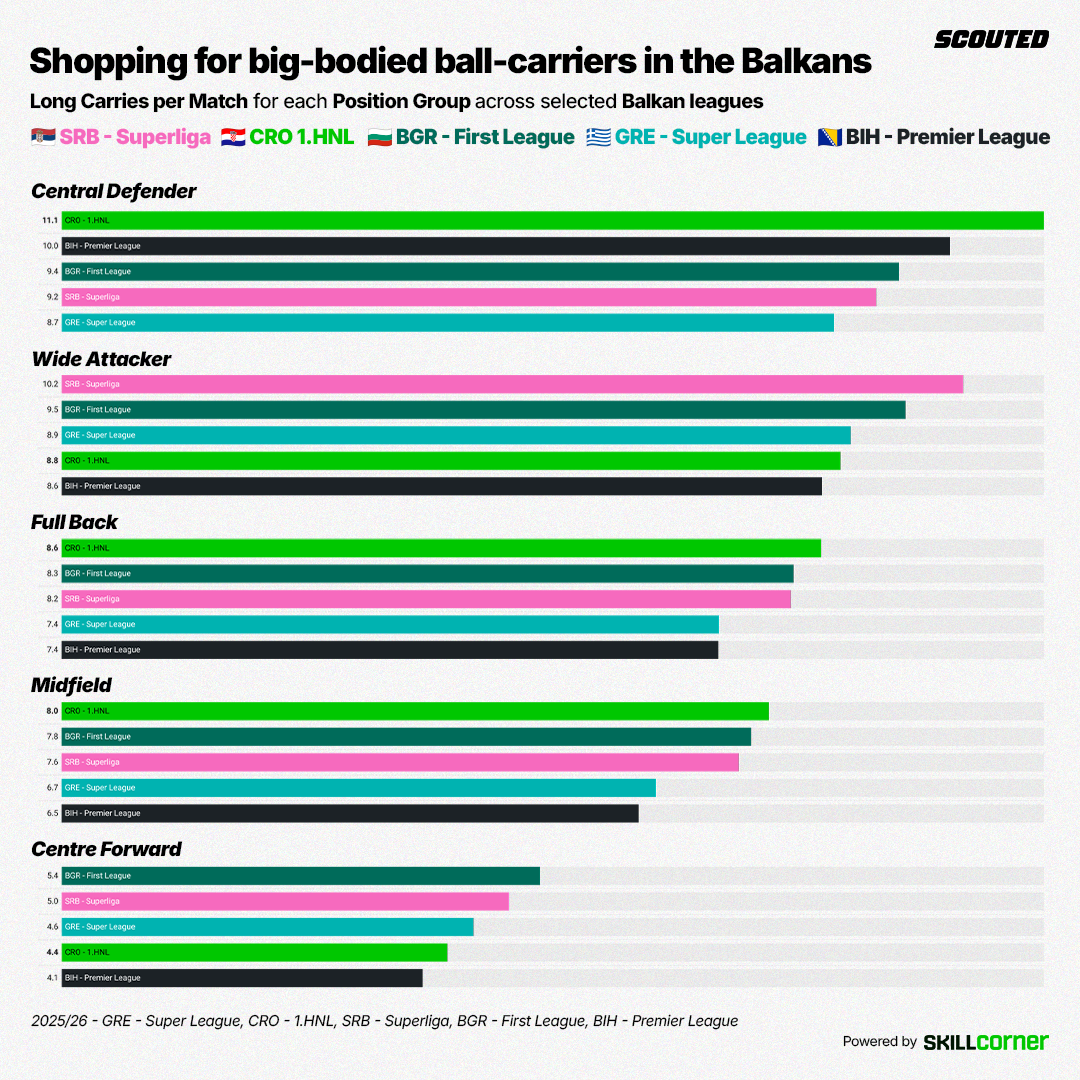
From our earlier benchmarking, the theory is that Croatia’s 1.HNL could be a hotspot for large, long-distance ball-carriers.
When looking at the average output for Long Carries by Position Group split between each league, the 1.HNL leads the way for Centre Backs, Midfield and Full Back. Our transition outliers in Serbia and Bulgaria, meanwhile, rank either first or second for Centre Forwards and Wide Attackers: another example of how environment influences output and another reason we should keep an eye on Bulgaria when it comes to bulldozing Power Forwards.
Focusing on Croatia, earlier we highlighted that Hajduk Split had recently cashed in on three young centre-backs, so could their ability to carry the ball be part of that? Luka Vušković's stature and his aerial ability are the attributes that have generated viral clips. But he has also ranked favourably for Carries at Speed feature at each of his last three clubs.
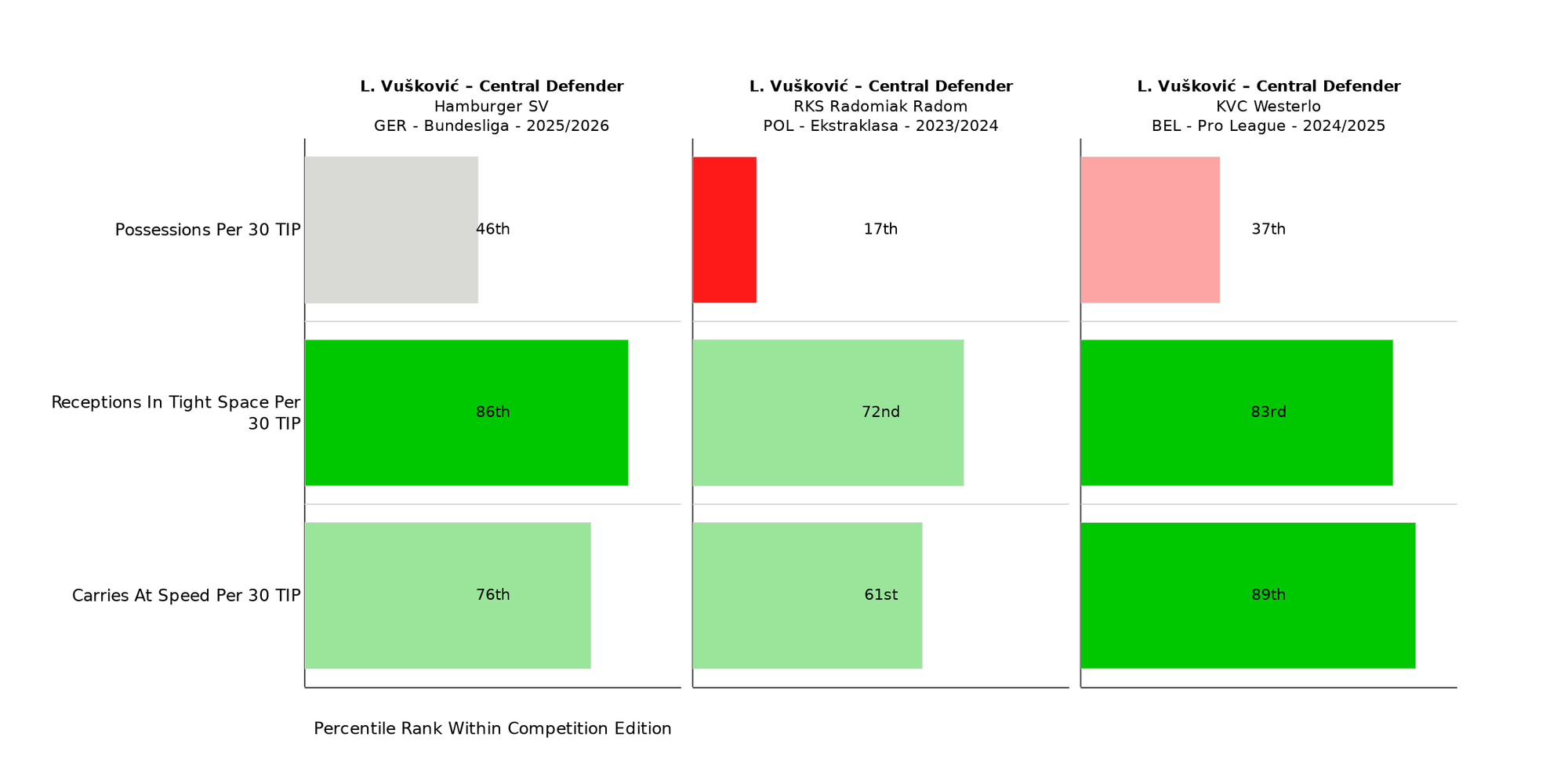
Although Vušković didn't play many senior games for Hajduk, his development at the Croatian club would likely have influenced this style. In an environment that encourages large, big-bodied centre-backs to bring the ball forward and develop their technical ability, two based in Zagreb are benefitting from it this season.
Ranking above now-Udinese centre-back Branimir Mlačić for Carries at Speed in the 1.HNL this season are 2005ers Sergi Domínguez Viloria (Dinamo) and Cheikh Mbacke Diop (Lokomotiva). Standing at 1.91m tall, Domínguez spent five years at La Masia before moving to Croatia so he represents the blend of physical stature and technical prowess the HNL is nurturing. Diop, meanwhile, has made his way to Zagreb from Wally Daan in his native Senegal via a season at Albanian side Labëria. On March 31st, he was signed by Eliteserien side SK Brann for €2.5 million.
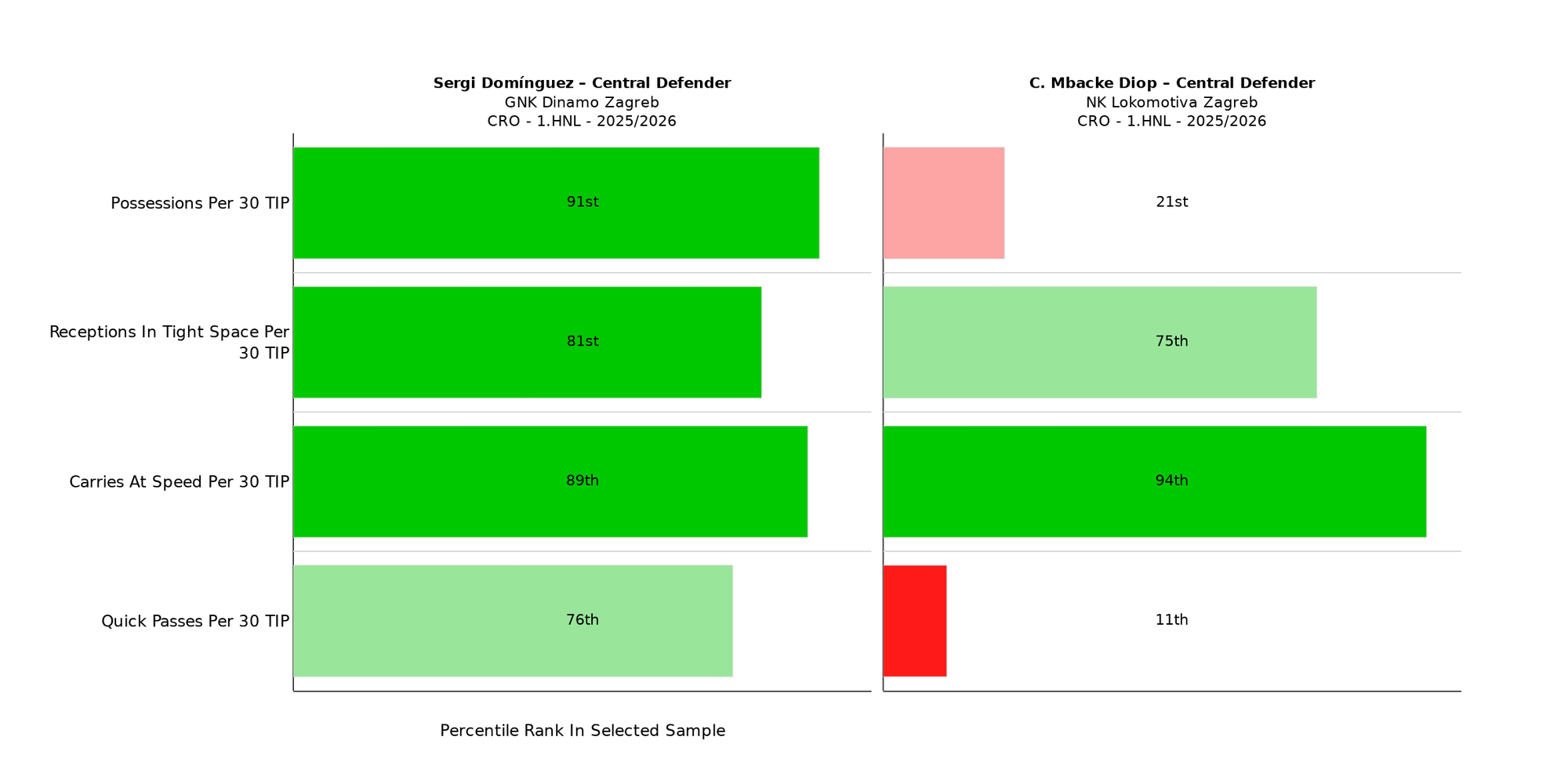
Among the pool of U23 Centre-Backs across the Balkan leagues, Diop and Domínguez rank 5th and 7th respectively for Carries at Speed. What’s interesting here is that the Bosnia and Herzegovina Premier League is the best represented in the top 10; one of them is 1.9m Croatian Duje Dujmović. Go figure.
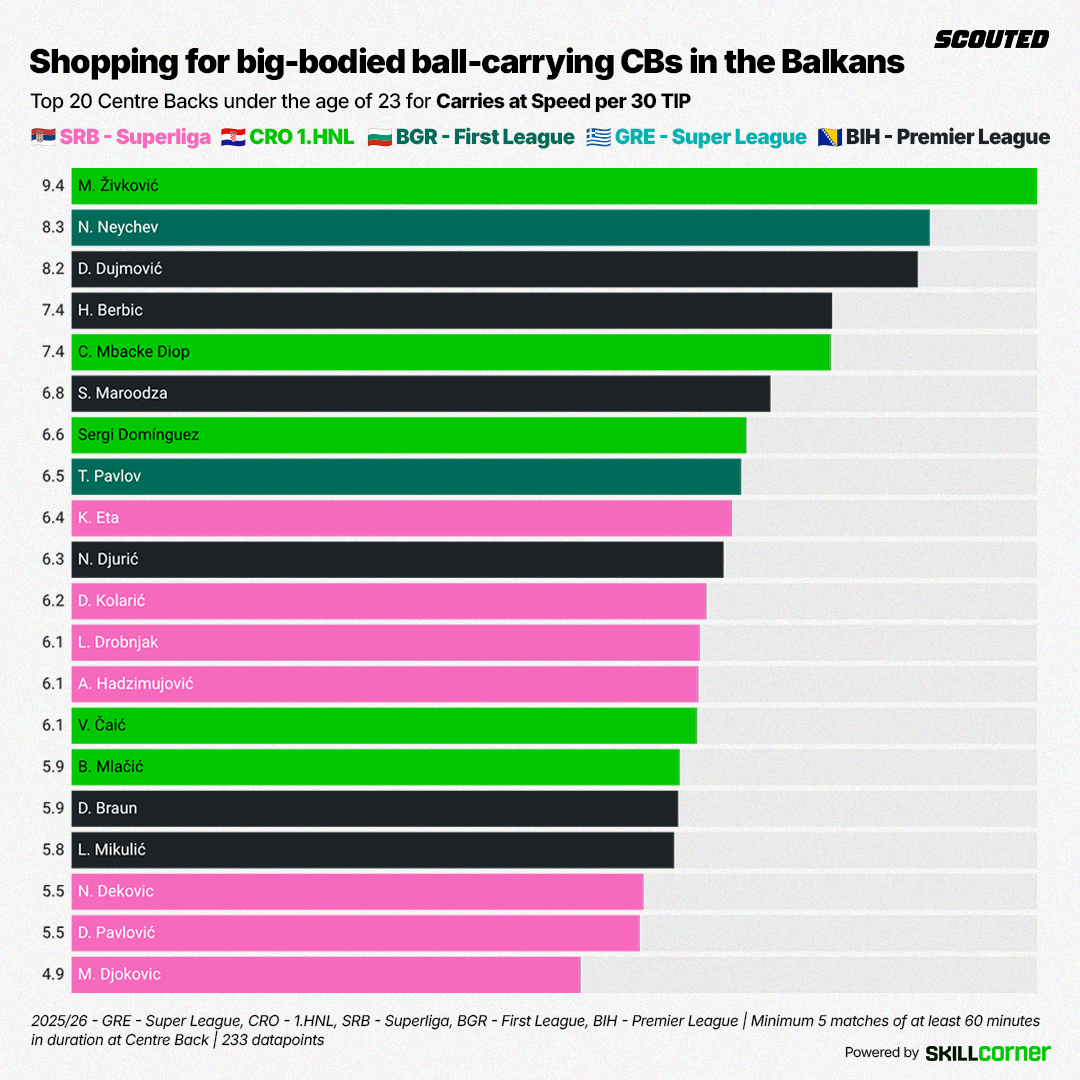
Just as Bulgaria emerged as a Power Forward supplier for Serbia, perhaps Croatia could supplement their pool of big-bodied, ball-carrying centre-backs by shopping south of the border. They will need to be quick, though, as the 1.90m Bosnian Haris Berbić was snapped up by Czech side Slovan Liberec in January this year.
Is Greece a Platformer paradise?
Moving onto our final brief, we were expecting Greek Super League midfielders to dominate the Platformer Performance Index ranking. Although this top 20 doesn’t quite match that theory, we do learn something interesting about this profile and the league.
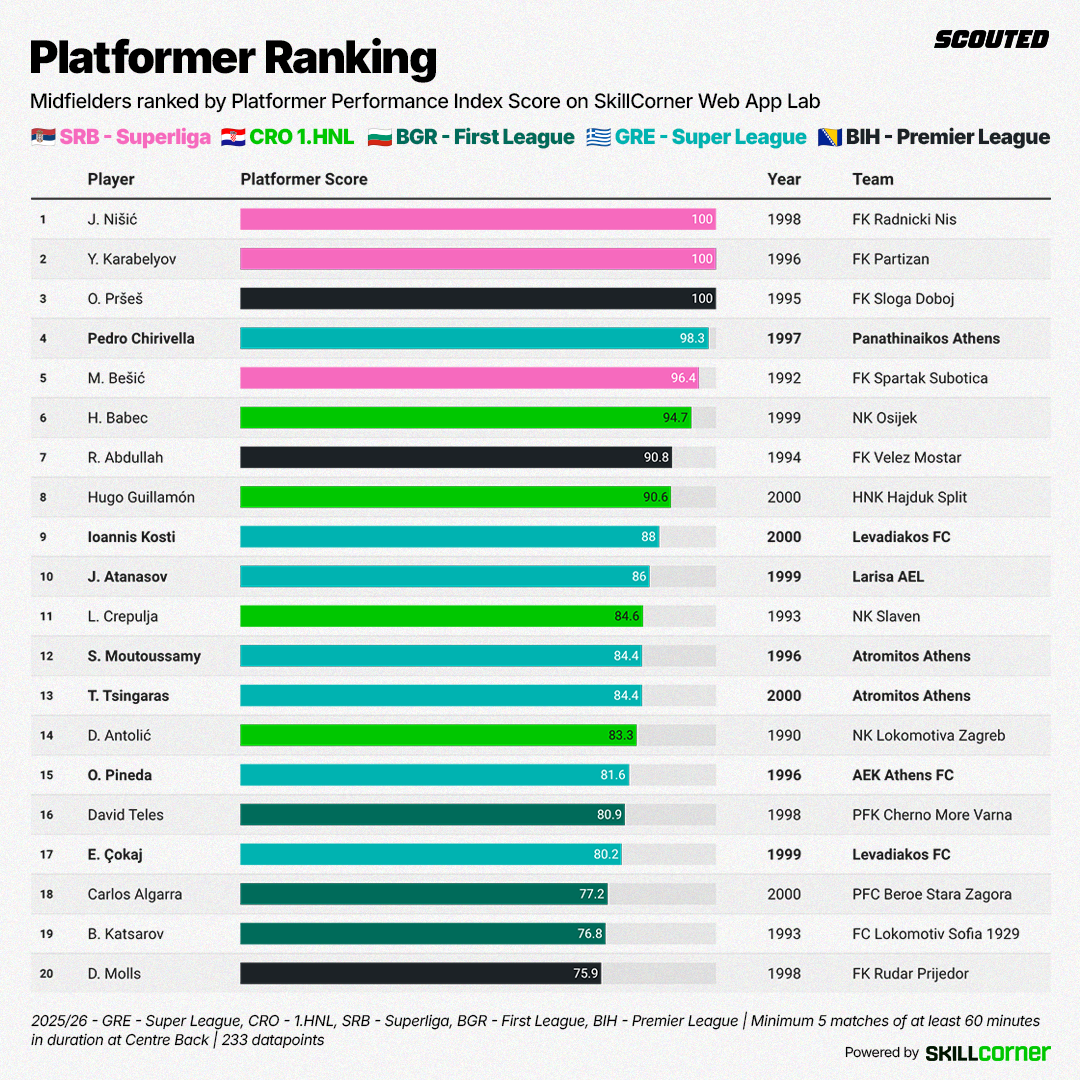
It's not until Giannis Apostolakis in 25th spot that we see a player from any league born in the year 2001 or later, and by that point he's not a perfect representation of the secure passing we associate with the Platformer anyway. It would be reductive to say definitively that the average age (28.4 per CIES) produces an environment that allows for more passes to be played under less pressure. However, it's interesting that older players across all Balkan leagues populated our ranking. Is there a link between the age profile of the Greek Super League and the style of play? More generally, are more experienced players more likely to profile as Platformers? Those answers require more research so let’s turn attention to a more pressing question.
In a league where it's difficult for young players to break into the starting XI, how does it happen? The antithesis of the metronomic passing we associate with the Platformer profile is Difficult and, to a slightly lesser extent, Dangerous Passing. Now focussing on Greek Super League midfielders only, a few younger players appear.
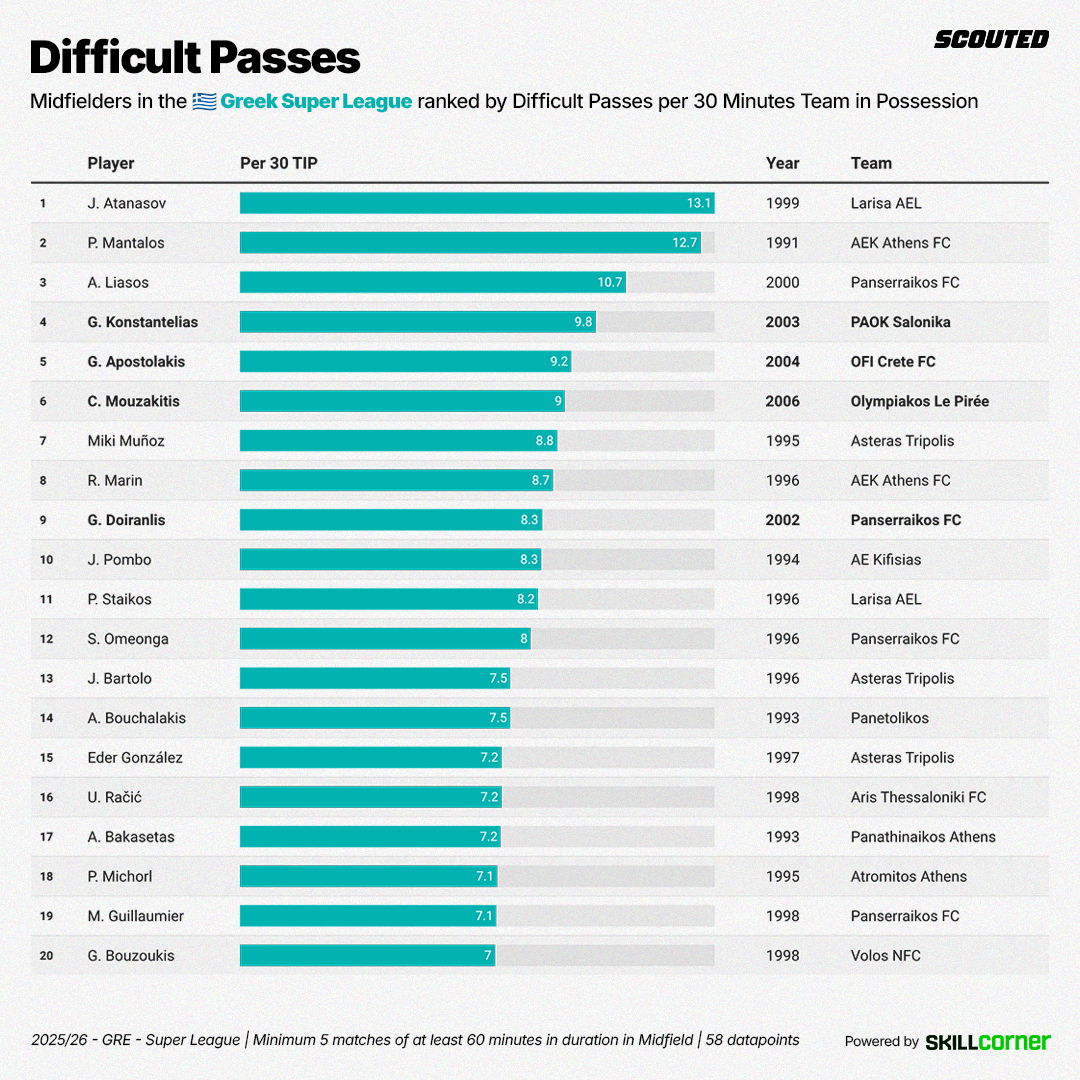
Four players born in 2002 or later appear in the top 10 for Difficult Passes, including the aforementioned Konstantelias, Mouzakitis and our not-so-Platformery prospect Apostolakis. Only Konstantelias and Mouzakitis also feature in the top 10 for Dangerous Passes.
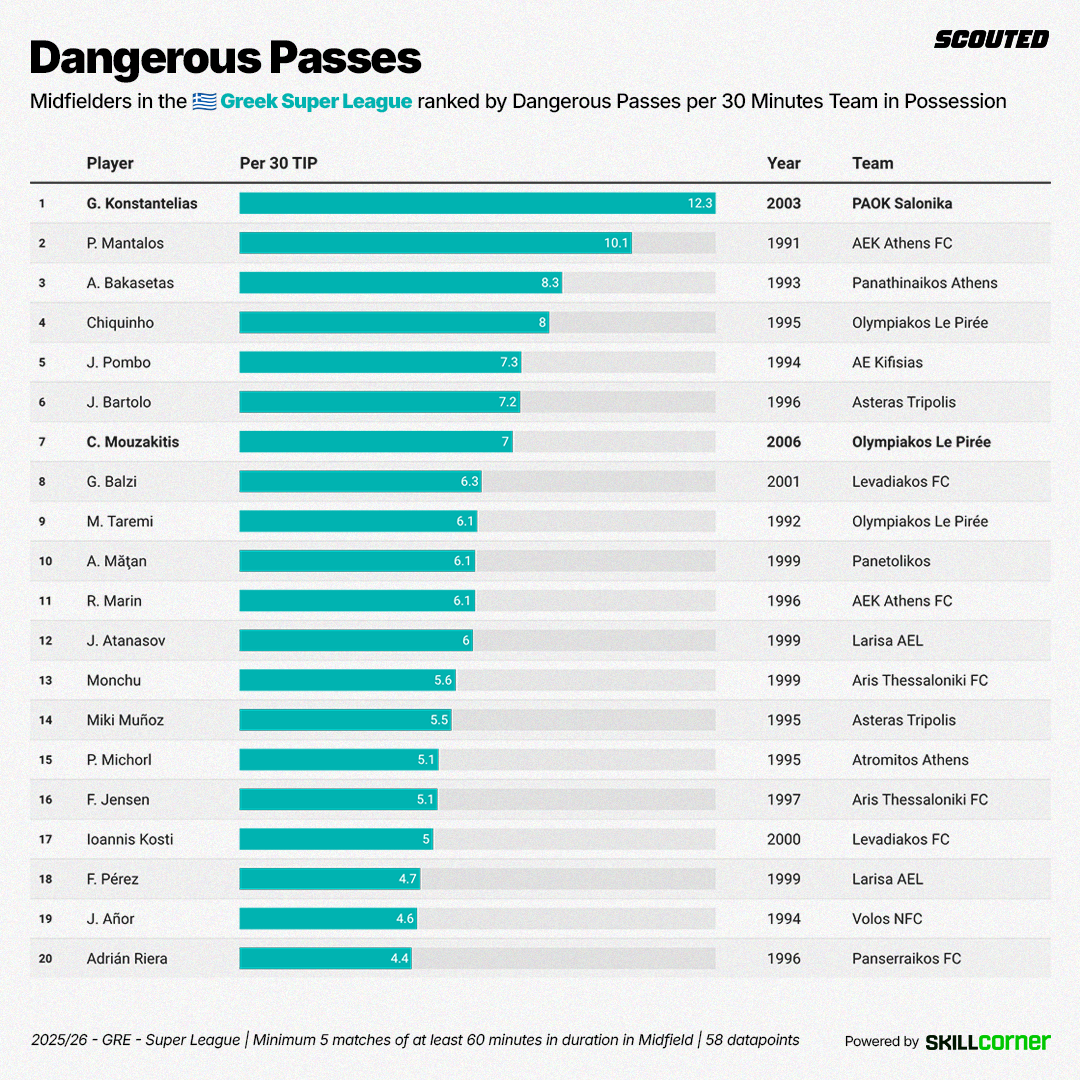
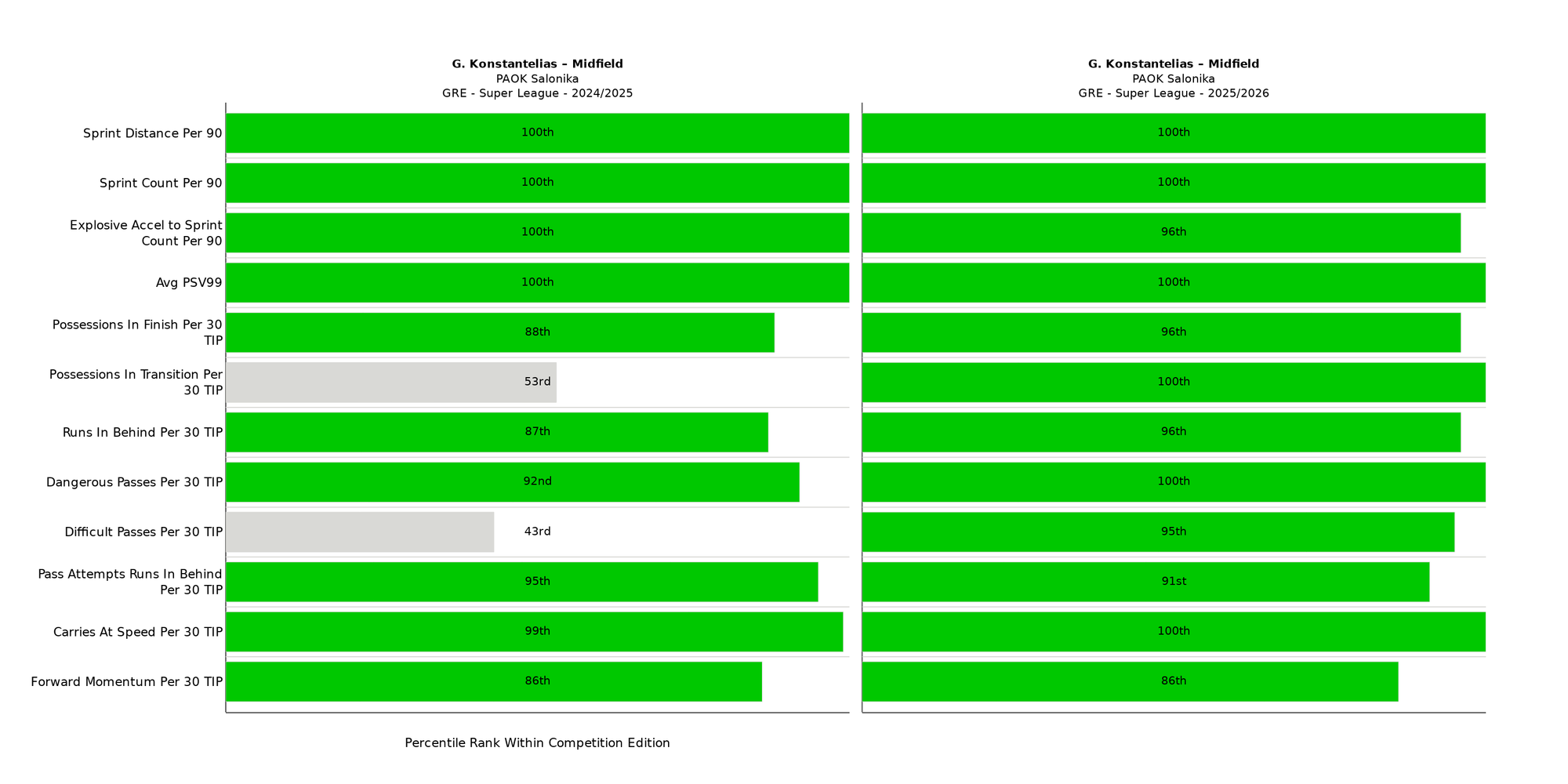
Of the 58 Midfielders that appear in this search, 11 are born in 2002 or later; five of which are born in 2002 so will be moving out of the U23 bracket this year if they have not already. You really do need to be a special young player to get a chance in the Greek Super League and Giannis Konstantelias certainly is.
As for Mouzakitis, who is not only the youngest player in the Greek Super League Midfield pool but also the only teenager, his ambitious passing breaks the mould and may be what has catapulted him into first team. A comparison with fellow Olympiacos midfielders makes that even clearer.
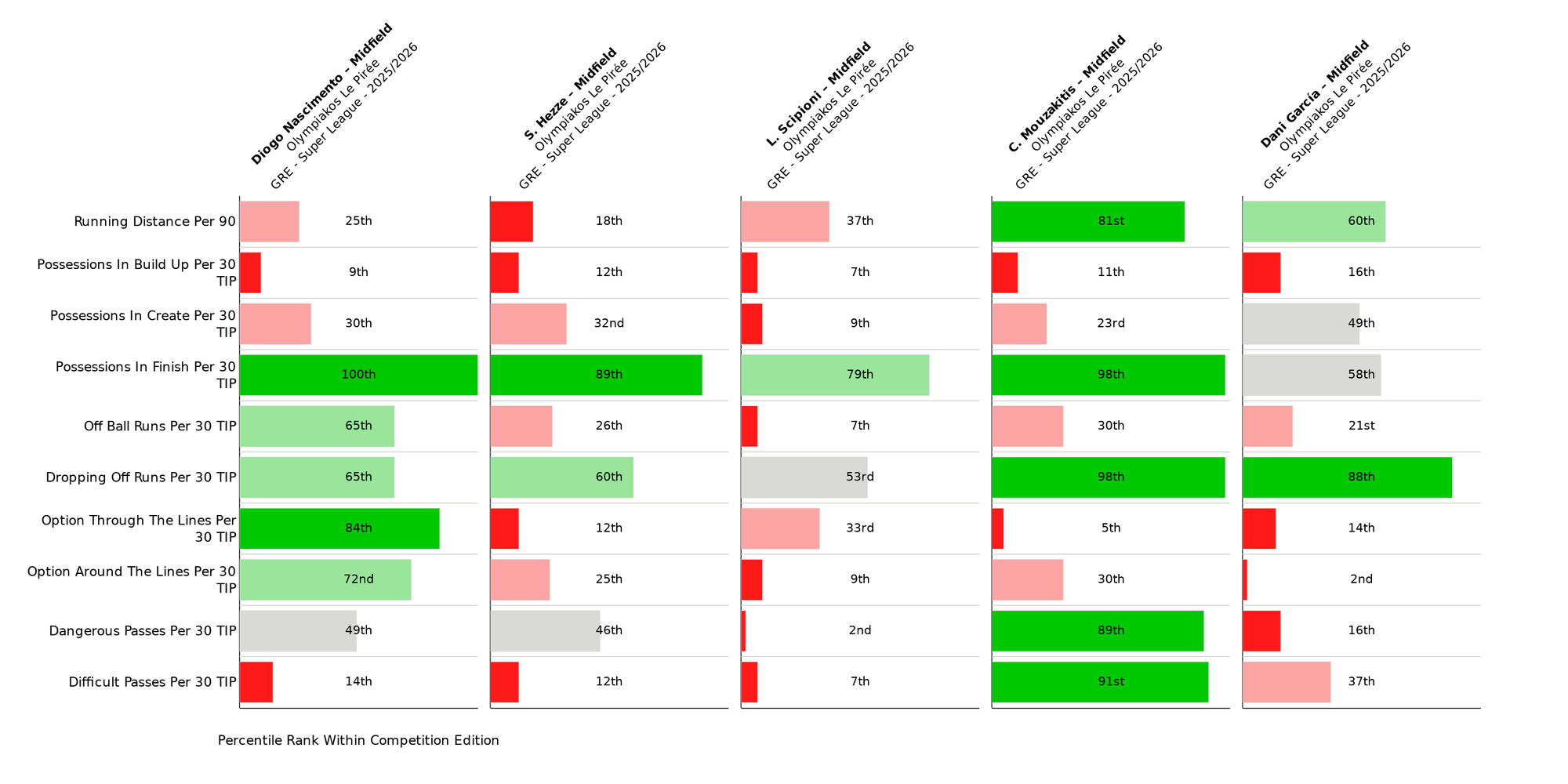
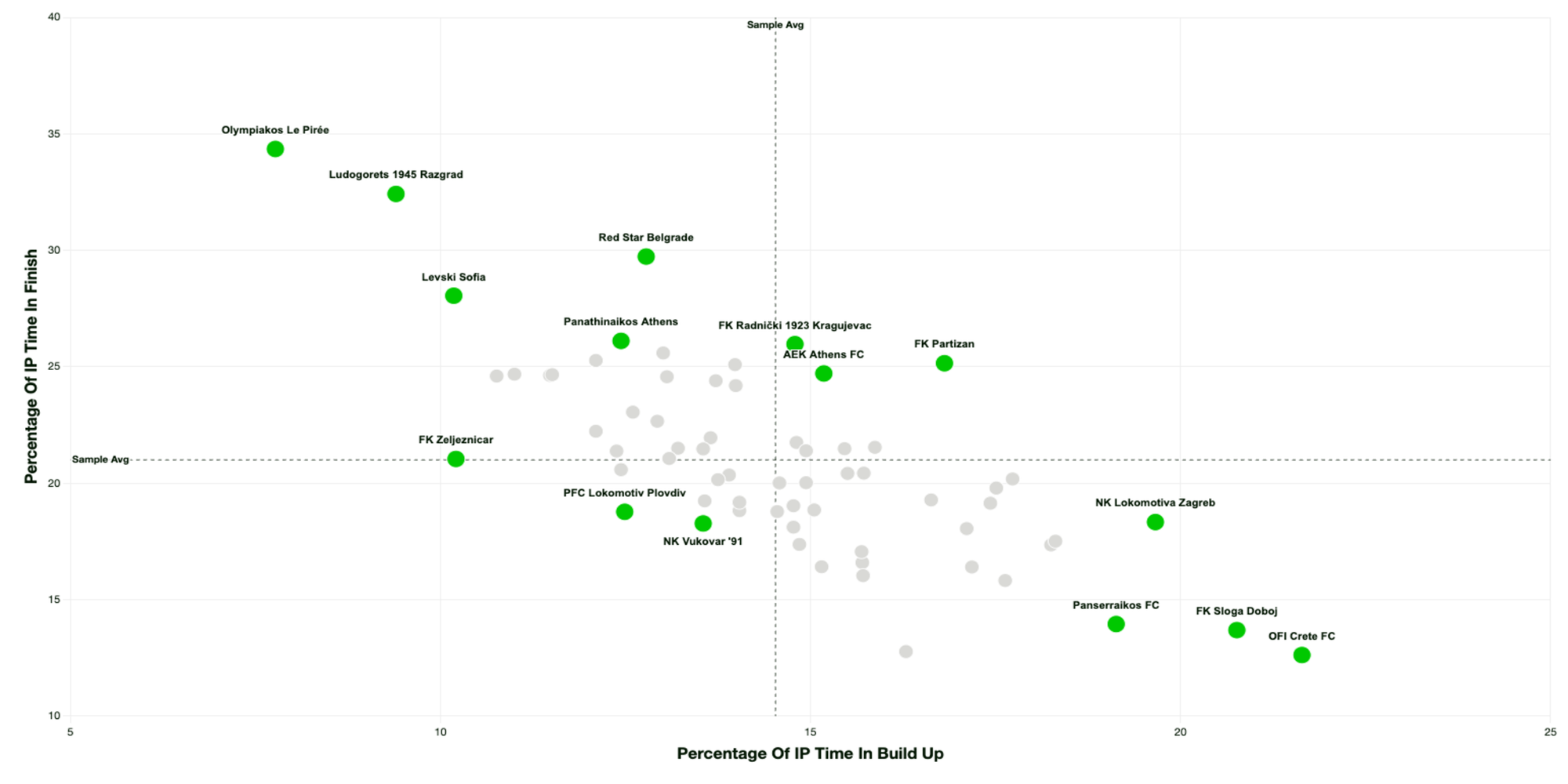
The combination of Difficult and Dangerous Passes with an outlying number of Dropping Off Runs paints a picture of a player moving out of the opponent's block to cause maximum damage with his left foot. As you can see, the outlying number of Possessions In Finish is more a reflection of his team environment than individual playing style. Olympiacos rank first for Percentage of IP Time in Finish and bottom for Percentage of IP Time in Build Up.
Whether he is able to find room for his progressive passing under more intense pressure - outside the Greek Super League - and if he can port his style to different phases - outside of the Olympiacos system - will be the key questions for any recruitment team eyeing him up. Even so, there are signs that he can develop into a Pathfinder, a profile inspired by the forward-first passing habits of players like Trent Alexander-Arnold and Adam Wharton and one that is rare to find in Greece.
Through revisiting and reprofiling the Balkans with the latest SkillCorner Data, we have learned even more about this region, or at the very least added more weight to our previous findings.
Serbia continues to be an athletic outlier, catering towards the Power Forward profile. Additionally, Bulgaria has emerged as a place for Serbian clubs to visit when restocking their shelves; the First League is home to a host of quick strikers acclimatised to transition phases - they don’t make them like Dimitar Berbatov anymore.
Clubs looking for big-bodied ball-carriers should go shopping in Croatia. Even those that are not immediate outliers for this style are developing in an environment which clearly encourages mobility on the ball. This is particularly notable for centre-backs which means, as one of the tallest regions in Europe, physical gifts are supplemented by technical development through time spent on the ball and the encouragement to carry it. Bosnia and Herzegovina could be a secondary market for this particular type of defender.
Finally, the Greek Super League's settled possessions and relative lack of athleticism could be related to the higher average age of the league. The young players breaking through are the ones challenging the status quo, breaking the mould with high-intensity running or penetrative passing all while displaying the technical security that appeals to Portuguese and Spanish teams.
Benchmarking physical output and stylistic traits has showcased the region’s development of diverse playing styles that cater to a wide range of scouting briefs and various markets. Knowing where to look for specialised profiles ensures you are able to identify high-level potential before it’s too late.
This newsletter was produced under a commercial collaboration with SkillCorner, SCOUTED’s official data partners. Their tracking and performance data is used by more than 150 of the world’s biggest clubs, leagues and confederations.