
Australia's Youth Revolution
The beginning of a transformation from A-League Men to A-League Boys

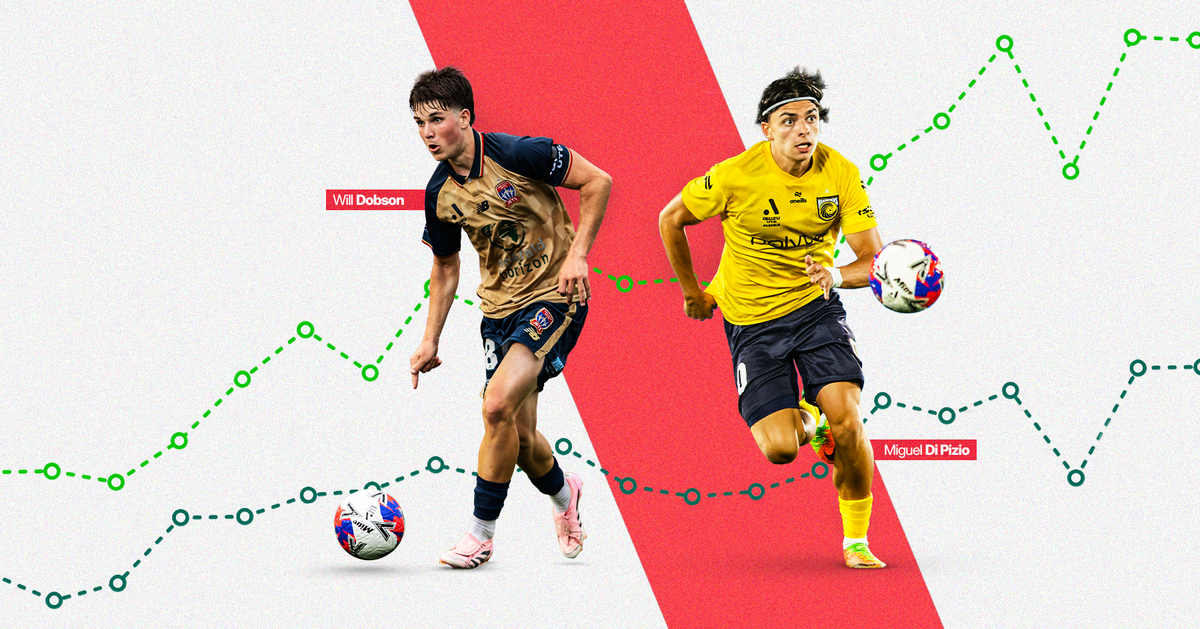
Once, developing leagues would sign marquee veterans on huge wages to boost their international profile. Today, more and more are seeing value in another route: developing and nurturing young talent to be sold, at profit, to more competitive leagues. The fashion has spread in particular throughout members of the Asian Football Confederation, where top Japanese and Korean clubs have realised any short-term losses are more than offset by the long-term sustainable growth provided by selling generations of quality to Europe. Now, teenagers are flooding one of the Confederation’s oft-forgotten members: Australia’s A-League.
All data correct as of 17 February 2026

Support SCOUTED
This analytical epic is free to read courtesy of SkillCorner, our data partners. Subscribe now to keep in-depth content like this coming your way.
Subscribe for freeHere’s an extract from a seasonal report of the A-League Men produced by Professional Footballers Australia (PFA):
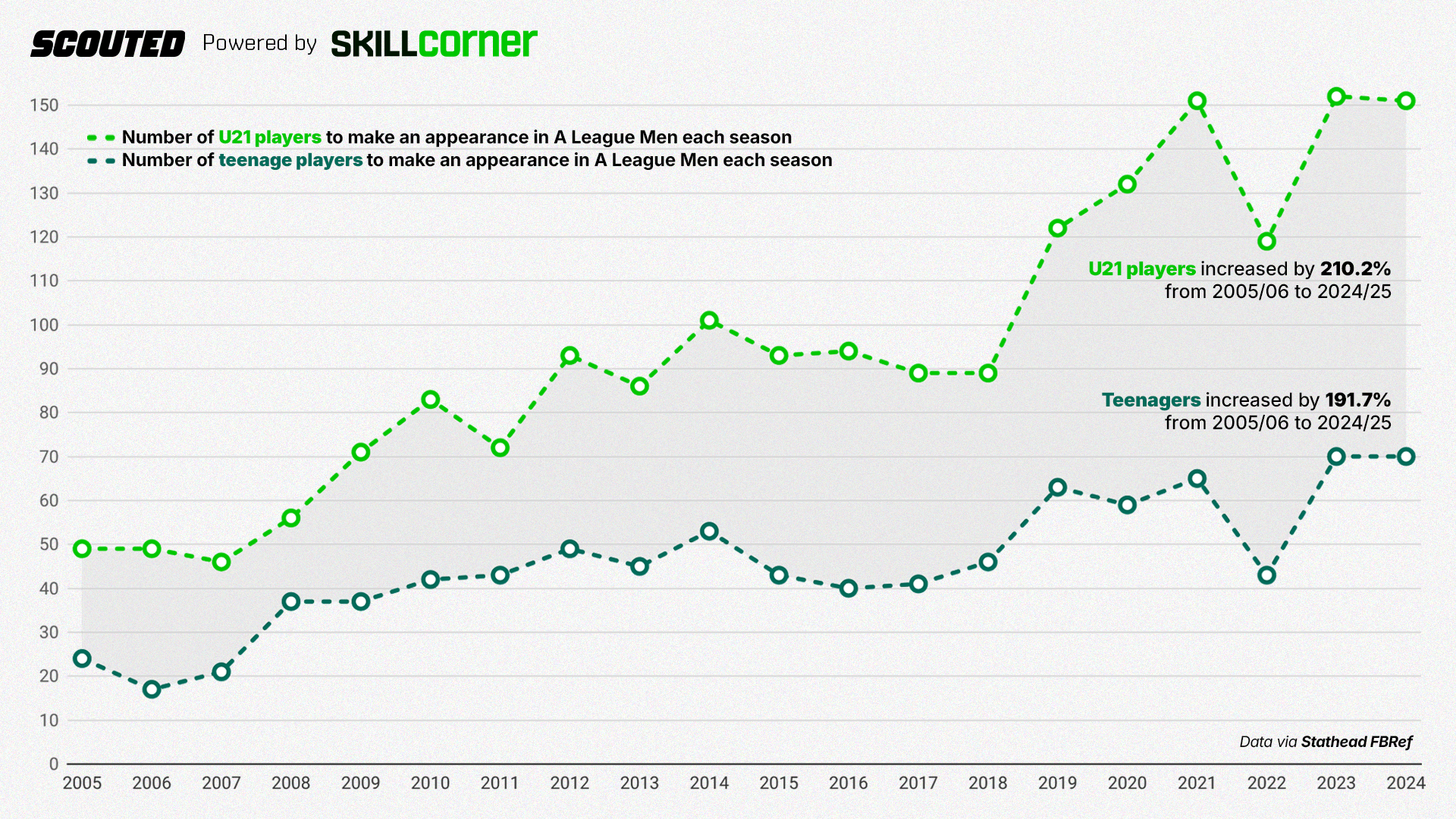
The ALM continued to transform in 2024-25, with clubs pivoting hard to youth development but experiencing increasing challenges in growing the fanbase and competing in Asia. The league’s recent trend towards younger players went to new extremes, with an all-time high share of match minutes going to players aged under 21. Under 21s accounted for 18% of match minutes in 2024-25 and players aged 25 and under grabbed more than half (56%) of the league’s match minutes for the first time. The youth focus is a product of maturing academies, cost-cutting, and pursuit of transfer revenue.
The report also highlights a piece of research from the CIES Football Observatory that found the A-League to be the most accommodating to homegrown young players. A-League ranked first among the top 50 domestic leagues worldwide for the percentage of minutes played by U-21 footballers eligible for the league’s respective national team in 2025.
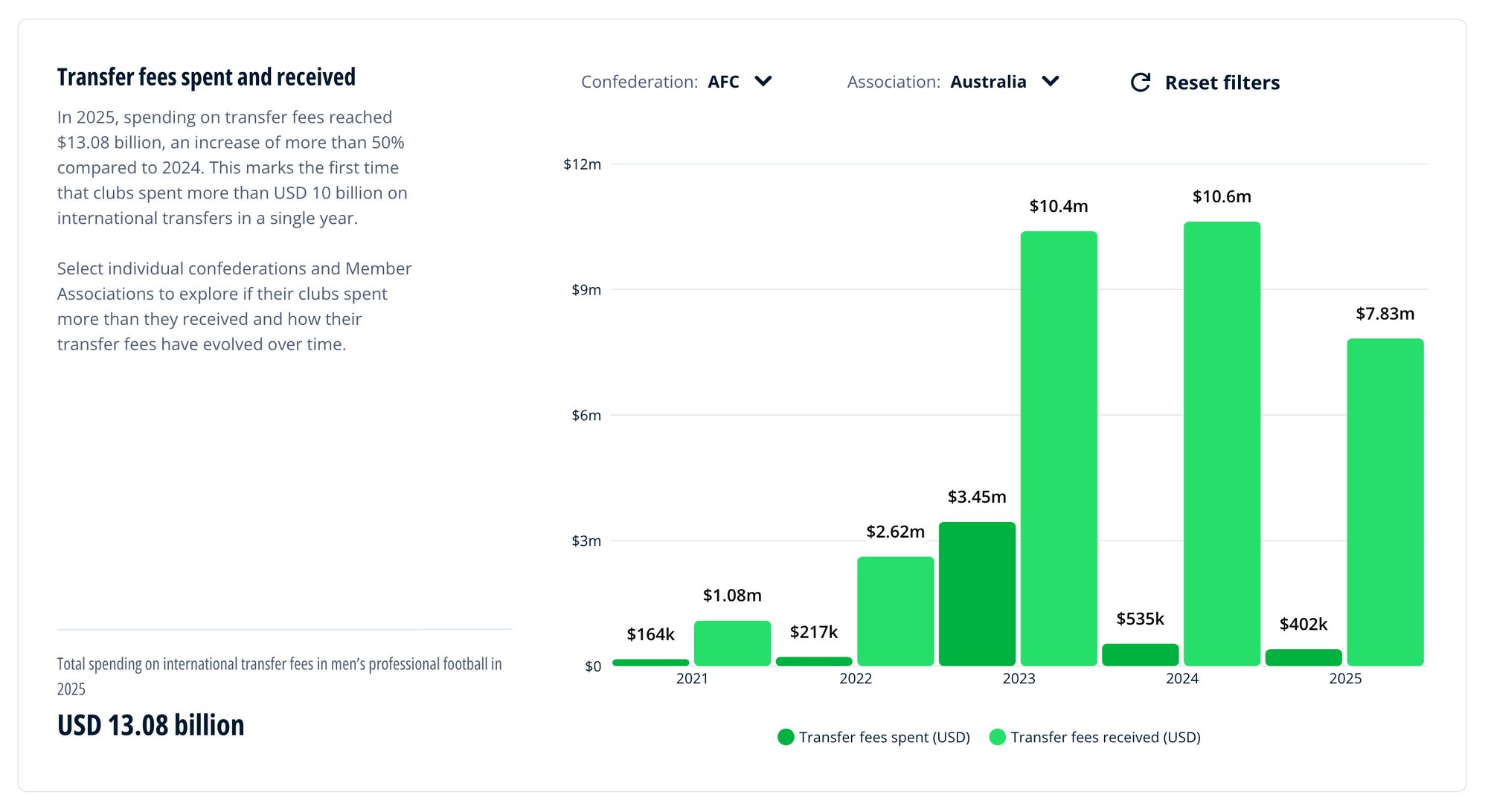
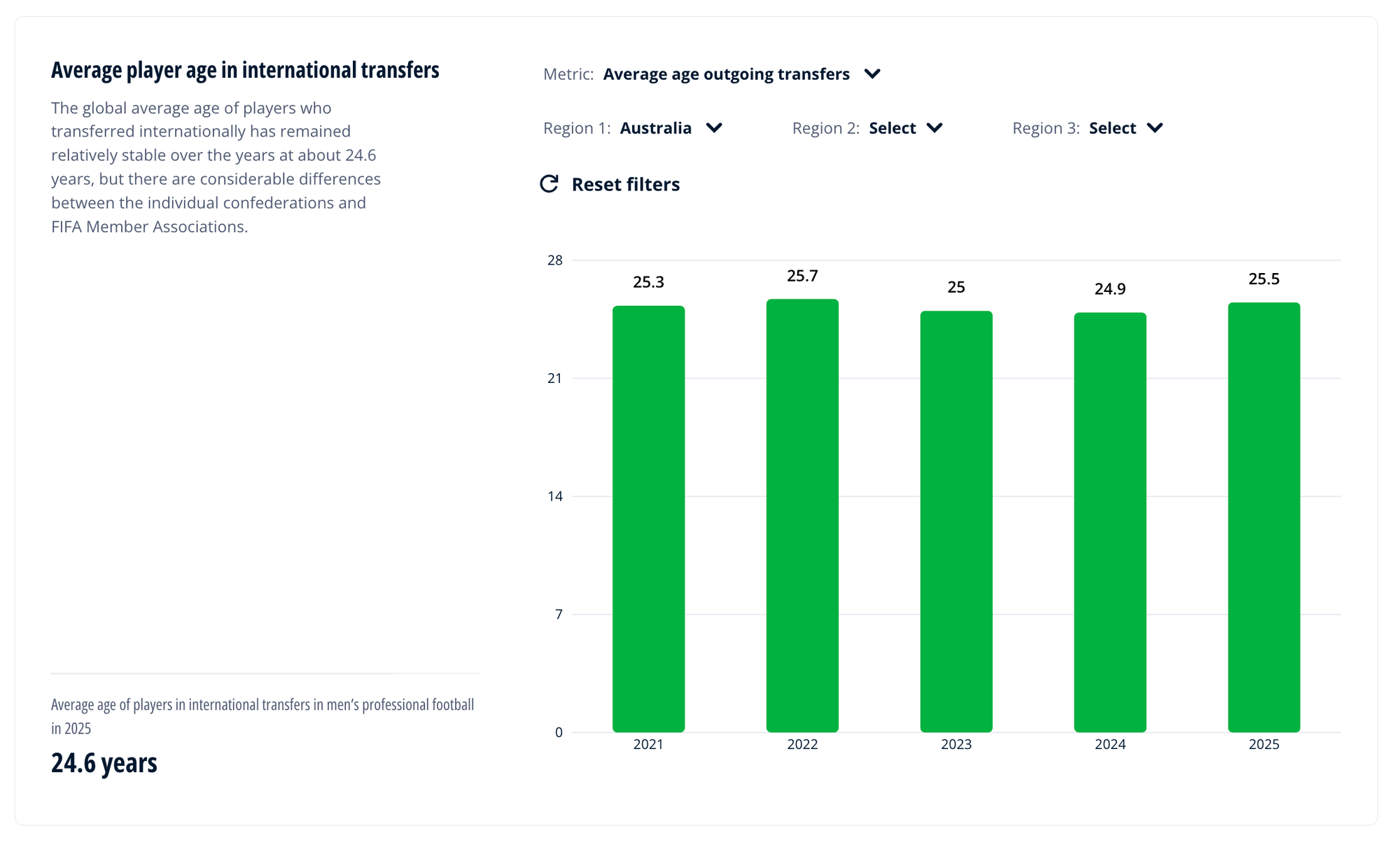
But this approach is yet to completely transform the market. According to the latest FIFA Global Transfer Report, the transfer fees received by the A-League in 2025 were lower than 2023 and 2024, while the average age of the outgoings represented the second-oldest figure of the past five years.
This doesn’t tell the whole story. By digging into the context, we can unpack the A-League’s journey so far, and explain why exactly they’re well-poised to improve their player profits in the coming years. And, of course, by using SkillCorner data, we can analyse the quality of the teenagers breaking out in Australia right now, detail the team and league context allowing them to thrive, compare them to their contemporaries in other developing leagues, and create a shortlist of the most exciting - including a potential fit for our new Archetype, the Berserker.
On the surface, the FIFA Global Transfer Report provides more evidence that the the A-League is not yet reaping the benefits of this pivot to youth development. Among AFC nations, Australia received less in transfer fees than Saudi Arabia, Japan, Korea Republic and the United Arab Emirates, while the number of outgoing transfers fell slightly (-2.8% growth rate).
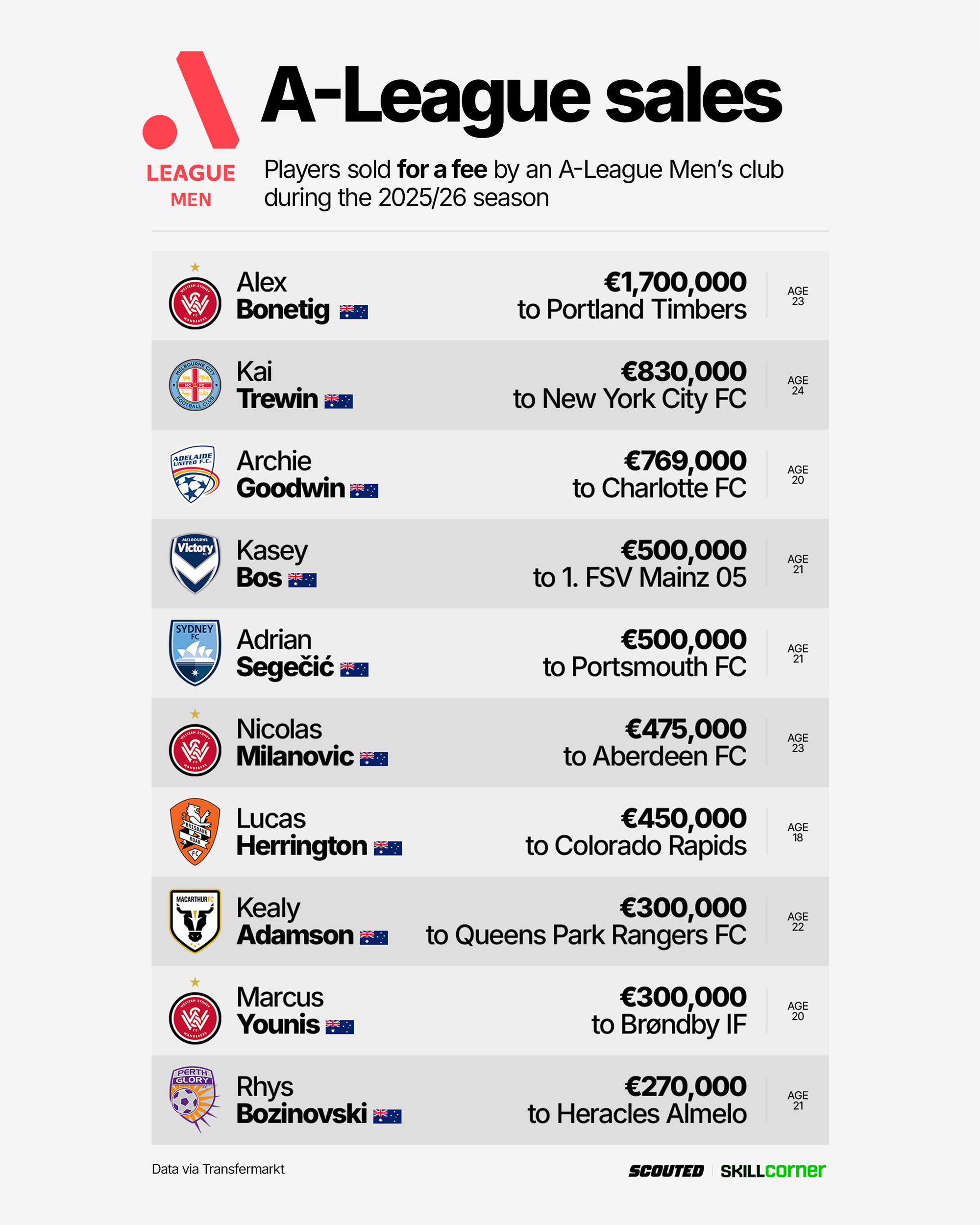
However, per Transfermarkt, only ten players have been sold for a fee during the 2025/26 season. Of those ten, four went to MLS, including the most expensive player, and all four were aged 24 or under. The only other league to double dip was the Championship.
According to FIFA, the United States is the second-most popular destination for outgoing A-League players alongside England, with the latter spending two times as much on A-League transfers. This echoes a recent SCOUTED study of the EFL Championship’s growing interest in the AFC.
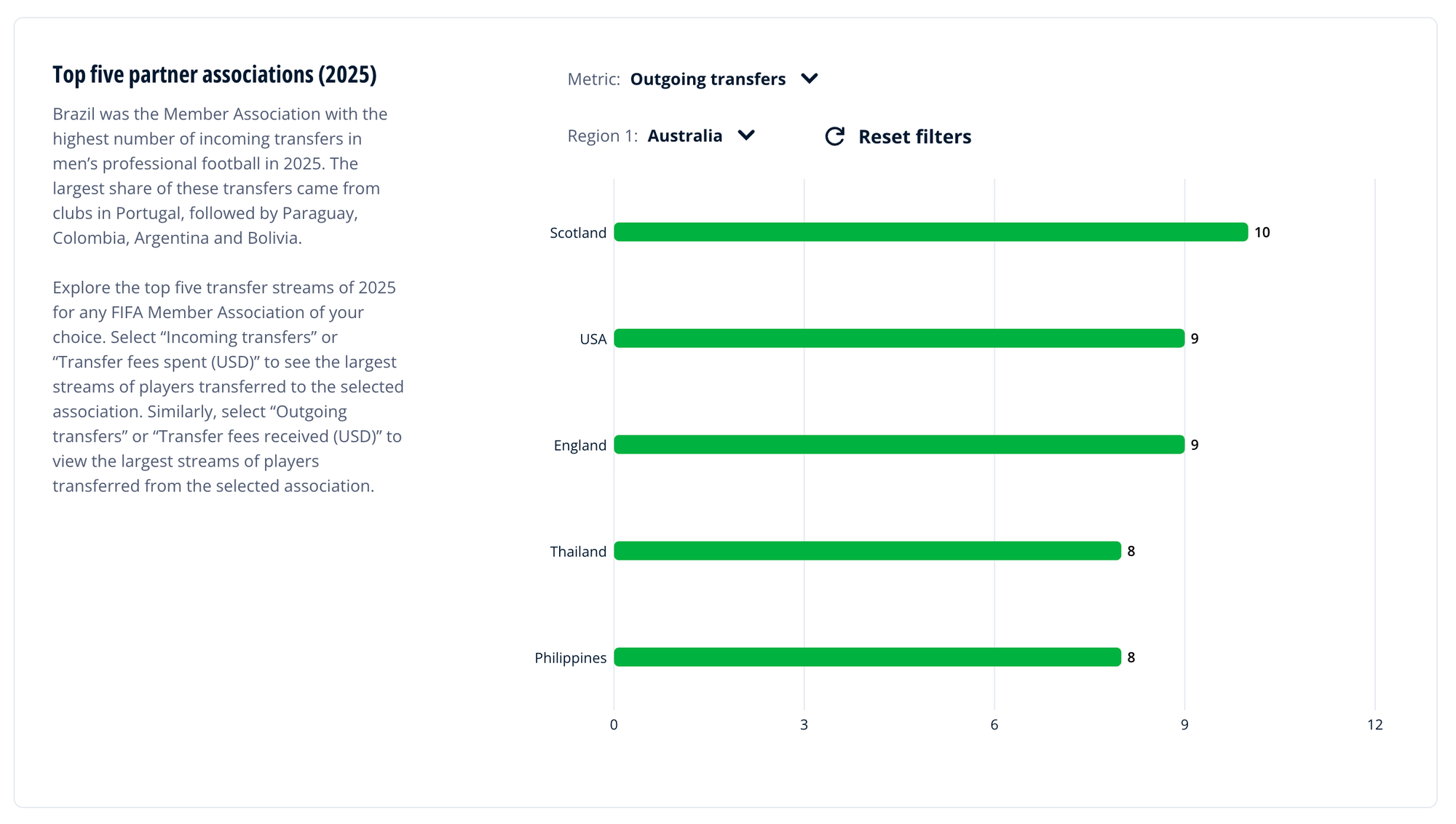
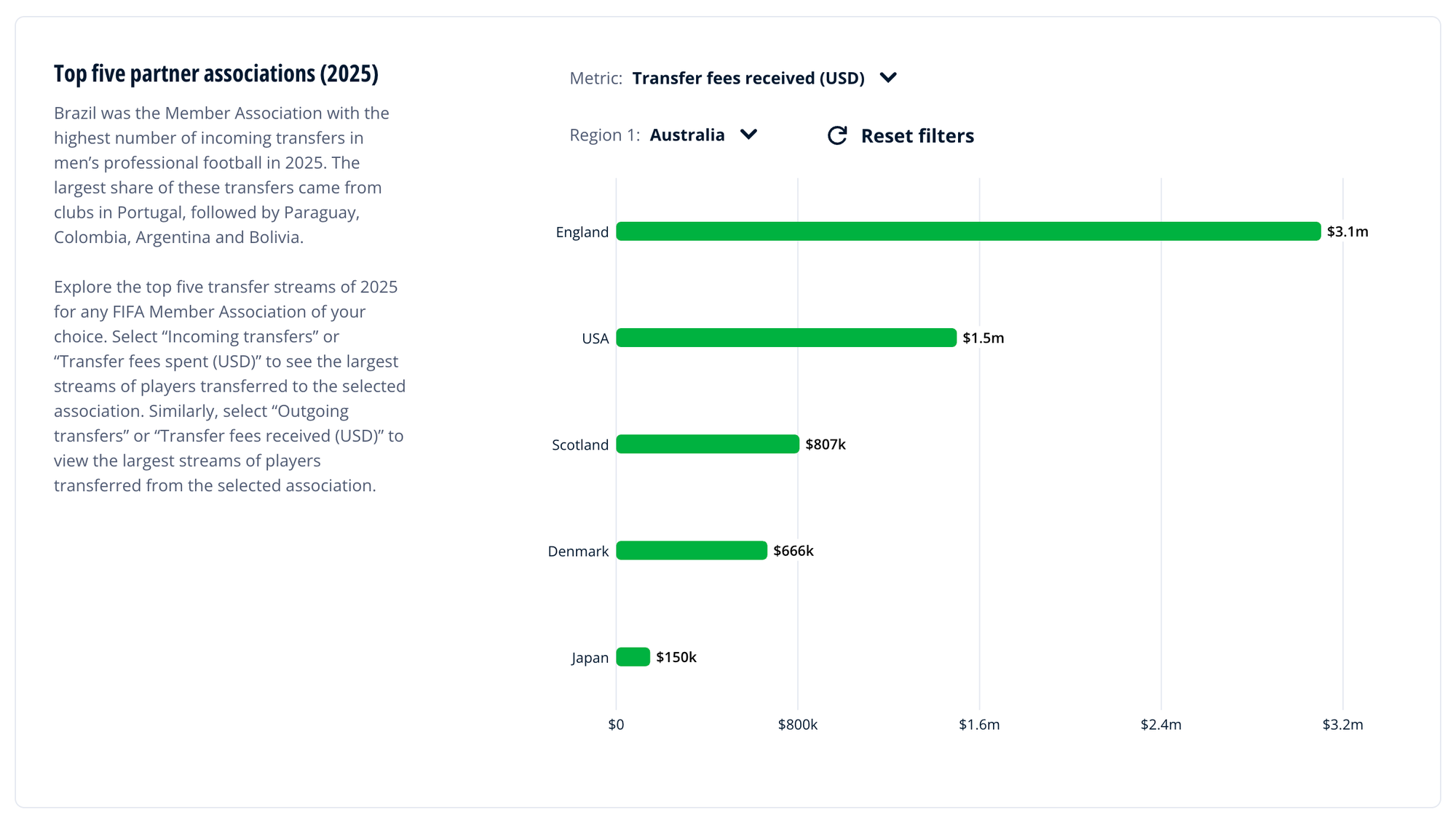
These tables and reports are more promising but they still miss important context. First, the suspension of Western United's A-League licence ahead of this season saw the termination of all players' contracts and therefore no transfer fees were paid for the likes of 2007-born Dylan Leonard, who moved to Schalke 04. More crucially, they also overlook any training compensation or solidarity contribution paid as part of the FIFA Training Rewards.
Since 2001, The FIFA Regulations on the Status and Transfer of Players (RSTP) introduced these measures as a way to reward clubs for successfully developing professional players. Both are mandatory payments outside of transfer fees. The full explanations are included in this monster FIFA RSTP document. But, put simply, training compensation (Annexe 4) is a financial reward paid upon a player signing their first professional contract while solidarity contributions (Annexe 5) are earned for all future transfers.
So, A-League clubs are not only receiving larger transfer fees for their homegrown talent, but will receive compensation for transfers beyond the initial sale. All this has culminated in a platform primed for producing and selling talent.
After 17 games of the 2025/26 campaign, 64 teenagers have made an appearance in the A-League. Among them is Lucas Herrington. The 2007-born, 1.92m centre-back featured in 11 matches this season following a breakout campaign in 2024/25 in which he was crowned the Brisbane Roar’s Young Player of the Year. Despite his age, Herrington proved incredible difficult to beat in a variety of 1v1 situations out of possession and displayed a keenness to play expansive, line-breaking passes when on the ball.
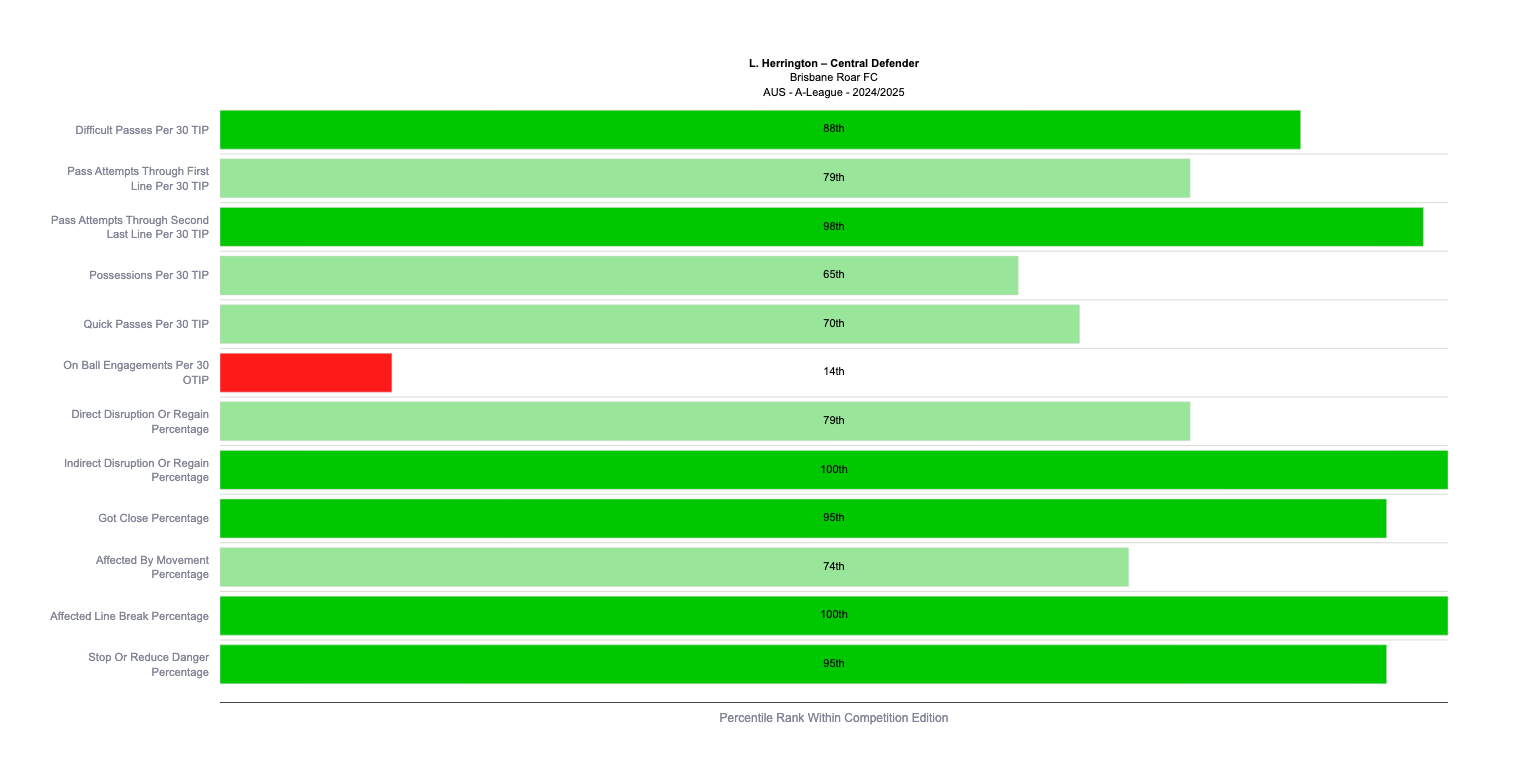
In August, he agreed a move to Colorado Rapids for the 2026 MLS campaign in a club-record sale. Roar Head Coach Michael Valkanis captured the shift in the A-League’s approach to youth when speaking about the move:
“At Brisbane Roar, we’re dedicated to identifying quality young Queensland talent and developing them into future stars, and this transfer is an example of just that.”
Herrington’s club-record sale to Colorado Rapids, the fact he benched Rob Holding for the first game of the 2026 MLS campaign, and the rise of spending from English clubs - Portsmouth signed Herrington’s Roar teammate Thomas Waddingham in January 2025 - are indicators this is beginning to change.
Before we begin digging into more players and teams, it’s always worth benchmarking the Physical output of the league compared to emerging destinations. Here's how Australia's top-flight compares to the five countries spending the most money on A-League transfers we saw earlier.
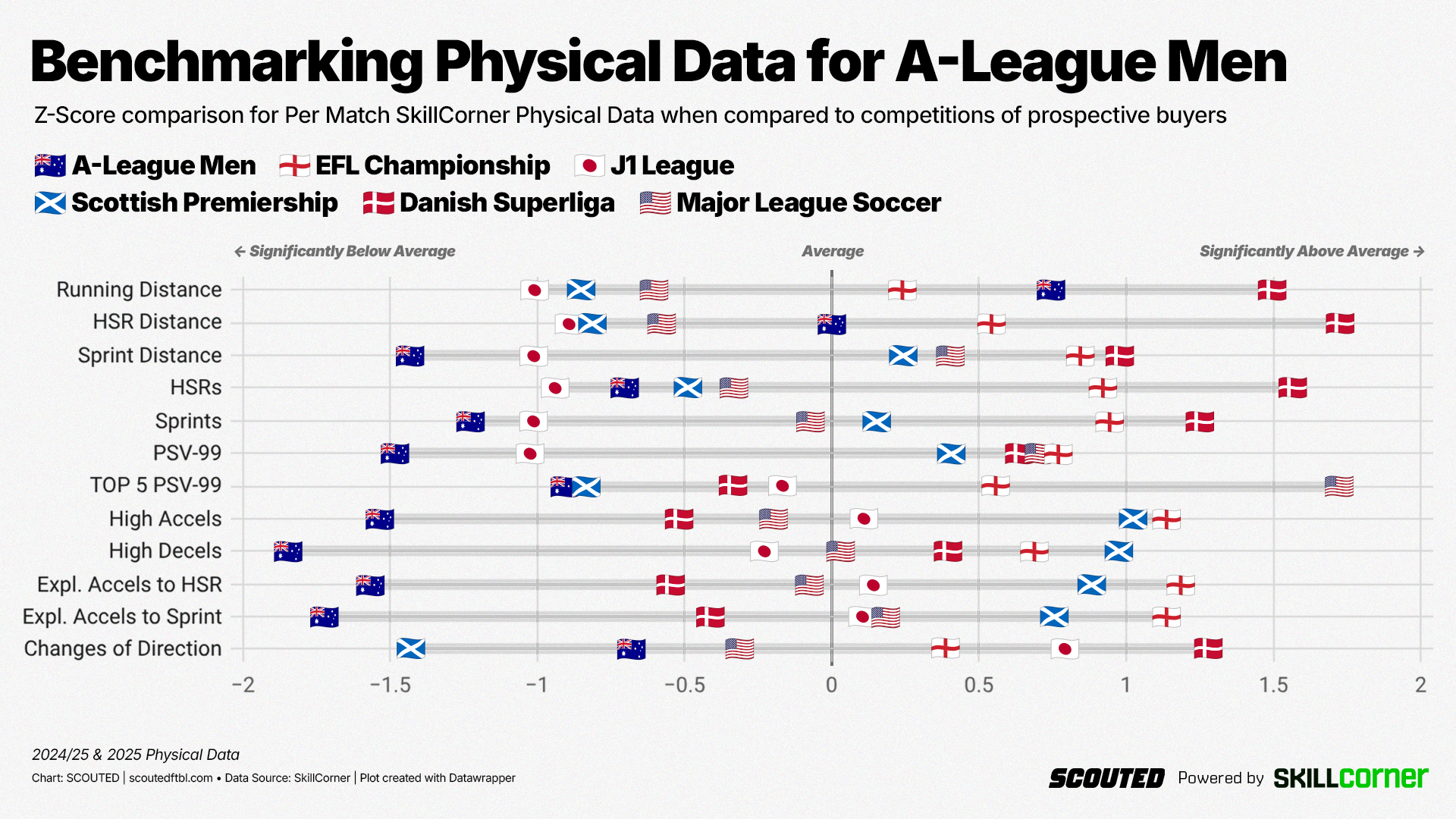
Immediately, it’s clear the A-League is the ‘weakest’ league of our six, at least in terms of maximum effort metrics like Sprints, Explosive Accelerations and High Decelerations. This is important to consider moving forward, especially for Physical outliers, and brings us to our first batch of homegrown A-League prospects - the teenagers lighting up Australia right now.
Defensive Prospects
Wellington Phoenix are providing the perfect platform for young, athletic defenders to stand out. No team in the A-League has played more U-21 defenders so far this season (6) and they have three of the top ten when it comes to minutes played: Lukas Kelly-Heald, Isaac Hughes and Matthew Sheridan, who has played more minutes than any other U-21 defender. These three, alongside 32-year-old teammate Manjrekar James, rank as the top four Central Defenders for both Sprint Distance per 90 and Average PSV-99.
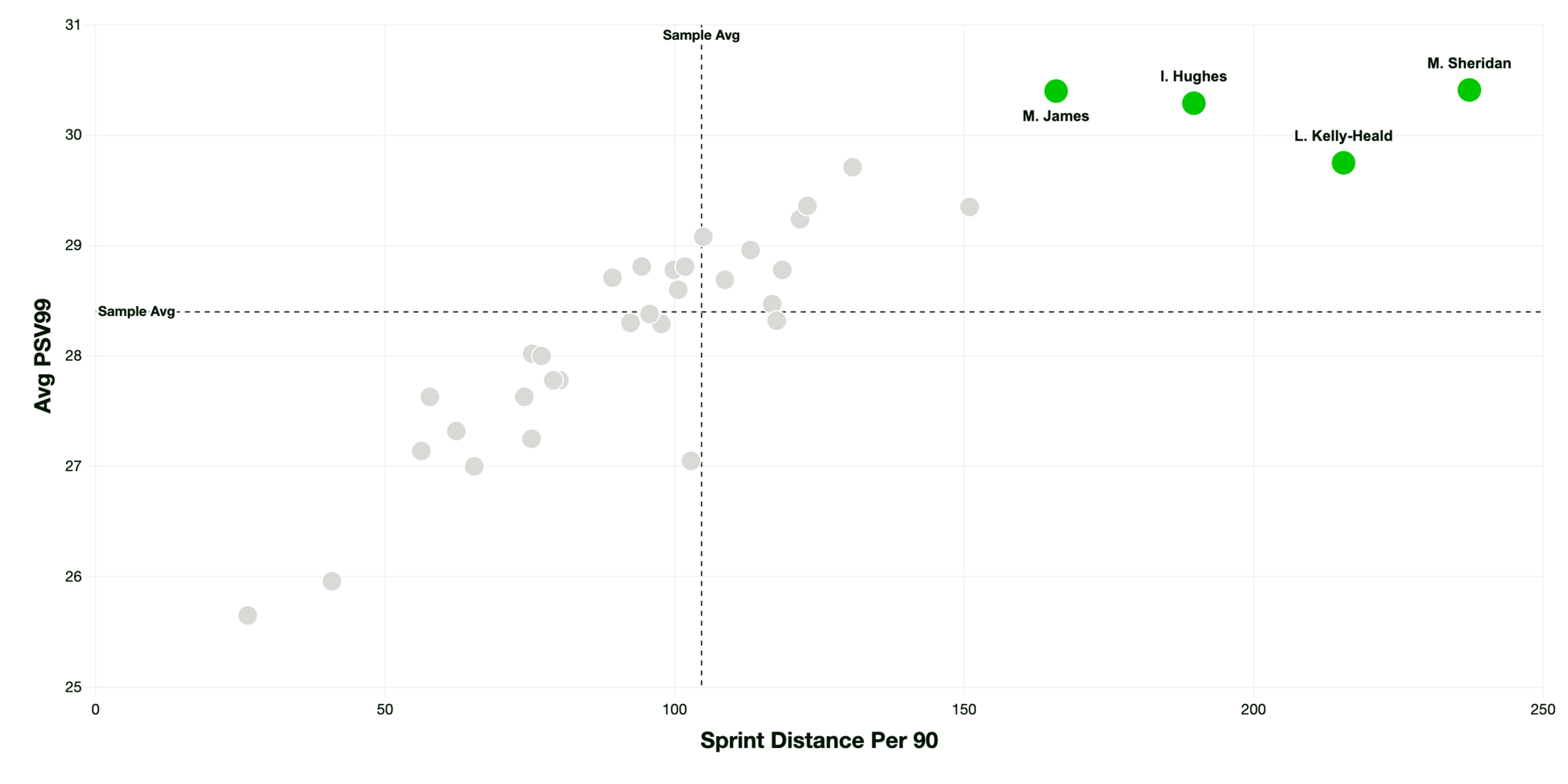
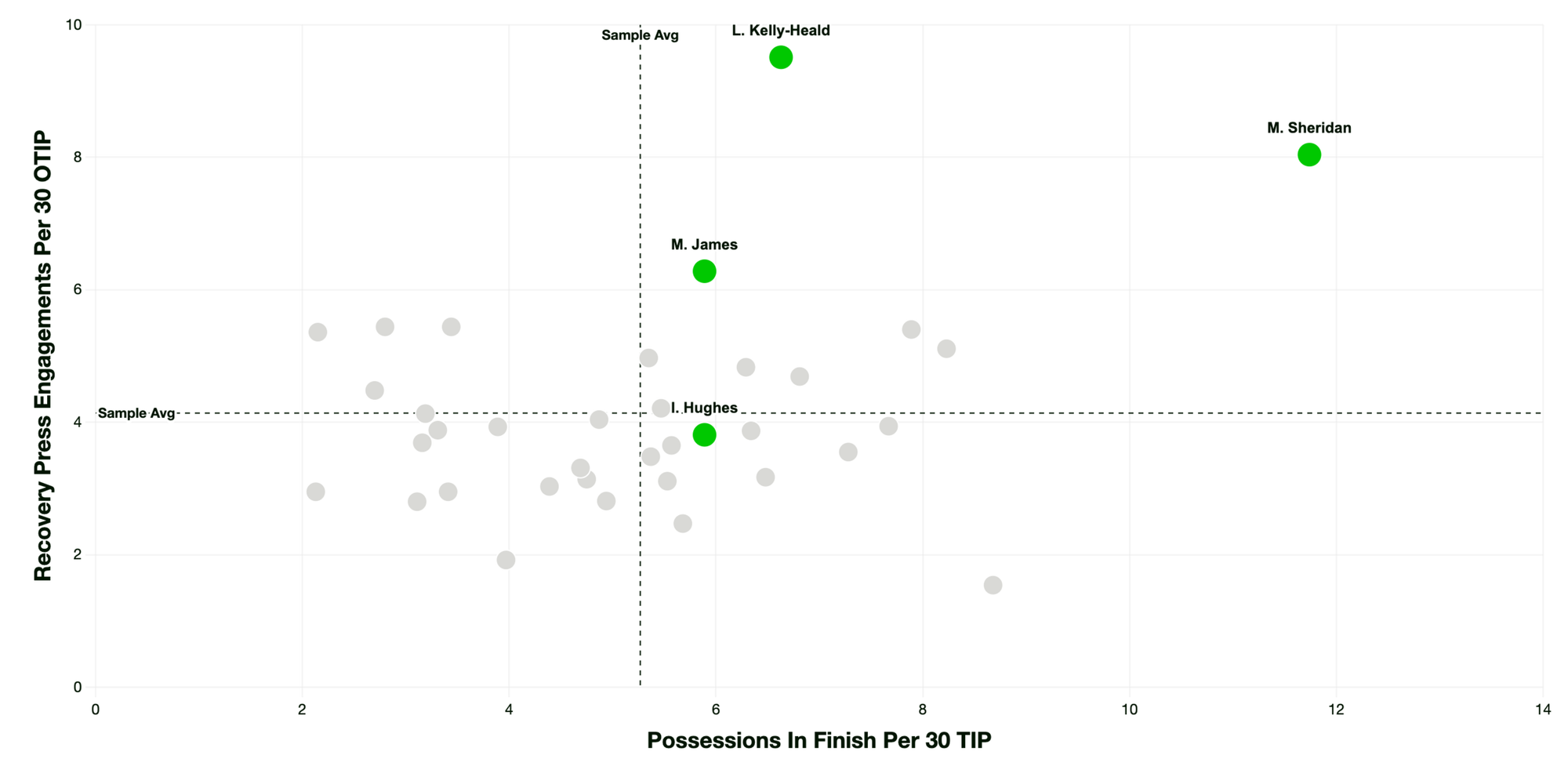
Phoenix’s back three system demands coverage of large distance both in possession (IP) and out of possession (OOP) from the wide centre-backs. They are encouraged to get involved higher up the pitch which then requires long sprints back towards their own goal if possession is turned over. Translated into SkillCorner data, all four Phoenix centre-backs rank above average for Possessions in Finish per 30 TIP and take all three spots on the podium for Recovery Press Engagements per 30 OTIP.
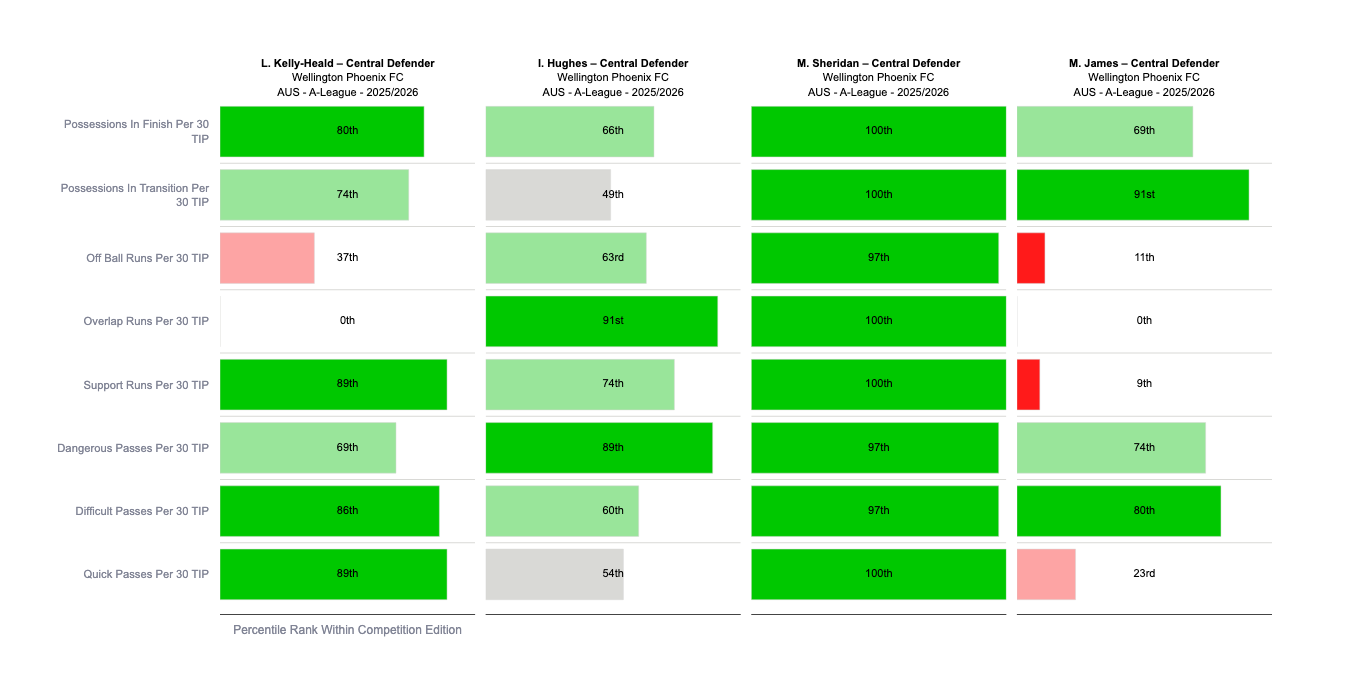
This is why, especially for Defenders, it’s important to consider the playing environment. But it also means that comparing teammates provides us with a clearer picture of strengths and weaknesses or, at the very least, idiosyncrasies. When comparing all four Phoenix centre-backs, Sheridan emerges as a particular profile. His Physical, Off-ball Running and Passing profile is one we would expect to see from the Flyer Archetype (a player, most commonly a full-back, that adds vertical thrust to their team’s play with high-intensity running in wide areas, particularly through Overlaps and Underlaps).
When compared to A-League Full Backs, Sheridan ranks second for Overlaps P30 TIP and second for Sprints per 90. He also ranks third for PSV-99. Comparing Sheridan to the teammates in this position again highlights any difference in style.
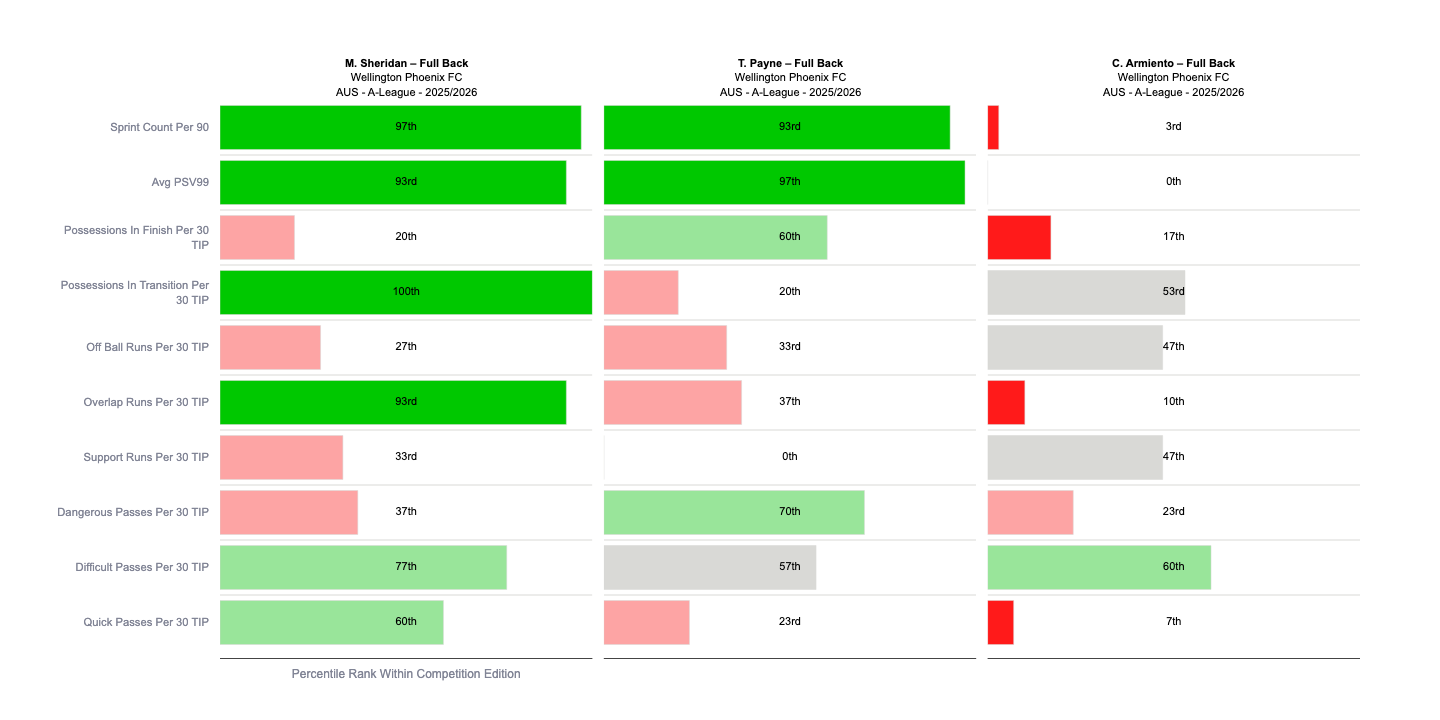
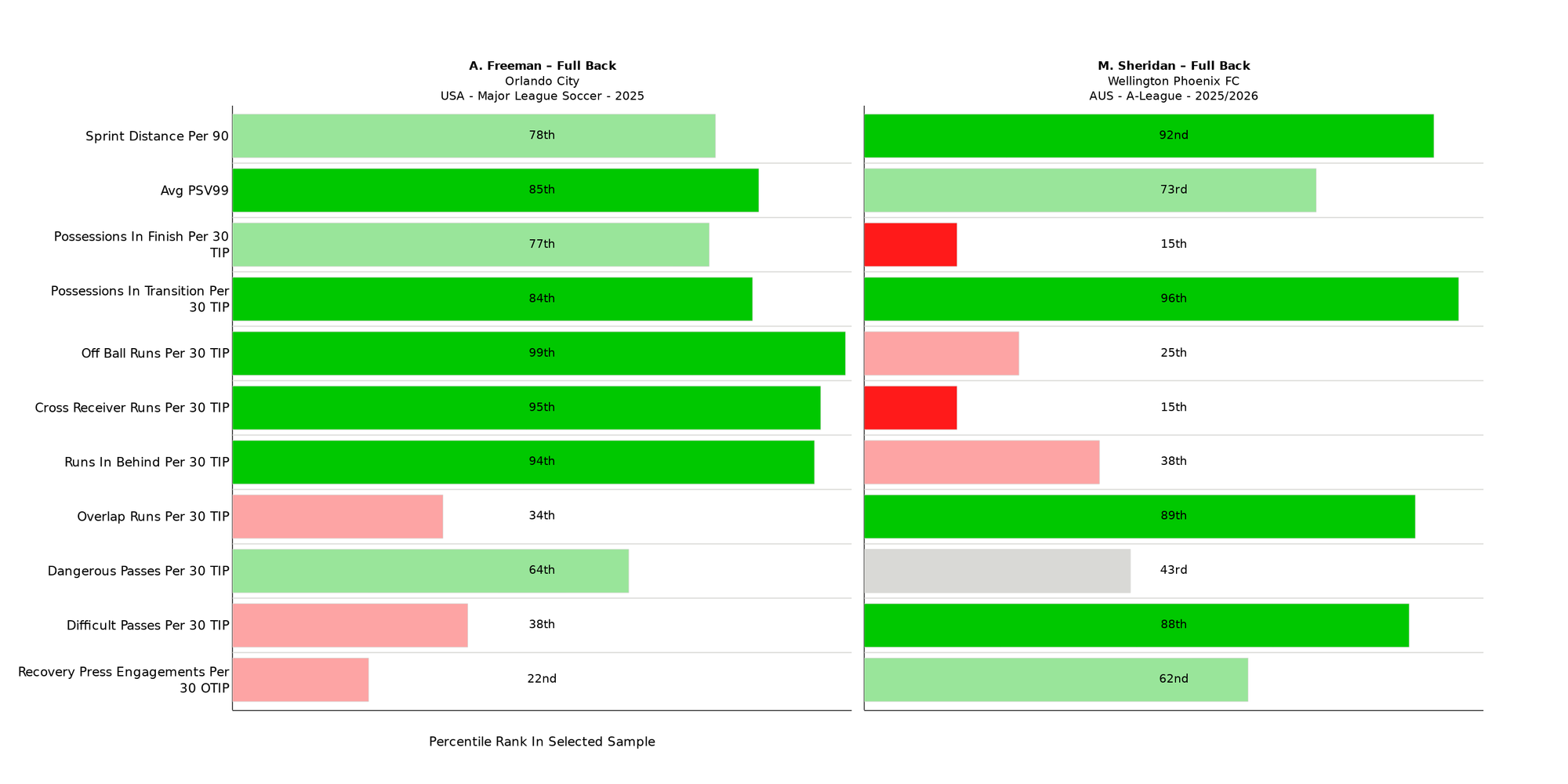
Sheridan has the potential to be an effective Flyer, whether as a wide centre-back, traditional full-back or a wing-back. He displays a clear tendency to overlap which is augmented by the ability to make repeated sprints at speed. A comparison to 2025 MLS Young Player of the Year, Alex Freeman - now at Villarreal - also provides some quick context for his Physical output relative to a potential destination league.
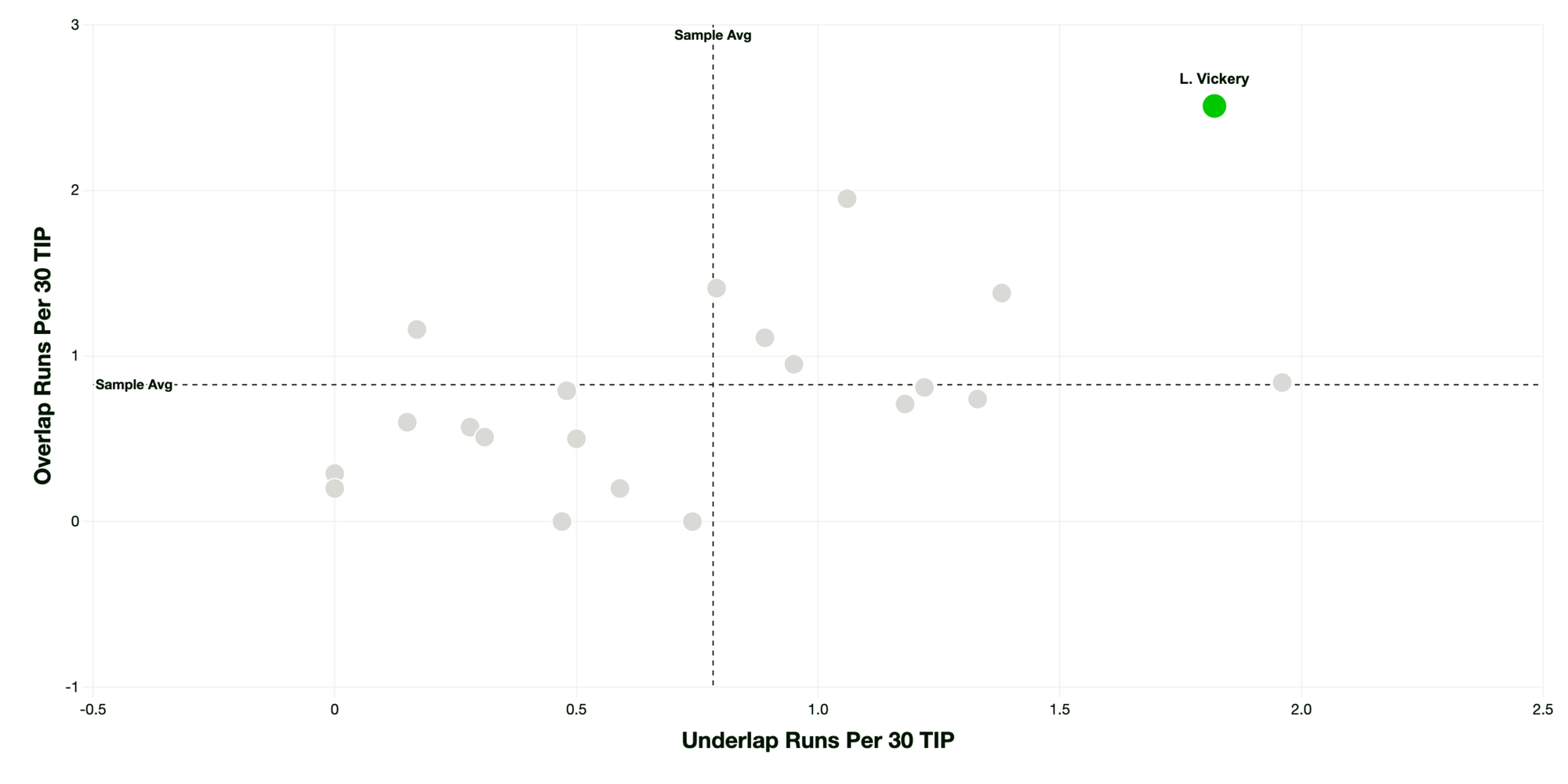
If the Flyer profile is of interest, Luke Vickery profiles as a similarly explosive Lapping wide player, albeit from a more advanced starting position. The 2005-born Macarthur right-winger is an outlier in comparison to other Wide Attackers when it comes to Lapping Runs. A Flyer does not have to be a full-back.
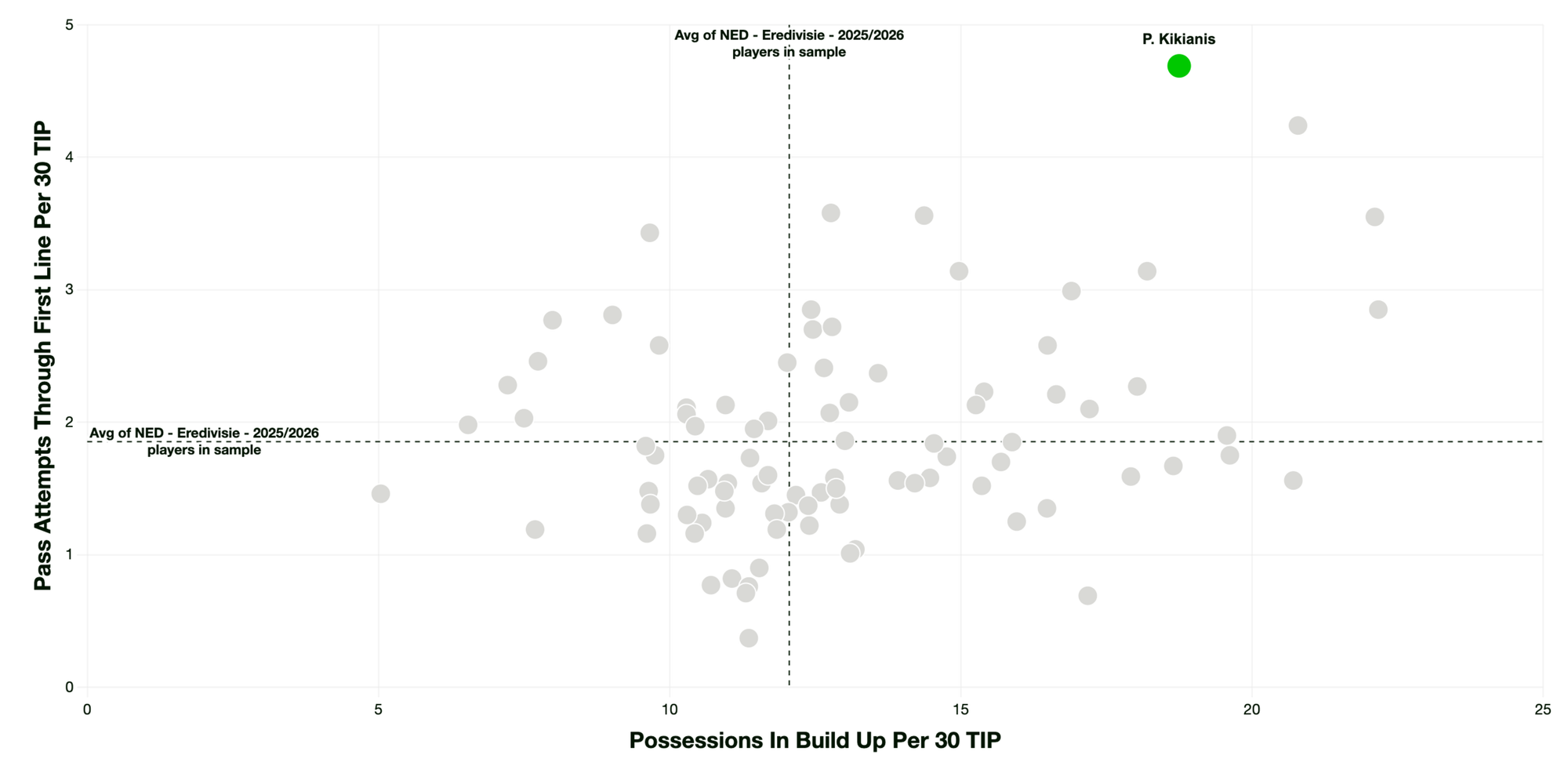
But it’s not just Physical attributes that will trip wires and set off alarm bells for clubs scouting for defenders. Adelaide United centre-back Panagiotis Kikianis has played more A-League matches since the start of last season than any other player born in 2005 or later. Pana, as he’s known, has been linked to Eredivisie side Heracles Almelo. Adelaide’s former technical director Ernest Faber is now the head coach - but that’s not the only reason.
Among all centre-backs in the A-League so far this season, Pana ranks first for a host of Passing metrics that will be a top priority for patient, possession-based build-up sides. Even when comparing to Eredivisie centre-backs, Pana ranks first for Pass Attempts Through First Line P30 TIP.
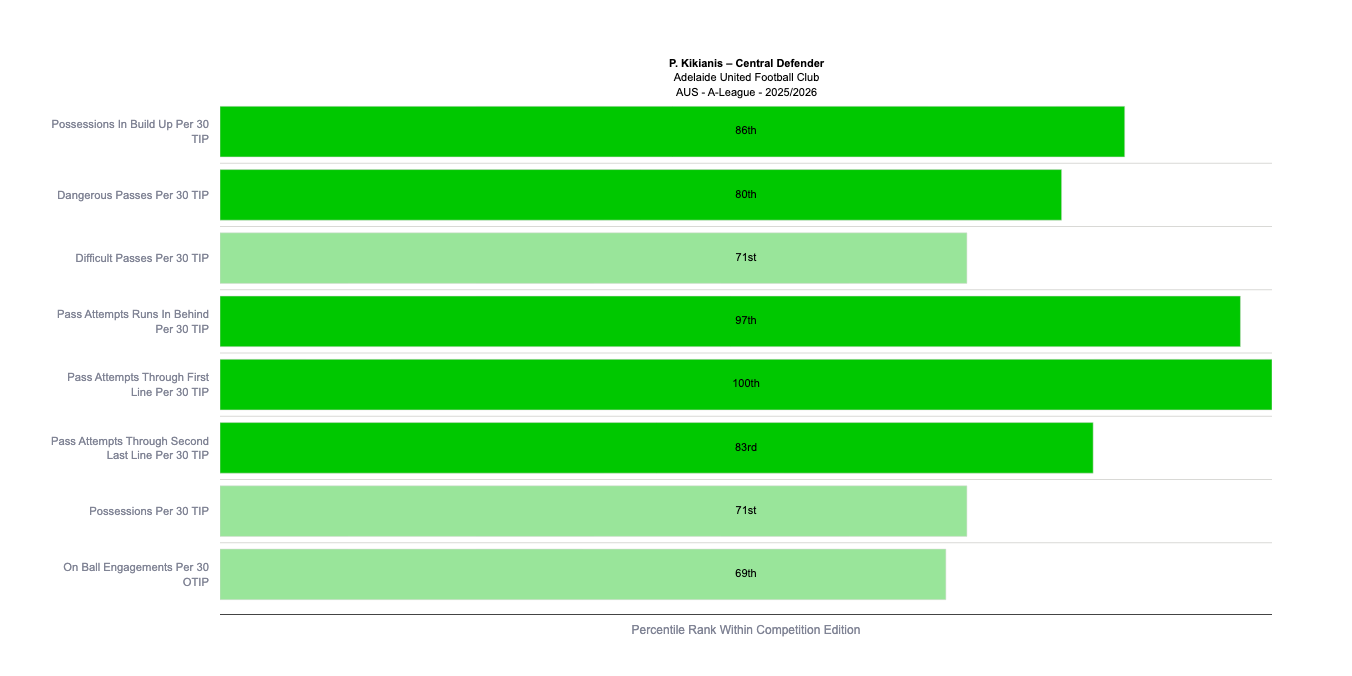
Even when comparing to Eredivisie centre-backs, Pana ranks first for Pass Attempts Through First Line P30 TIP.
It’s also worth making a note of Besian Kutleshi. The 2009-born defender has featured in multiple games for Melbourne City this season, becoming the club’s youngest-ever starter. That fact alone may be enough to convince teams to invest this summer. If not, he is definitely a name to track as he racks up more minutes, whether that’s at right-back or centre-back.
Midfield Talents
In Volume I of the new SCOUTED online magazine, we laid out the framework for a new Archetype: the Berserker. This profile is characterised by an unstoppable forward force generated by frenzied, high-speed carrying through central areas. In the A-League, a teenager matches this profile.
Here's how 2007-born Will Dobson compares to A-League Midfielders for the key metrics used when translating this Archetype into the SkillCorner Web App Lab:
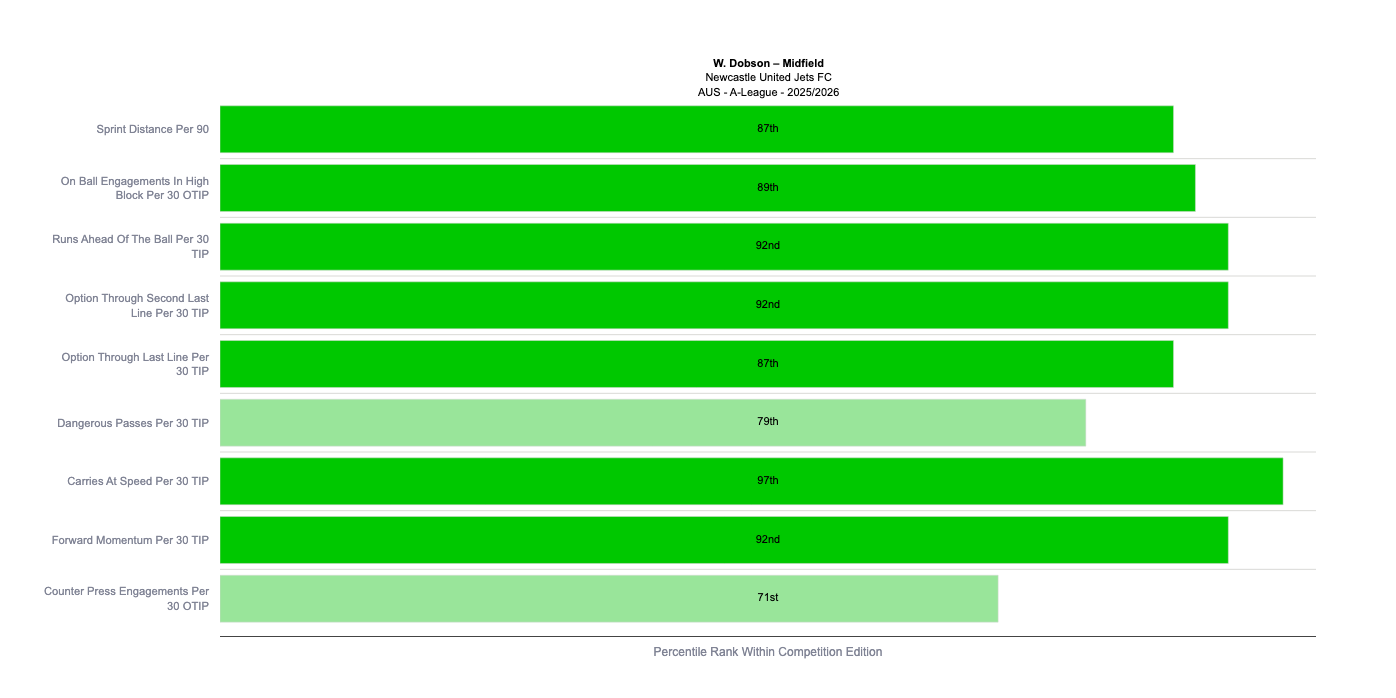
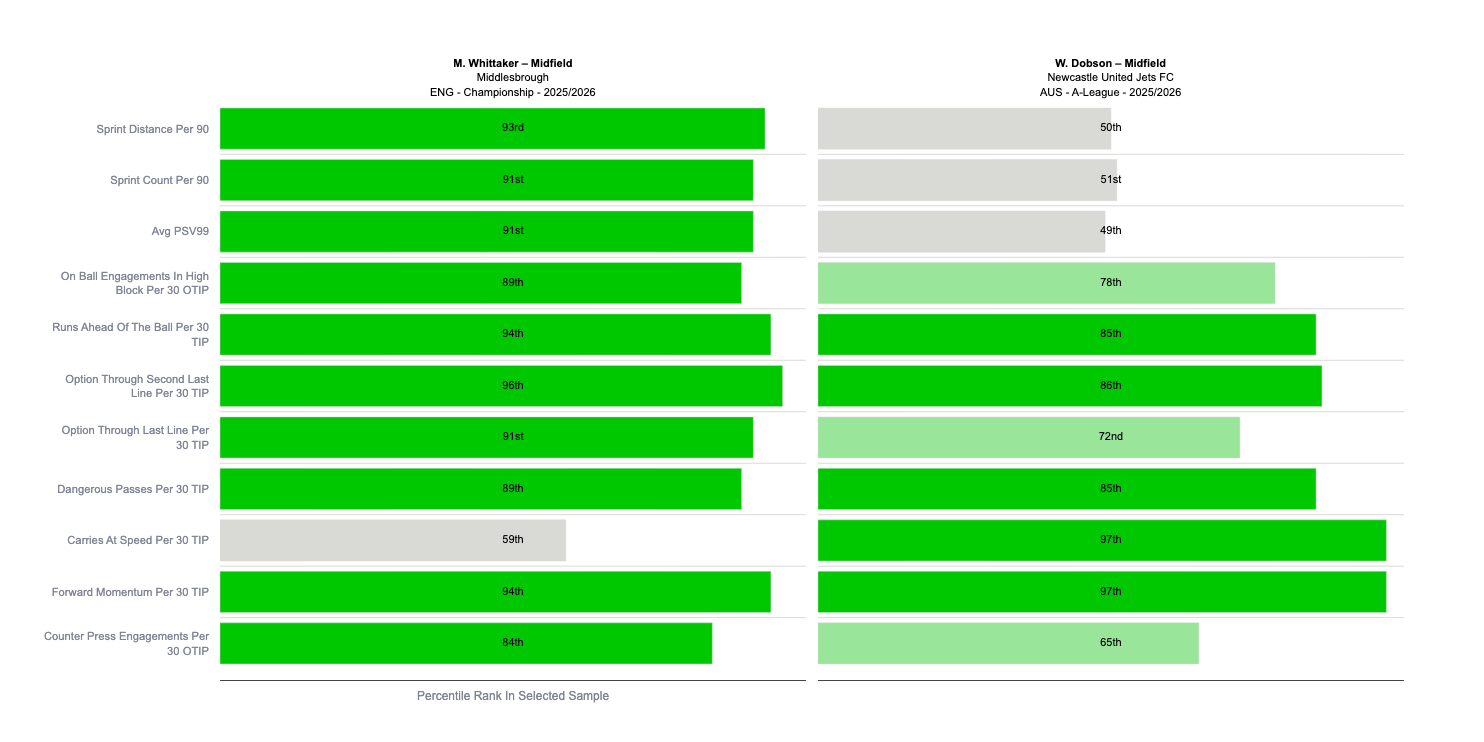
This comes with a big warning. Although the Newcastle Jets teenager profiles as an outstanding A-League Berserker, we have to remember that the Physical levels paled in comparison to other leagues. His ability to maraud through central areas in another competition is predicated on his ability to develop physically. At just 18 years old, there is plenty of room to do so. But a quick comparison to an EFL Championship variant, for example, helps contextualise his current Physical level.
From his stints in attacking midfield, Morgan Whittaker scored as one of the highest-rated Berserkers when running a Player Index search in the Championship and although Dobson still ranks well for stylistic attributes across both leagues, it’s clear there would be a big jump in the Physical base needed to perform those actions should he make a move now. Again, it’s important to highlight that he was born in 2007.
A slightly more calculated attacking midfield prospect is Sydney FC's Tiago Quintal. Like Dobson, he receives the ball often Through the Second Last Line and although he does so more often in Tight Space, he is less likely to go berserk after receiving the ball. Quintal is also the most extreme ‘luxury’ player in the Midfield dataset: he ranks first for Sprint Distance P30 TIP and second-last for Sprint Distance P30 OTIP.
Teams looking for a relentless runner in and out of possession will be drawn towards Adelaide United’s 2005-born midfielder Ryan White. He ranks in the top 10% for Running Distance, High Intensity Distance and Sprint Distance which reflects a state of perpetual movement. In possession, he constantly looks to be available through all lines. Out of possession, he makes an enormous effort to engage the opposition. In fact, it’s the most enormous effort.
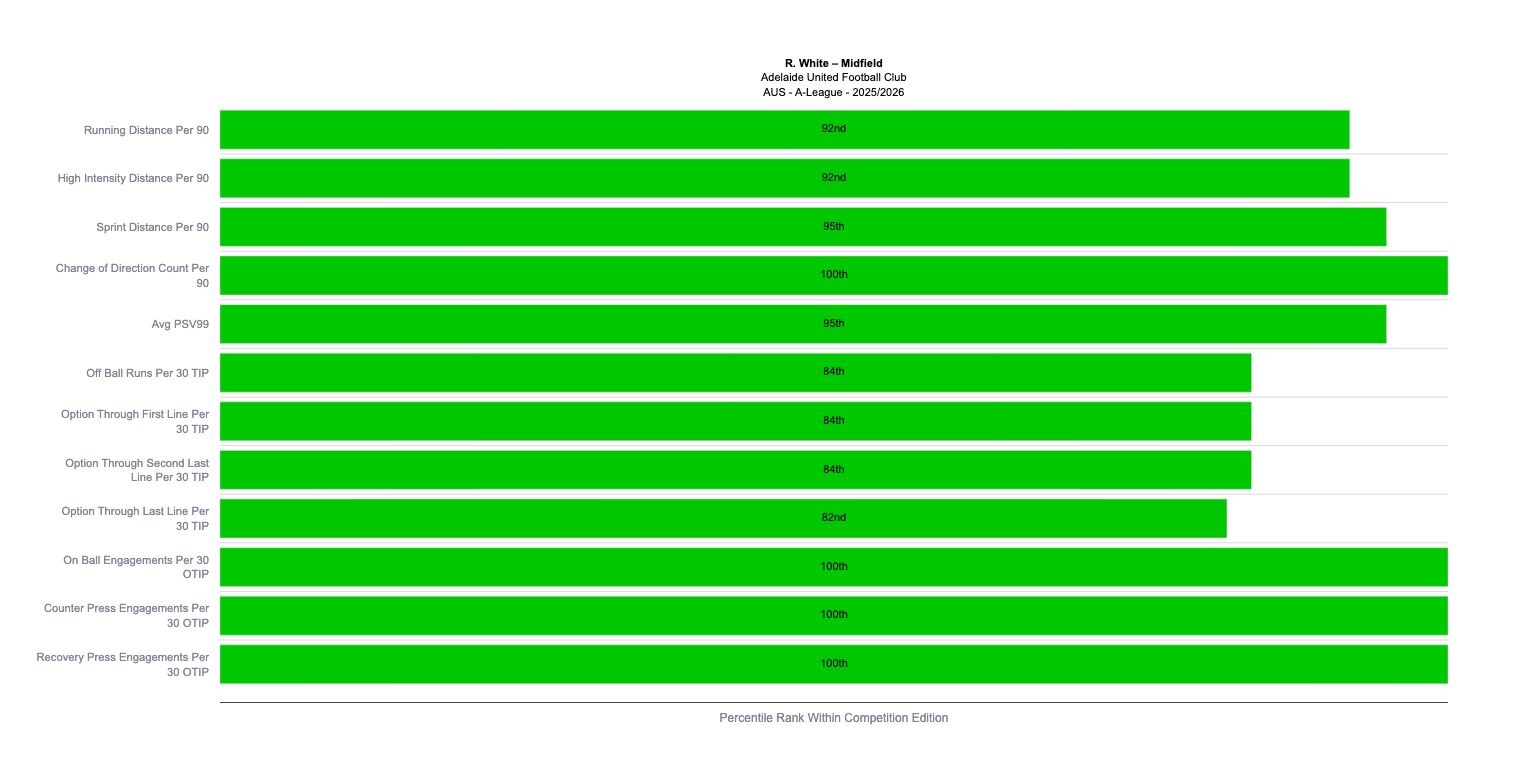
Again, to provide context, let's compare White's output to the most athletic of the prospective destinations: the Danish Superliga. And, more specifically, with a prospect that will be one of the most in-demand young players in Europe this summer
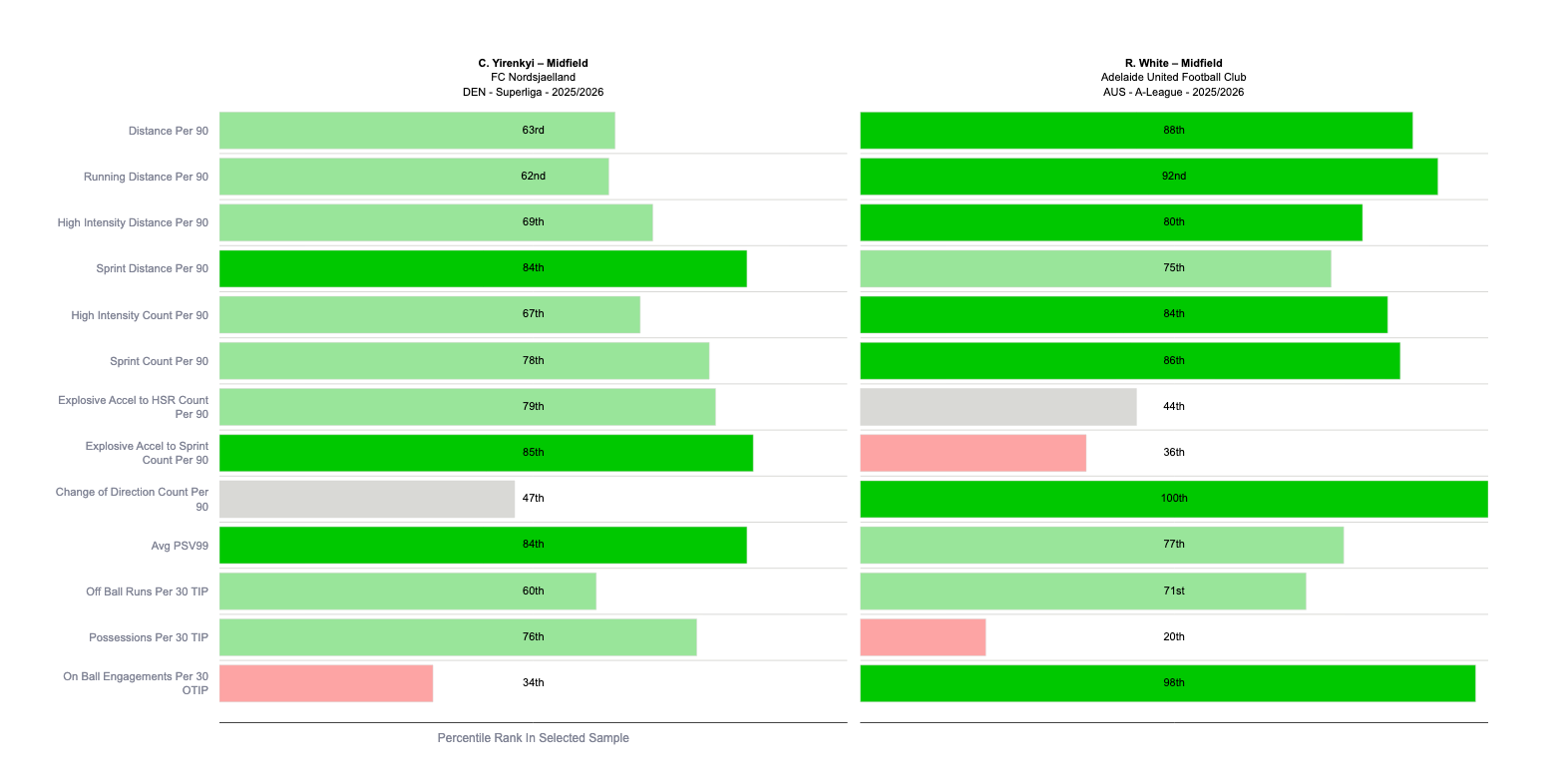
Although White’s max effort metrics like Sprinting Distance, Explosive Accelerations to Sprint and PSV-99 do appear less impressive within this pool of Midfielders from Australia and Denmark, specifically when compared to FC Nordsjælland's 2006-born Ghanaian international Caleb Yirenkyi, the Adelaide United prospect still stacks up decently well in this very quick sense check.
And remember, for clubs looking to add technical quality and progressive passing to their build-up, we added Pathfinder prospect Paul Okon-Engstler to our basket in a recent shopping spree around the AFC leagues.
 Jake Entwistle
On his first-ever A-League start, Akon provided a hat-trick of assists against city rivals Western Sydney, from whom the Sky Blues poached this explosive wonderkid. In that match, Akon ranked second among all players to feature for High Decelerations and was one of the second-quickest on his team through the PSV-99 lens. This combination is the making of a stop-start winger that can explode past full-backs before settling down to pick a pass, as well as an effective presser OOP. In a recent study, Billy Carpenter highlighted elite deceleration as a foundation for Sadio Mané's ascent to world class levels at Liverpool.
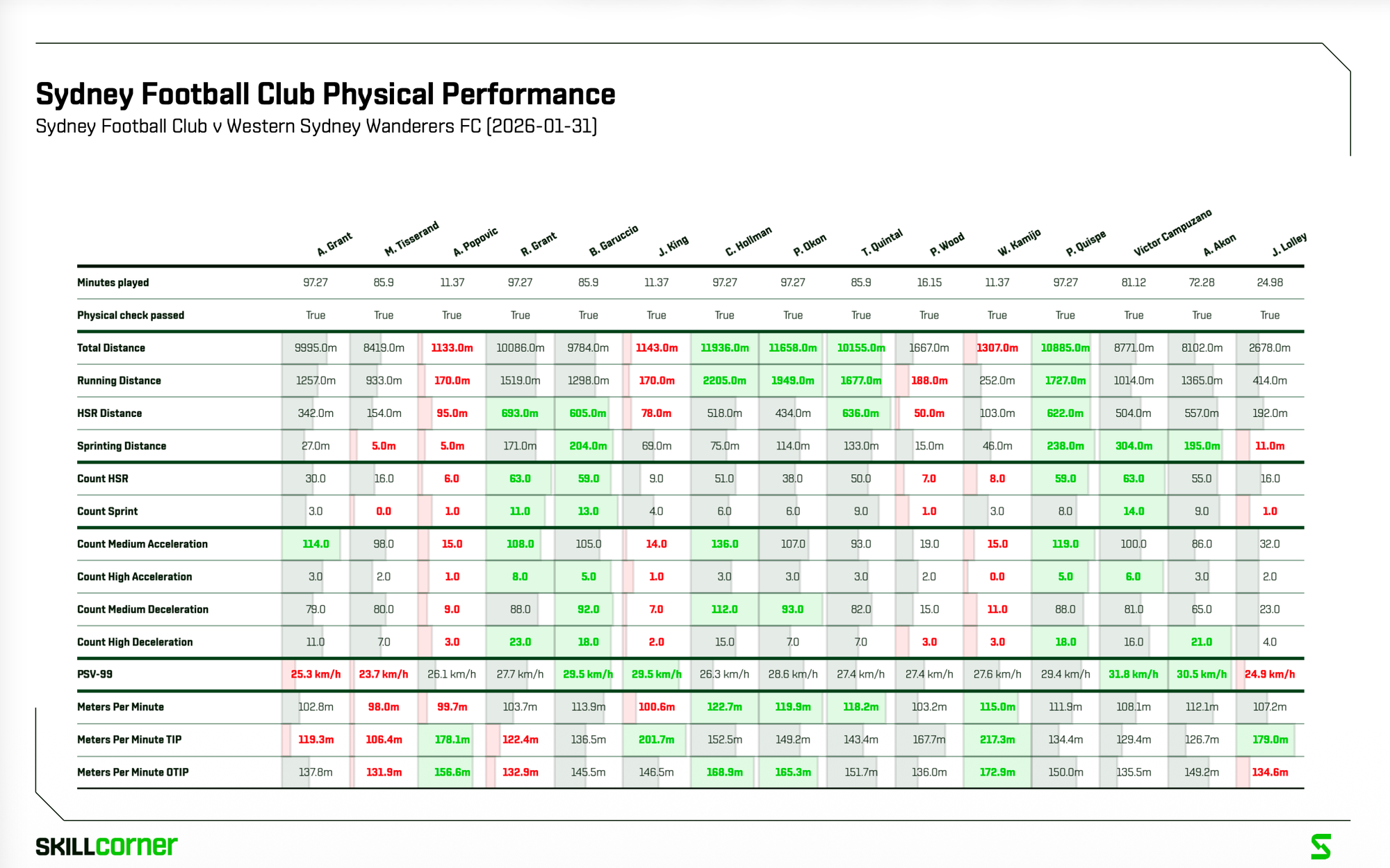
We also see the natural differences between a deep-lying midfielder, an attacking midfielder and a winger. Okon-Engstler covers more distance than both Quintal and Akon, but does so at a lower intensity. When looking at High Speed Running Distance, Quintal tops the charts. Then, finally, Akon leads this trio of young players for Sprinting Distance.
Ironically, should Akon make a jump to Europe, both Sydney clubs would benefit. Sydney FC would of course enjoy the transfer fee while Western Sydney would be owed both training compensation and a solidarity contribution having trained Akon before he was poached by their rivals.
Young Strikers
Finally, the Centre Forwards. The youngest players with a bank of SkillCorner Data this season are Melbourne City’s Max Caputo and the Central Coast Mariners’ Miguel Di Pizio: they are completely different profiles.
The 2005-born Caputo is a Goal Hanger. His off-ball profile is geared towards Runs In Behind, Cross Receiver Runs, and not much else.
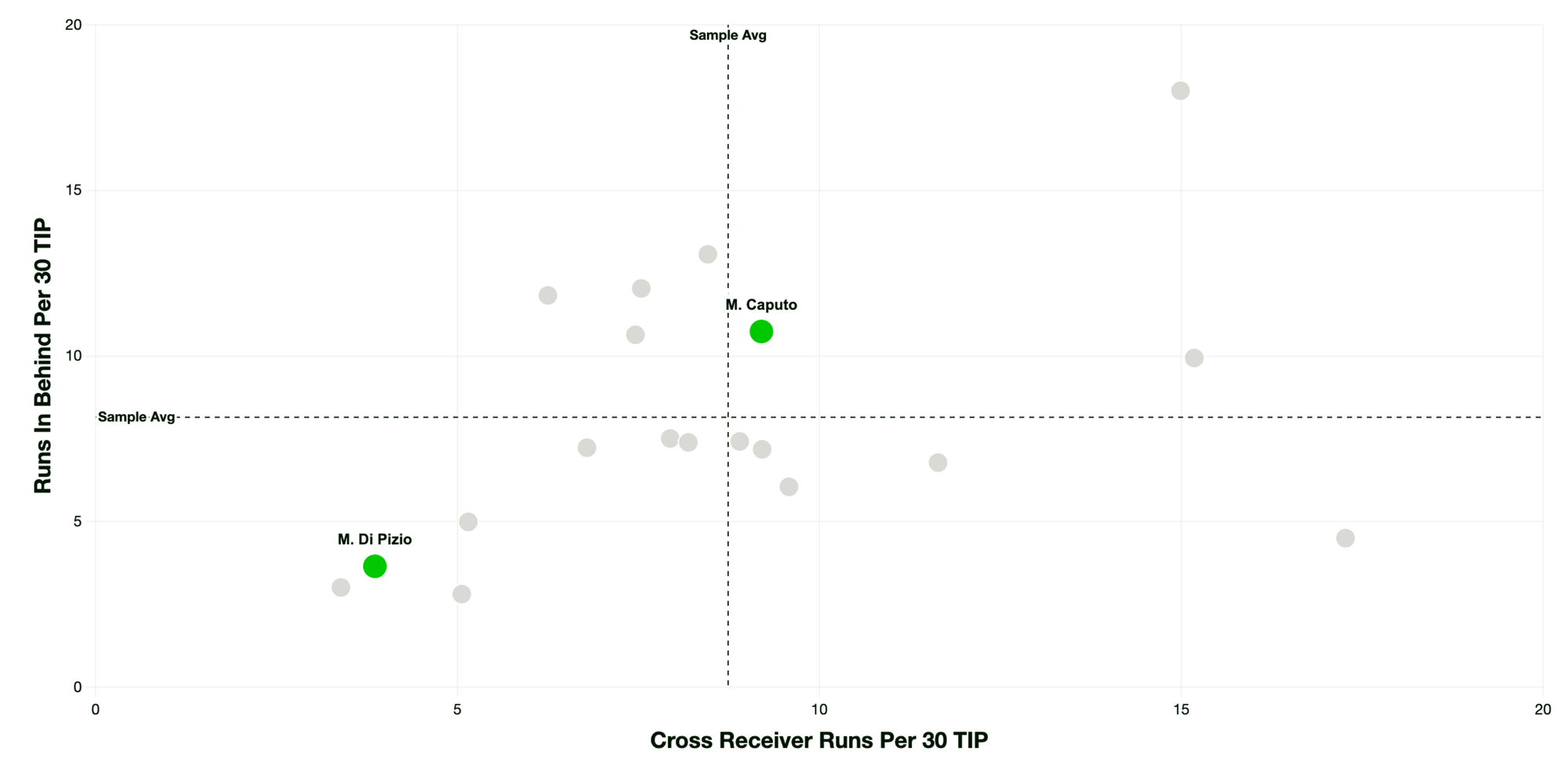
Meanwhile, 2006-born Di Pizio is at the opposite end of the striker spectrum. That’s because Mariners’ number ten plays exactly like the number on the back of his shirt - one reason he’s been deployed in central midfield for Australia Under-17s.
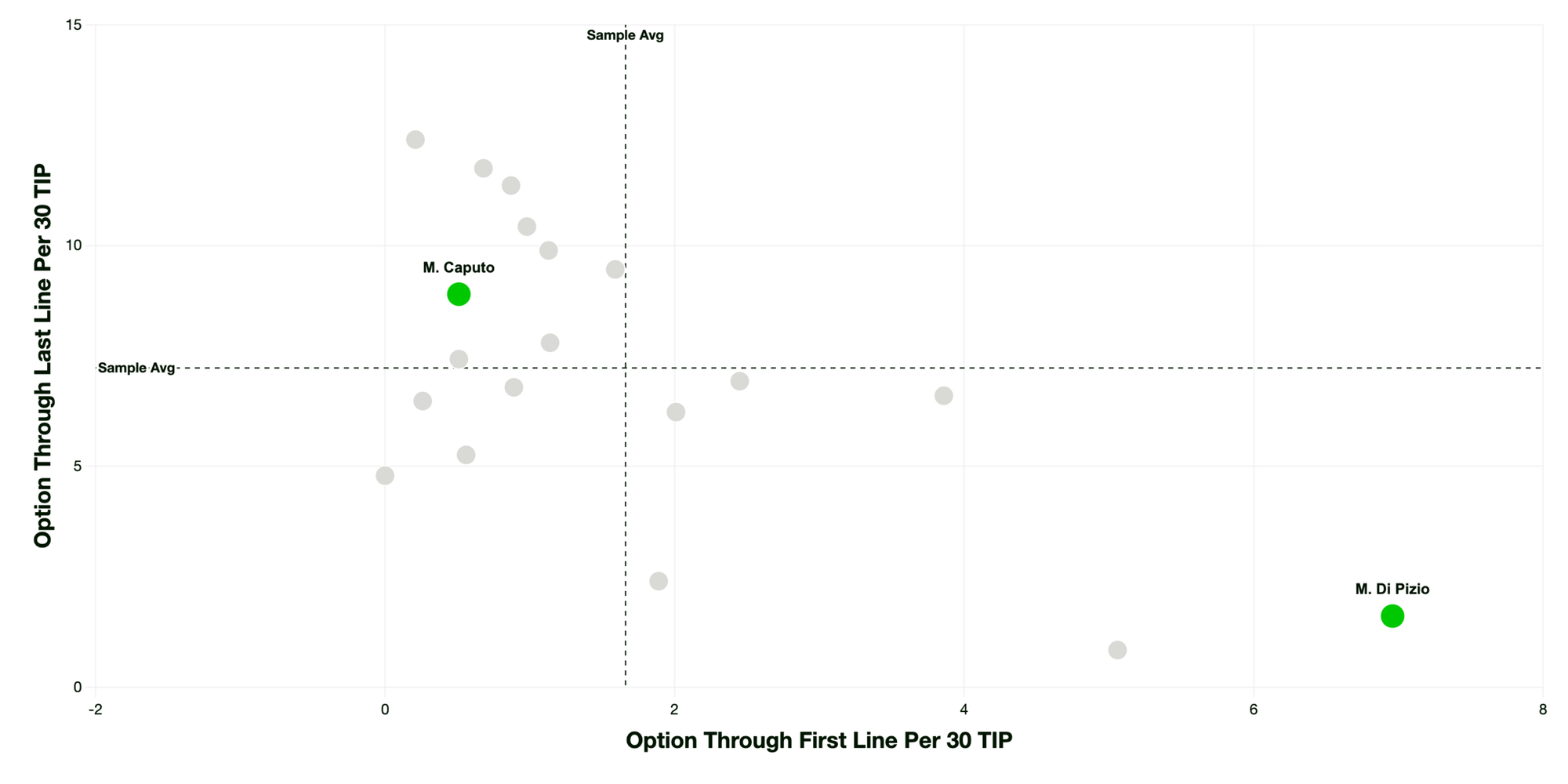
Di Pizio consistently drops deep to receive the ball across the width of the pitch. As a left-footer, his most effective spot is in the right half-space or even the wide channel on that side as it sets him up to receive and spray out to the other flank or, better yet, flip it in behind as quick as possible. These movements must be balanced by runs in behind from flanking wingers or a striker partner; Caputo and Di Pizio would complement each other well.
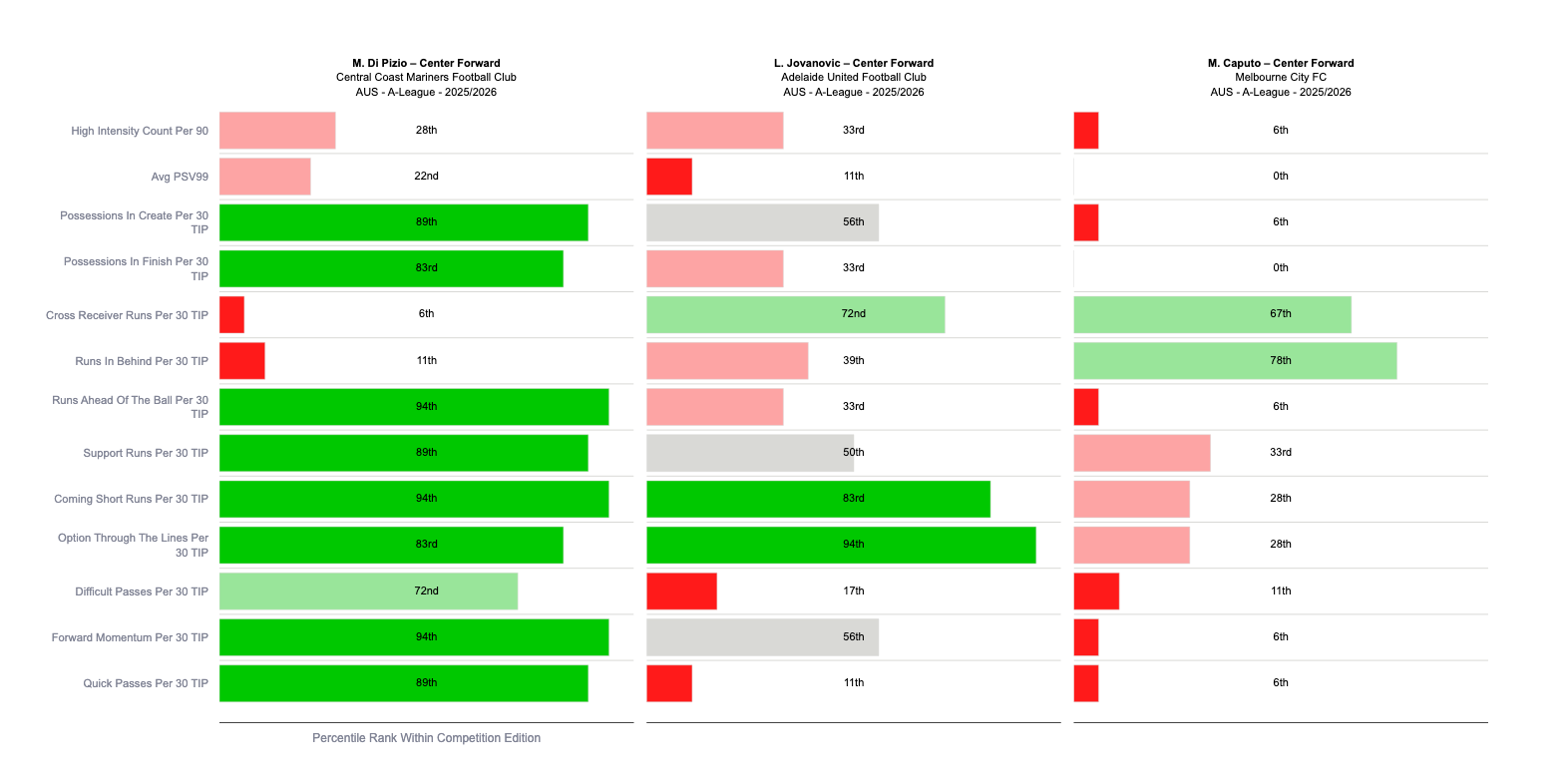
Caputo is the only player born in 2005 or later that has scored more A-League goals than Luka Jovanovic since the start of last season. From the snapshot above, the Adelaide United forward profiles as the Gravitar Archetype inspired by Nick Woltemade’s style (not his stature); the ability to attract and absorb pressure in central areas to create space for others within his orbit.
Similar to his fellow 2005er Caputo, however, he has not yet displayed the necessary physicality to survive as the in-demand big-bodied super athlete striker dominating the meta at the highest level. Because of this, the current crop of centre-forwards looks the least likely avenue for massive profit for A-League clubs.
That being said, Mohamed Touré’s lightning start at Norwich City suggests it is possible. The Adelaide United academy graduate profiled as a quintessential Power Forward at Randers before making the move to East Anglia in January.
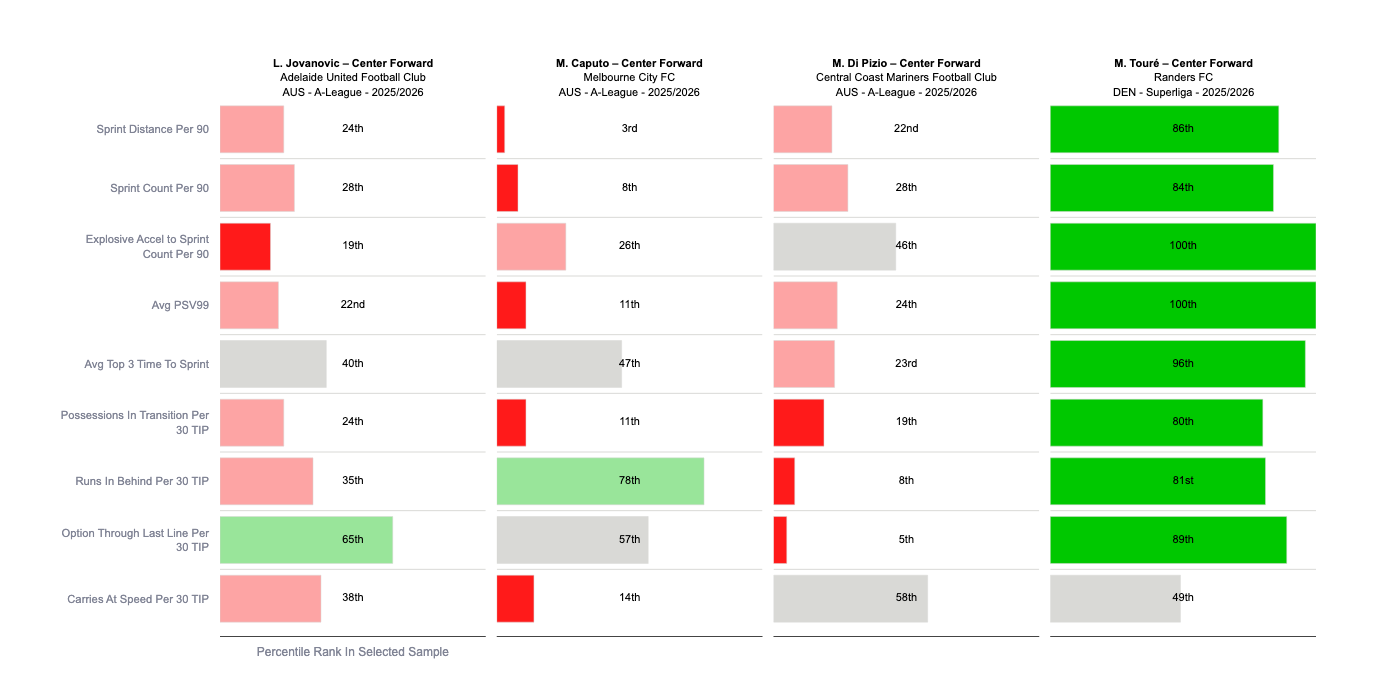
The Reds will be collecting solidarity contributions for both Mohamed Touré and his younger brother, Musa, in the years to come.
The A-League Men is very much becoming the A-League Boys. We are only just beginning to see the product of this league-wide switch to youth: the golden prospects are beginning to set records as the youngest debutants and youngest goalscorers, and the path to become record sales is set.
To walk it, clubs will have to be smart in understanding which profiles they’re developing, and how they fit into the desires of buying clubs. That’s in part why, alongside SkillCorner, we’ve developed Archetypes. To sell a product you must ensure there’s a market and, although it's still early days, Australia seems on the right track: the youth revolution has begun.

This newsletter was produced under a commercial collaboration with SkillCorner, SCOUTED’s official data partners. Their tracking and performance data is used by more than 150 of the world’s biggest clubs, leagues and confederations.